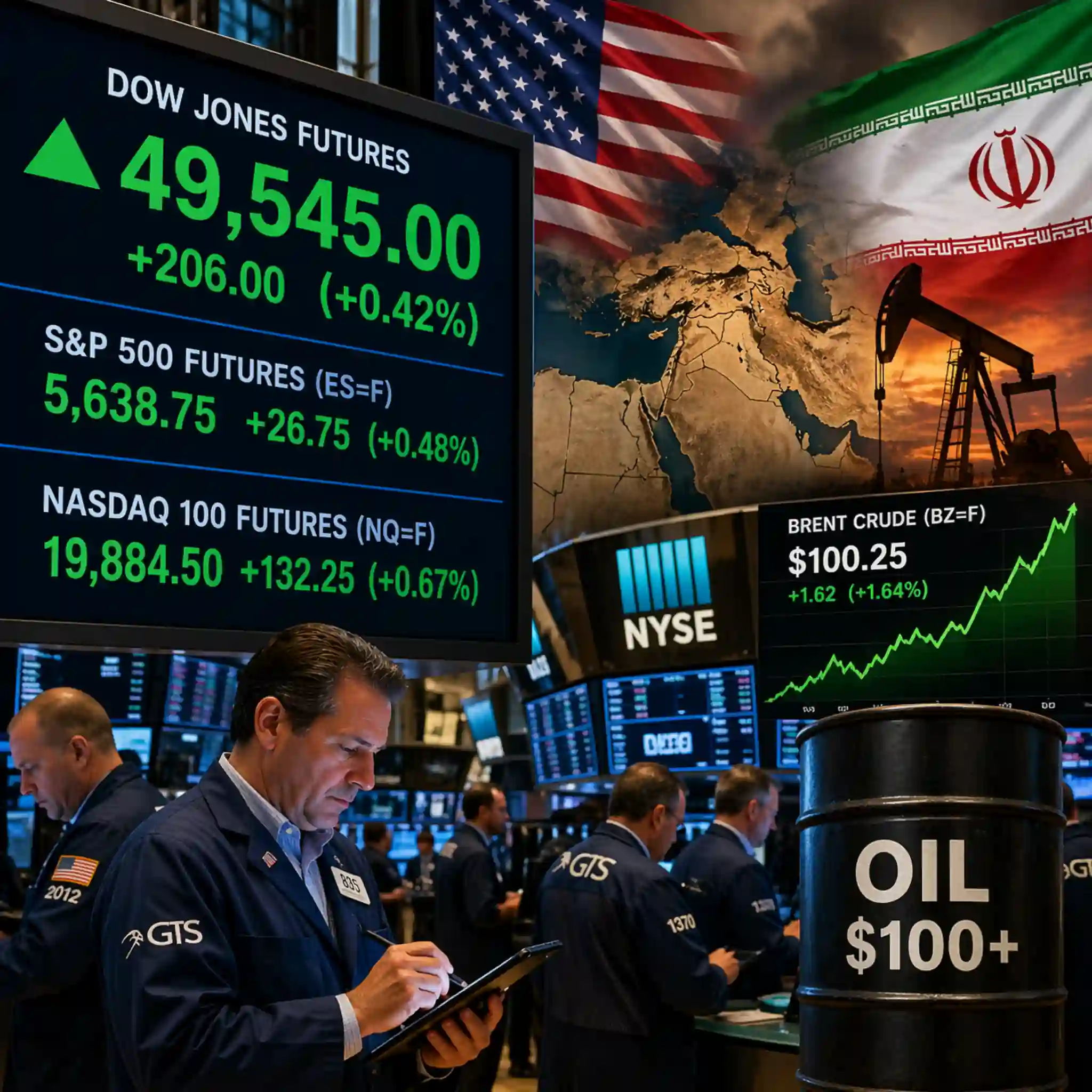
US stock futures slid Monday as a sudden surge in crude oil jolted global markets following a new escalation in the Middle East. Brent crude briefly traded above $82 a barrel after spiking as much as 13%, reviving inflation fears and pushing investors back into a defensive stance.
Futures tied to the Dow Jones Industrial Average fell about 1.2%, or more than 500 points. S&P 500 futures dropped roughly 1.1%, while Nasdaq 100 futures sank around 1.4%, as investors trimmed risk exposure in the first full session after the weekend’s escalation.
Equity futures slide as oil becomes the main macro driver
Oil’s move set the tone across assets. Brent crude surged through $82 before cooling to below $80 in early trading, while US benchmark WTI hovered just under $73, up around 8%. Alongside Iran’s status as a major OPEC producer, traders focused on the possibility of sustained disruption around the Strait of Hormuz, where tanker flows can quickly become a market-wide pressure point.
The oil spike landed as investors were already uneasy about the near-term backdrop for equities. The S&P 500 finished February in negative territory after renewed volatility in AI and software-linked names, and the energy shock added another layer of uncertainty to positioning and rate expectations.
Live futures moves across the Dow, S&P 500 and Nasdaq, alongside oil and metals, can be tracked via Yahoo Finance markets.
Oil shock lifts energy and defense, hits travel-linked stocks
The early tape showed sharp sector separation. Energy names attracted buyers, with Exxon Mobil among the premarket gainers as crude rallied. Defense stocks also found demand, including Lockheed Martin, as the market weighed the risk of prolonged conflict and broader security spillovers.
Travel-linked stocks moved the other way as fuel-cost pressure returned to the center of the narrative. Delta Air Lines was down nearly 6% in premarket trading, while American Airlines fell about 5%. Cruise operators also weakened, with Norwegian Cruise Line sliding roughly 7% and Royal Caribbean down around 5% as investors recalculated near-term cost headwinds.
Gold jumps above $5,400 as “risk premium” talk returns
Safe-haven demand pushed gold above $5,400 an ounce, even as the US dollar strengthened. One major driver was renewed discussion of a geopolitical “risk premium” embedded into commodity pricing, particularly if energy disruption risks remain elevated.
Gold’s strength stood out alongside oil’s surge, reflecting both safety demand and concern that higher energy prices could feed inflation expectations quickly. Silver also advanced in the broader precious-metals move.
For baseline market data and commodity context, the CME Group provides contract details and reference pricing for major futures markets.
Treasury yields rise as inflation concern outweighs the usual haven bid
US Treasuries didn’t deliver a clean haven rally. Instead, yields rose as markets focused on the inflation impulse that can follow an oil shock. The two-year yield climbed about 4 basis points to roughly 3.42%, while the 10-year yield rose about 3 basis points to around 3.97%.
Rate expectations shifted as traders marked down the chances of quick easing if crude stays elevated. Money markets pushed the likely timing of the next Fed cut back, with pricing pointing toward September rather than earlier expectations.
Crypto slips as volatility spreads across risk assets
Bitcoin traded below $67,000 as the risk-off mood rippled through markets, after dropping toward the low $63,000 area during the sharp weekend swing. Ether traded near $1,950 after a steep pullback around the escalation.
Strategists focus on oil’s staying power
Some strategists argued that geopolitically driven equity volatility often fades unless crude remains elevated long enough to change inflation and growth assumptions. One key line in the market debate is whether oil’s surge becomes a sustained level shift rather than a spike that retraces as risk headlines cool.
The scenario risk is that a prolonged disruption forces a deeper repricing across equities, credit, and rates. Several banks outlined higher oil scenarios if conflict intensifies, while acknowledging that forecasts are highly sensitive to the duration and breadth of supply disruption.
Berkshire in focus, jobs report next on the macro calendar
Markets were also digesting fresh corporate headlines, including Berkshire Hathaway, which slipped about 1% in premarket trading after reporting that operating profit after taxes fell about 30% from a year earlier.
The next major macro input arrives Friday with the US monthly jobs report. Economists expect payrolls to rise by about 60,000 in February, down from January’s 130,000 gain. With oil driving inflation anxiety, the labor data could influence how aggressively markets price the path of Fed cuts in the months ahead.
For official labor-market releases and schedules, the U.S. Bureau of Labor Statistics is the primary reference.

Make Swikblog your go-to source on Google for reliable updates, smart insights, and daily trends.