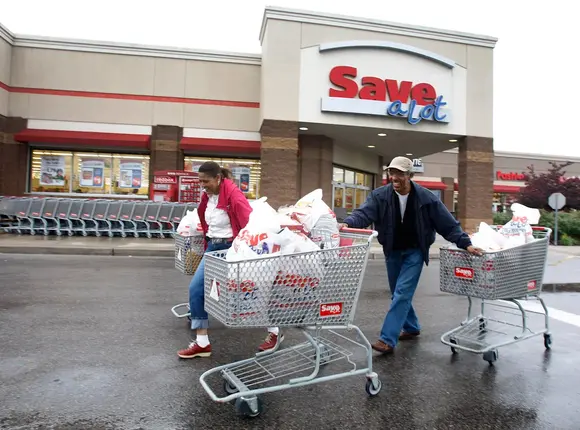

Seven Save A Lot grocery stores on Chicago’s South and West sides could close on Saturday, July 25, 2026, unless an investor or replacement operator steps in. Six of the locations benefited from a city-backed agreement involving $13.5 million in public financing, raising questions about food access, employee jobs and whether Chicago can recover taxpayer money.
The stores are owned and operated by Yellow Banana, an independent retailer licensed to use the Save A Lot name. Save A Lot ended its arrangement with the operator following months of financial and operational problems. The development affects these Chicago locations and does not mean Save A Lot is shutting down nationwide.
Which Chicago Save A Lot stores could close?
The seven locations facing possible closure are:
- 420 S. Pulaski Road — West Garfield Park
- 10700 S. Halsted St. — Morgan Park
- 2858 E. 83rd St. — South Chicago
- 4439 W. 63rd St. — West Lawn
- 7240 S. Stony Island Ave. — South Shore
- 7908 S. Halsted St. — Auburn Gresham
- 832 W. 63rd St. — Englewood
The first six stores were included in Chicago’s redevelopment agreement. The Englewood location, operating in a former Whole Foods space, is also owned by Yellow Banana but was not part of the six-store public financing package.
What happened to Chicago’s $13.5 million investment?
Chicago approved $13.5 million in Tax Increment Financing assistance to acquire, renovate and reopen six stores in communities with limited access to full-service supermarkets. Combined with private capital and other financing, the redevelopment represented an investment of approximately $26 million.
Improvements included refrigeration, meat and dairy cases, lighting, flooring, heating and cooling systems, equipment, signs and exterior work. The City of Chicago’s project announcement said the plan was expected to preserve approximately 100 full-time jobs.
Yellow Banana agreed to keep the six publicly supported stores operating for at least 10 years, effectively through 2035. Closing early could place the operator in default. Chicago officials say they are exploring available options to recover taxpayer funding if necessary, although no repayment amount or enforcement decision has been announced.
Why did Save A Lot end the Yellow Banana arrangement?
Save A Lot operates mainly as a wholesaler and brand licensor. Yellow Banana manages these stores while using Save A Lot’s name, products and supply network.
Save A Lot reportedly paid for or supplied substantial inventory after Yellow Banana struggled to meet its bills. Industry reporting indicates that the operator had not paid for inventory for six or seven months. Save A Lot notified Yellow Banana in late June that it would terminate the arrangement.
The stores were reportedly approaching break-even at the beginning of 2026 but were still projected to lose about $500,000. Without continuing inventory support or new financing, the operator could not establish a sustainable path forward.
How did the decline in SNAP spending affect sales?
Save A Lot said these Chicago stores experienced a 26% year-over-year decline in SNAP and EBT payment activity. Other reporting placed their overall revenue decline at approximately 27%, with benefit-supported purchases previously accounting for a substantial portion of sales.
The 26% figure does not mean every household’s SNAP benefit declined by that amount. It describes the reduction in SNAP and EBT transactions recorded by the stores. Higher labor, inventory and property costs, together with Yellow Banana’s existing debts, also contributed to the crisis.
Yellow Banana’s problems started before 2026
Save A Lot shifted toward a wholesale model after eliminating about $500 million in debt during a 2020 restructuring. Its stores were transferred to independent operators responsible for expenses including rent, labor and inventory.
Yellow Banana once operated 38 Save A Lot stores outside Chicago, but those locations have since closed. The company also accumulated more than $2 million in vendor lawsuits and municipal debt, along with liens, sanitation violations and complaints involving expired products.
The Chicago project experienced repeated construction delays. Yellow Banana eventually completed the six renovations but paid more than $70,000 in penalties after missing some minority-owned, women-owned and Chicago-resident workforce commitments.
Other supermarket businesses are also trimming weaker locations, as reflected in Albertsons’ store closures and workforce reductions. The Yellow Banana situation, however, is an operator-specific financial crisis rather than confirmation of a nationwide Save A Lot collapse.
How did CEO Joe Canfield’s death affect the company?
Yellow Banana CEO Joseph “Joe” Canfield died following a stroke on April 10, 2026, at age 54. He had led the Chicago redevelopment and worked closely with city officials, lenders and community organizations.
His death triggered a succession requirement in the city agreement. Yellow Banana later provided succession information for review, but it had not publicly announced a permanent replacement capable of assuming Canfield’s responsibilities when the possible closures were disclosed.
What happens to employees and shoppers?
Employees have reportedly been warned about possible termination and are expected to receive pay through the end of July. The number of affected workers has not been confirmed, and no chain-wide liquidation sale has been announced.
Customers should check directly with their nearest location because opening hours, inventory and the closure timetable could change quickly. Shoppers should not assume special discounts or altered return rules are in effect without confirmation from the store.
The threatened shutdowns are particularly important in neighborhoods where residents without reliable transportation already travel farther for fresh produce, meat and household necessities. A closed supermarket can increase travel costs while shifting more demand toward smaller stores with fewer options.
Read More:
- Zip is closing its Pay in 4 service in New Zealand: What customers need to know
- Disney and Kraft Heinz expand partnership: What it means for brands, parks and cruise guests
- Visit the Swikblog homepage for more latest news
Could another grocery operator take over?
Chicago, Yellow Banana, Save A Lot and financial partners are discussing potential investors, replacement suppliers and new operators. Save A Lot has indicated that it could support a transition by remaining solely as a wholesale supplier.
Other possibilities include community-run markets, municipally supported grocery stores or supermarkets trading under another name. No completed rescue agreement had been publicly announced as of July 22.
The search for a replacement comes during broader changes in the grocery market. The proposed Kroger acquisition of Giant Eagle illustrates how larger supermarket companies are pursuing greater scale while smaller operators face more difficulty absorbing rising costs.
Is Save A Lot more expensive than Walmart?
A national Consumer Reports comparison of selected identical brand-name products found that Save A Lot prices averaged 19.3% above Walmart’s in that study. Aldi and Lidl were below Walmart’s benchmark.
The finding was not a complete comparison of every product or these seven Chicago stores. Save A Lot sells private-label goods and smaller package sizes that may fit shoppers’ immediate budgets. For households without cars, distance and transportation costs can also matter as much as the advertised shelf price.
Chicago says its priority is keeping the locations open with Yellow Banana or replacement operators. If that cannot happen before July 25, officials want the buildings returned to full-service grocery use as quickly as possible.

Make Swikblog your go-to source on Google for reliable updates, smart insights, and daily trends.