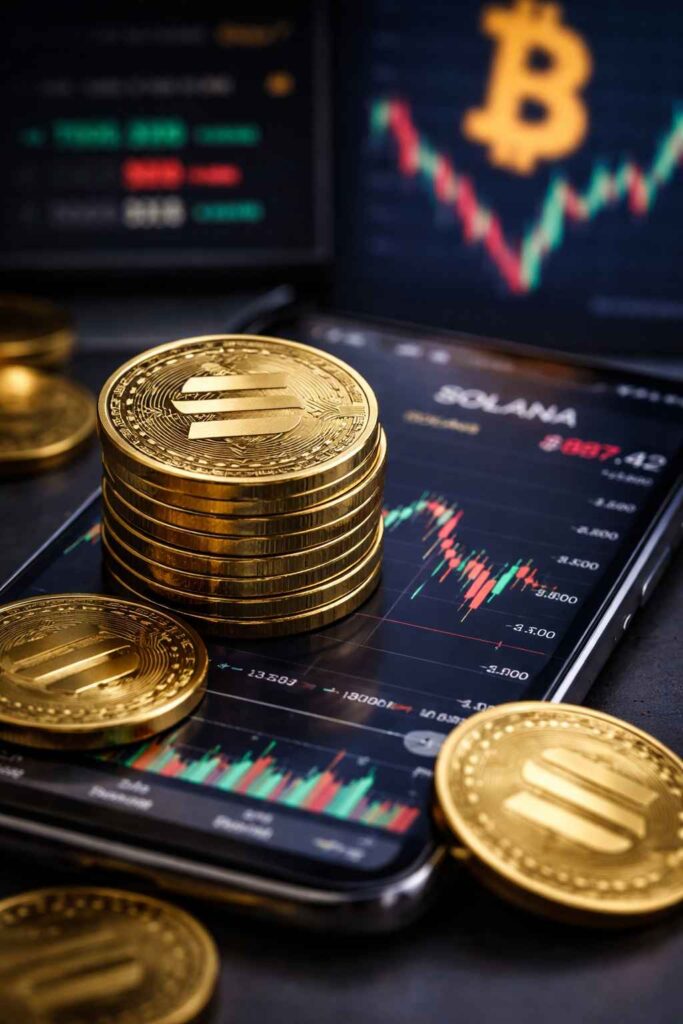

Solana has fallen 3% to around $87, extending its recent downtrend and putting it far below its previous highs above $260. But for long-term investors, this dip is raising a bigger question — can a $1,000 investment at current levels still grow into $36,000 by 2030, or is that just another crypto fantasy?
At today’s price, $1,000 buys roughly 11.4 SOL tokens. If Solana reaches $300 by 2030, that investment grows to about $3,400. At $1,000, it jumps to $11,400. And at the bullish $3,200 target, the same $1,000 could turn into more than $36,000. While those numbers look attractive, the real story lies in whether Solana can justify such growth.
Why Solana’s 3% drop could be an opportunity
Short-term price declines often create long-term entry points. Solana’s fall to $87 comes after a broader correction in crypto markets, where even strong projects have seen sharp pullbacks. Historically, large-cap altcoins tend to recover strongly during bullish cycles, especially those with strong ecosystems.
Solana stands out because of its speed, low transaction costs, and growing adoption across DeFi, NFTs, and payments. The network currently hosts over $6.5 billion in total value locked (TVL), making it one of the most active blockchain ecosystems outside Ethereum.
The real growth engine: ecosystem and institutional adoption
Unlike XRP, which depends heavily on institutional payment adoption, Solana’s growth is tied to its broader ecosystem. Developers are building applications across gaming, decentralized finance, and digital payments, creating multiple demand drivers for the token.
Institutional interest is also rising. Spot Solana ETFs have already attracted more than $3.3 billion in assets, providing a regulated entry point for large investors. Companies like Visa and Shopify are integrating Solana Pay, while asset managers such as BlackRock and Franklin Templeton are exploring tokenized assets on the network.
This combination of retail usage and institutional exposure is what fuels the more aggressive price forecasts.
For broader crypto market trends and institutional flows, investors can track updates on Yahoo Finance Crypto.
Can Solana realistically hit $3,000?
The $3,000+ price target depends on several key factors aligning. First, Solana must continue scaling its network. Upcoming upgrades aim to reduce transaction confirmation times to under a second, making it viable for real-time global payments.
Second, the ecosystem must evolve beyond speculative trading. A large portion of Solana’s activity still comes from meme coins and short-term trading, which is not a stable foundation for long-term valuation.
Third, the broader crypto market must remain supportive. Solana rarely moves independently and tends to follow overall market cycles.
How Solana compares to XRP as a $1,000 investment
While Solana offers higher upside potential, XRP presents a different type of investment case. At around $1.40, $1,000 buys roughly 690 XRP tokens. If XRP reaches $5 by 2030, that investment becomes $3,450. At $12, it grows to around $8,280, and at the bullish $27–$28 range, it could reach about $19,500.
The key difference lies in their growth drivers. XRP depends on Ripple’s success in convincing banks to use it as a settlement asset for cross-border payments. Solana, on the other hand, depends on ecosystem expansion and user adoption.
XRP has a fixed supply of 100 billion tokens, making it slightly deflationary over time as fees are burned. Solana, however, inflates at around 4–5% annually through staking rewards, though this rate gradually declines. This means Solana must maintain strong demand growth to offset inflation.
The risks investors should not ignore
Despite its potential, Solana carries significant risks. The network has faced outages in the past, raising concerns about reliability. Although improvements have been made, confidence has not fully recovered.
Competition is another major factor. Ethereum’s layer-2 solutions, such as Arbitrum and Base, are rapidly improving scalability and reducing fees, narrowing Solana’s advantage.
There are also regulatory and legal risks. A class-action lawsuit linked to Solana ecosystem projects could impact investor sentiment if outcomes turn negative.
For a deeper understanding of Solana’s technical roadmap and upgrades, readers can explore the official Solana documentation.
What $1,000 in Solana could realistically become
While the $36,000 projection grabs attention, more realistic outcomes fall within a lower range. A move to $300–$500 would already deliver strong returns of 3x to 5x. Reaching $1,000 would represent a major success and a roughly 10x gain from current levels.
The higher targets depend on sustained adoption, strong market conditions, and continued technological improvements.
The bottom line for long-term investors
Solana’s 3% drop to $87 highlights the volatility that defines crypto markets, but it also presents a potential entry point for investors willing to take on risk. Compared to XRP, Solana offers greater upside potential but comes with higher uncertainty.
The real question is not whether $1,000 can turn into $36,000, but whether Solana can continue evolving into a dominant blockchain ecosystem. If it does, even conservative targets could deliver meaningful returns. If it doesn’t, the more optimistic projections will remain out of reach.
For now, Solana remains one of the most closely watched large-cap cryptocurrencies — a high-risk, high-reward bet that could define the next phase of the crypto market.
You may also like: Dow Futures Drop 400 Points Ahead of Monday as Trump Iran Threat Sends Oil Surging 2.8%

Make Swikblog your go-to source on Google for reliable updates, smart insights, and daily trends.