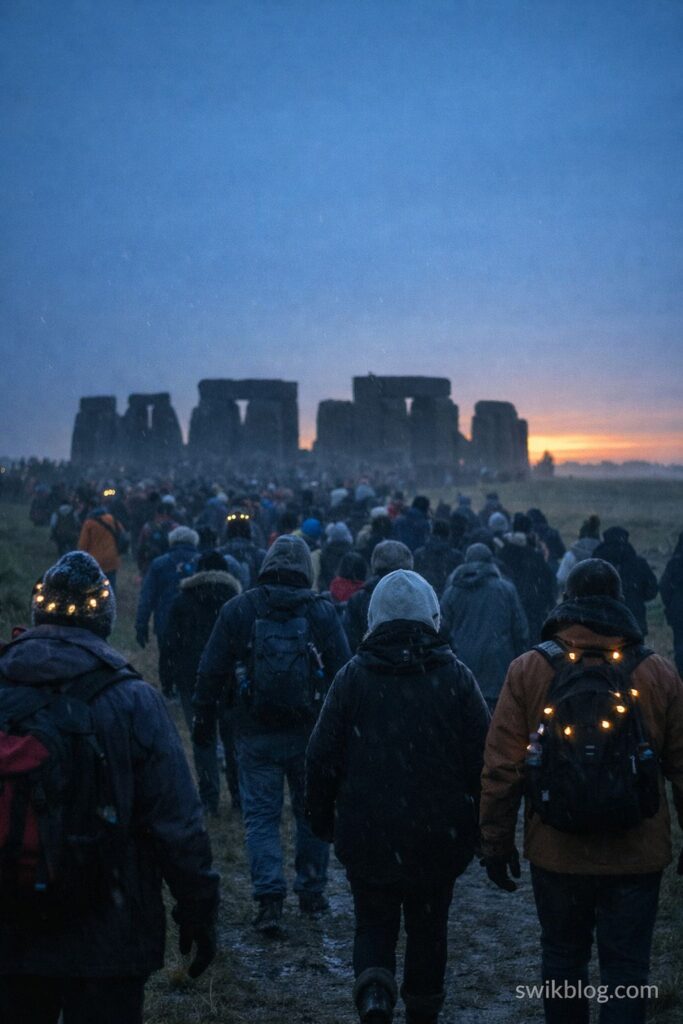

Before most of Britain had even made the first cup of tea, thousands of people were already moving across dark roads and wet fields, travelling toward a place that feels older than the country built around it. They came wrapped in winter coats, scarves and hats, some carrying flasks, some carrying drums, some carrying nothing at all — except the quiet certainty that they needed to be there.
On the winter solstice — the shortest day of the year — Stonehenge becomes less a monument and more a meeting point. The ritual is simple: arrive before dawn, wait together in the cold, and watch the sky slowly turn. For many, the sunrise is the headline. But the real draw is the feeling that something changes — that the long slide into darkness pauses, and the light begins to return.
Why people travel for this morning
The winter solstice isn’t just a date on a calendar. It’s a marker of endurance — a moment people have noticed for as long as they’ve had seasons to survive. In modern life, where everything is scheduled and backlit, there’s a particular power in turning up somewhere without a ticketed “show”, simply to witness the world doing what it has always done.
Some arrive because the atmosphere is communal and unexpectedly tender; strangers make space, share snacks, swap stories, and then fall into the same hush when the horizon starts to soften. Others come for spiritual reasons — modern Pagan and Druid traditions sit alongside casual visitors who just want to start the day in a way that feels meaningful. And plenty come because Stonehenge is one of the rare places where you can feel history as a presence, not a lesson.
A monument built around the Sun
Stonehenge is uniquely suited to the winter solstice for a technical reason: the monument was deliberately laid out on a north-east to south-west solar axis, so the Sun’s most extreme positions in the year are “built into” the geometry of the site. In midwinter, the key alignment is toward the south-west, where the Sun sets at the winter solstice — the opposite of midsummer, when the Sun rises in the north-east. English Heritage explains that Stonehenge was constructed to align with the Sun on the solstices, with winter solstice marked by the sunset to the south-west of the stone circle, which is why this day remains so powerful to witness in person. Read English Heritage’s guide to solstice at Stonehenge .
That connection is why the winter solstice carries its own gravity. It’s quieter than summer, colder and less festive — and for many, more personal. You’re not just watching a sunrise. You’re watching the year turn, and feeling the old relief that comes with the idea that the days, from here, will slowly grow longer.
What the solstice actually is
The science is straightforward, even if the emotions it triggers are anything but. The Earth is tilted on its axis, and in late December the northern hemisphere leans farthest away from the Sun. That’s why daylight is at its shortest, the Sun’s arc sits lower in the sky, and the morning light can feel thin — as if it’s had to work harder to arrive.
It’s also why this day lands differently depending on where you stand. In southern England it’s a long dusk; farther north, it can feel as if the day barely begins before it’s already leaving. That unevenness is part of what makes the solstice such a human event: everyone experiences it, but not in the same way.
The real reason the crowds keep coming back
If you ask people why they travel for it, you’ll get different answers — atmosphere, tradition, spirituality, history, curiosity. But the shared theme is the same: the desire to be present for a hinge in time. In a culture that rushes past endings, the solstice insists you pause. You wait. You look up. You notice the light.
And then, almost imperceptibly, the year begins to turn the other way — not dramatically, not in a single morning, but enough to feel hopeful. The crowd disperses, footprints dissolve into wet grass, and the stones remain, as they always have, marking time without a word.
You may also like
Longest Night 2025: Winter Solstice Explained — What It Means and Why It Matters

Make Swikblog your go-to source on Google for reliable updates, smart insights, and daily trends.