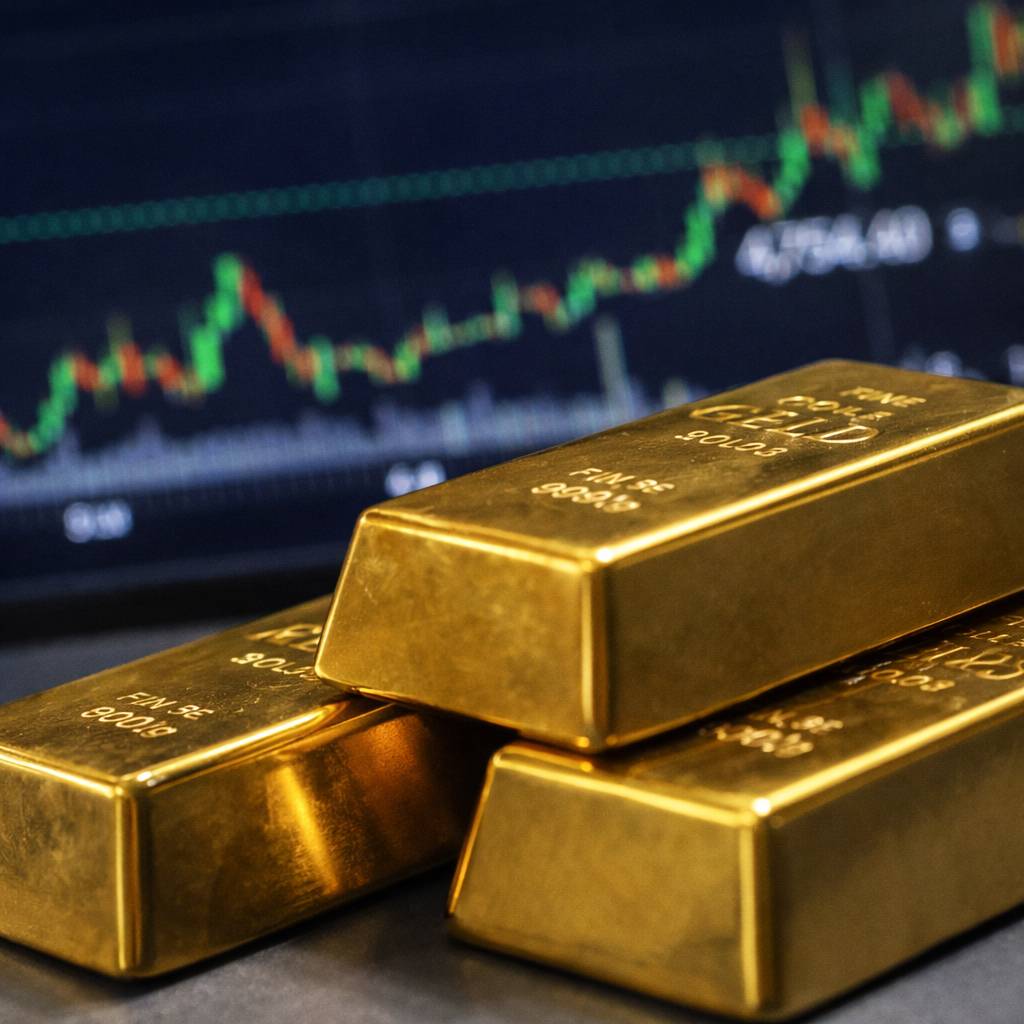

US gold prices traded near $4,700 per ounce on Sunday after COMEX gold futures rose about 0.5%, a move that kept bullion close to a key technical resistance zone and reinforced the metal’s strong momentum. The latest gain came as investors continued to favor gold amid a supportive macro backdrop, including persistent demand for safe-haven assets, expectations that interest rates may not stay restrictive forever, and ongoing caution around global growth, currency volatility, and geopolitical risks. For market participants, the reaction was notable not because the gain was dramatic, but because buyers were still willing to add exposure at already elevated levels.
That matters because gold’s move higher was not driven by a single shock headline. Instead, the price action suggested steady investor conviction. When an asset rises into resistance and then holds most of its gains, traders often read that as a sign of strength rather than exhaustion. In this case, the market appears to be pricing in a world where portfolio protection still matters, inflation risks have not fully disappeared, and central banks remain an important part of the demand story. The investor reaction has been disciplined rather than euphoric, which may be one reason the rally has remained intact.
The main trigger behind gold’s latest rise is the broader macro setup. Gold tends to benefit when real yields soften, when the dollar’s strength becomes less certain, and when investors start questioning how durable economic momentum really is. Even without a sharp deterioration in the data, the market has become more sensitive to downside risks, and that has made bullion attractive as both a hedge and a momentum trade. COMEX futures holding near the top of their recent range show that traders are still positioning for upside, even as prices test an area where profit-taking would normally be expected.
Market structure data further highlights the strength in gold’s current positioning. Spot gold was trading near $4,672, while COMEX futures hovered around $4,702, reflecting a premium of roughly $30 that signals continued bullish expectations. Intraday, prices moved within a wide band of approximately $4,580 to $4,825, underscoring both volatility and the presence of strong resistance near the upper range. Despite this, the relatively modest gain of around 0.5% suggests a controlled rally rather than a sharp spike, pointing toward steady institutional accumulation rather than short-term speculative buying.
Unlike a stock, gold does not post quarterly revenue, margins, or earnings guidance, but investors still track a financial framework around the asset. The equivalent signals include futures premiums to spot prices, exchange-traded fund flows, central bank purchases, and the relationship between bullion, Treasury yields, and the U.S. dollar. When futures remain firm relative to spot, it can suggest confidence in near-term demand. When official-sector buying stays strong, it adds credibility to the bullish case. The World Gold Council has consistently pointed to the importance of central bank demand and investment flows in shaping the gold market’s direction.
Why investors are still leaning bullish
Investor sentiment has improved because the market has not seen the kind of deep reversal that usually follows a strong run. Gold has already climbed sharply over recent months, yet pullbacks have remained relatively contained. That has surprised some traders who expected elevated prices to trigger more aggressive selling. Instead, the market has shown a pattern of shallow dips and renewed buying, suggesting that investors still view weakness as an opportunity to build or defend positions. In practical terms, expectations have shifted from asking whether gold can hold its gains to asking what catalyst might be needed for another breakout.
Part of that confidence reflects the way gold is being used today. It is not just a defensive asset in the traditional sense. It has also become a broader portfolio tool for diversification at a time when the relationship between stocks, bonds, and currencies has become less predictable. For institutional investors, that matters. If an asset can offer liquidity, historical credibility, and some insulation from policy and geopolitical shocks, it earns a bigger role in asset allocation decisions. That helps explain why gold has remained supported even when the immediate news flow has not been especially dramatic.
Still, the market is not without risks. The biggest near-term challenge is valuation and positioning. At roughly $4,700 per ounce, gold is trading in territory that already reflects a significant amount of optimism. If U.S. economic data strengthens materially, Treasury yields rise again, or the dollar regains momentum, gold could struggle to push through resistance in the short term. Crowded bullish trades can also unwind quickly if traders decide the market has moved too far, too fast. That makes the current level psychologically important: it is high enough to attract momentum buyers, but also vulnerable enough to invite tactical selling.
What the market is watching next
The next phase for gold will depend on whether this latest rise proves to be a pause before a breakout or the start of a broader consolidation period. If prices continue holding above the mid-$4,600 area on any dip, investors are likely to interpret that as a sign that the uptrend remains healthy. A clean move through resistance, on the other hand, could draw in another wave of trend-following money. Analysts are also watching whether ETF demand improves further and whether central banks remain steady buyers, since both factors could help absorb any short-term selling pressure.
Broader sector and macro conditions remain important. Gold’s strength is unfolding at a time when investors across global markets are reassessing how much risk they want to carry and where they want to hide from uncertainty. In that environment, bullion continues to benefit from its status as both a defensive asset and a momentum trade. For now, the market’s message is straightforward: COMEX gold may only be up 0.5% today, but the fact that it is holding near $4,700 per ounce says investors still believe the underlying case for owning gold remains strong.
You may like: US Flights Delays Easter Travel Chaos 2026

Make Swikblog your go-to source on Google for reliable updates, smart insights, and daily trends.