
By James Carter • Thu 15 Jan 2026
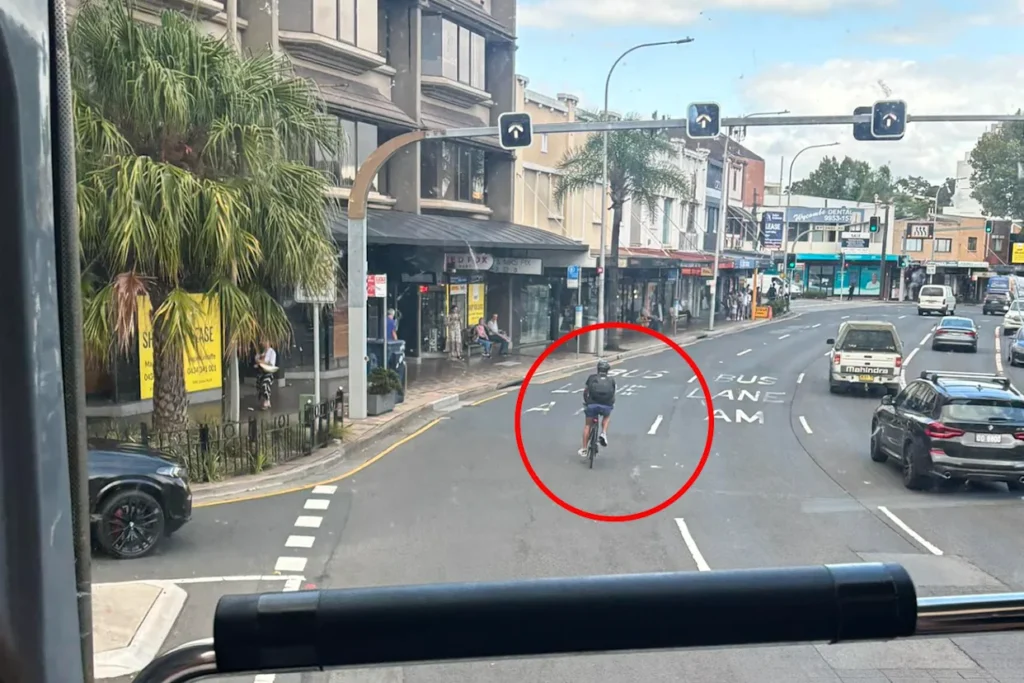
A single photo from Sydney’s Lower North Shore has reignited one of Australia’s most stubborn road arguments: when a cyclist and a bus share the same lane, who “should” move? In the image, a rider travels ahead of a B-Line bus through Neutral Bay during peak hour. Some commuters described it as an “entitled” move — a person on two wheels “stalling” a vehicle carrying dozens. But the viral outrage has collided with an inconvenient truth: in many cases, the rider is not breaking the rules at all.
The confusion is understandable. Bus lanes look and feel like priority space. They’re painted, signed, and often treated by motorists as a protected corridor meant to keep public transport moving. Yet in New South Wales, bus lanes are not automatically “bus-only” lanes — and that distinction changes everything.
The little-known rule: “Bus lane” isn’t the same as “Buses Only”
In NSW, bicycle riders are allowed to use bus lanes on many roads — alongside buses, taxis and other permitted vehicles — unless the signage or lane markings explicitly restrict access. Transport for NSW spells it out in its official road rules guidance: cyclists can ride in transit, truck and bus lanes, but not in tram-only or bus-only lanes. If you want the primary-source wording, it’s worth reading the TfNSW guidance directly: Transport for NSW’s road rules for bicycle riders .
Bicycle NSW — which regularly publishes plain-English explainers for riders — makes the same point: cyclists may use a bus lane, but must exit if it becomes a clearly marked “Bus-only” lane. Their “Road Riding” guide breaks down the practical reality of sharing that space: Bicycle NSW: Road Riding (Bus Lanes) .
So… can a cyclist “hold up” a bus?
Legally, a cyclist riding in a permitted lane is treated as a road user in their own right — not a temporary obstacle that must step aside on demand. That means there is typically no automatic obligation to pull over at every red light to let the bus launch first. The bus driver can decide whether it’s safe to overtake, but the rider is also entitled to remain in the lane while proceeding lawfully.
This is where the emotional temperature rises. Many drivers and passengers assume “slower” must equal “give way”. But the road rules don’t work like a queue at a coffee shop. On the street, the priority is safety, predictability, and legal right-of-way — not speed.
The traffic-light detail most people miss
The viral discussion also surfaced another nuance: special bus signals. At some intersections, buses get a “B” light that lets them move ahead before general traffic. Cyclists must follow the main traffic lights that apply to them — and they cannot treat a bus-only signal as permission to go. If you’re unsure how different signals work (including bicycle signals at crossings), NSW’s official traffic lights guidance is a useful refresher: NSW Government: Traffic lights rules .
Why “just pull over” isn’t always safer
The most heated comments often come with a simple instruction: “Move aside at the lights.” But in real-world riding, repeatedly pulling over can create its own dangers — especially on busy corridors like Military Road and feeder routes near Spit Bridge. Merging in and out of a bus lane forces a cyclist to re-enter fast-moving traffic, interact with turning vehicles, and negotiate blind spots again and again.
Intersections are particularly fraught. Left-turning vehicles can legally enter a bus lane to turn, and the conflict point is often exactly where cyclists are most exposed. That’s why many road safety specialists emphasise predictable positioning over constant weaving: the rider who stays visible, holds a line, and behaves like a vehicle is often easier to anticipate than one who darts in and out.
The bigger Sydney problem: patchy cycling infrastructure
Beyond the legal arguments sits a practical one: Sydney still has gaps where safe, continuous bike infrastructure simply doesn’t exist. When separated lanes disappear, riders are funnelled back into mixed traffic — sometimes into bus lanes that feel like the “least worst” option. The result is a daily friction point between passengers who want reliable travel times and riders who want to arrive alive.
This is also why one photo can spark such a furious response: it compresses a decade of frustration into a single moment. Bus passengers see a delay; cyclists see a rare slice of space where they’re more visible and less squeezed by cars. Motorists see “special treatment”; transport planners see two modes competing for limited road width.
A practical reset for everyone sharing the lane
- For cyclists: Use bus lanes only where permitted, hold a predictable line, and be extra alert at intersections and near left-turning vehicles.
- For bus passengers: It may look slow from the window, but the rider in front is often following the law — and re-merging repeatedly can increase risk, not reduce it.
- For drivers: Expect bicycles in bus lanes unless signage says otherwise. If you’re turning left, check carefully — this is where most close calls happen.
The takeaway from Neutral Bay isn’t that cyclists should “win” or buses should “win”. It’s that a surprising number of road users are operating on assumptions — and in a city with tight corridors and heavy traffic, assumptions are where crashes begin. The rule is simple once you see it: bus lane often means shared; buses only means restricted. Everything else is the hard work of sharing.
Want a break from road rage discourse? Here’s a lighter read on Swikblog: Kane Cornes slams the “one-point slam” — fans push back .
Note: Road rules can vary by lane signage and markings. If a lane is marked “Buses Only”, cyclists must not use it. Always follow the signals that apply to you at intersections.

Make Swikblog your go-to source on Google for reliable updates, smart insights, and daily trends.