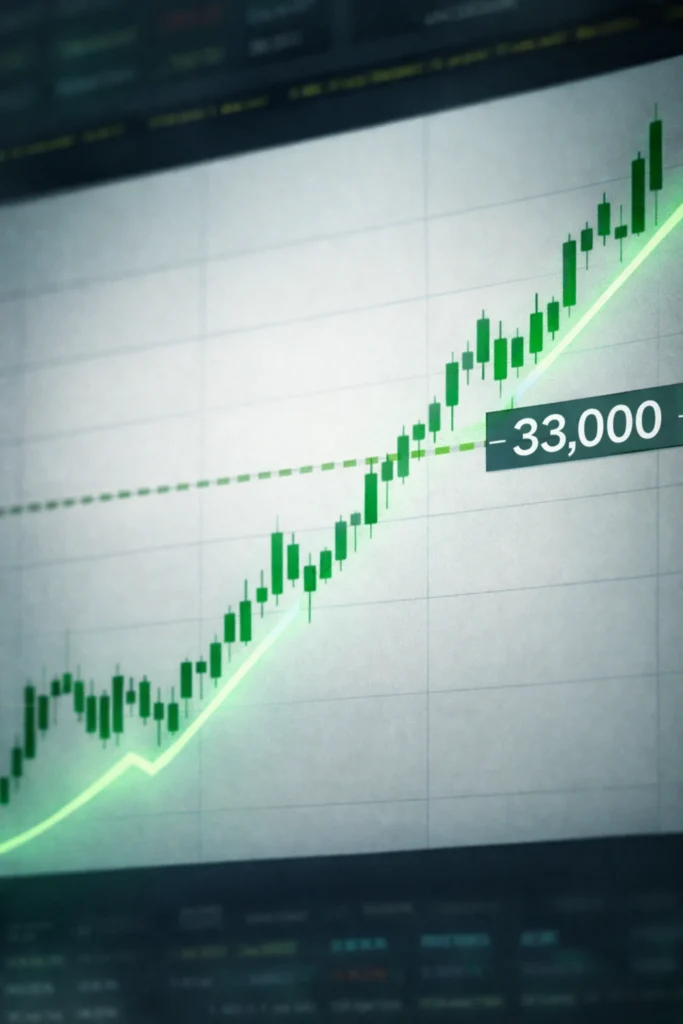

The S&P/TSX Composite wrapped a volatile week with a decisive push higher, finishing at 33,073.71. The move wasn’t a slow grind — it was a week defined by sharp swings, then a powerful late-week rebound that put Canada’s two biggest engines back in front: energy and bank stocks. By the close, the index was up about +1.86% on the week, with Friday delivering the loudest signal in points and momentum.
The headline numbers tell the story fast, but the path mattered. The TSX traded through a broad weekly range — a reminder that conviction was tested before buyers regained control. The week’s action leaned into the classic Canadian mix: commodity sensitivity through energy and materials, and heavyweight leadership through the financial sector. When those groups align, TSX rallies tend to broaden quickly because the index’s largest constituents are doing the heavy lifting.
The week in numbers
Weekly close: 33,073.71
Weekly change: +1.86% (about +603 points)
Weekly high: 33,693.39
Weekly low: 32,148.37
That creates a high-to-low swing of roughly 1,545 points across the week. In practical terms, it was a market that sold off, stabilized, and then snapped back hard enough to reclaim key territory. Round-number levels shaped the tape, with 33,000 acting as the psychological line that dominated late-week positioning.
Quick visual: weekly range and close
What drove the rally
The week’s strongest burst arrived late, with momentum accelerating into the close as risk appetite improved. Macro-sensitive positioning played a role, but the TSX’s identity showed up in the sector leadership: when energy rises and banks move with it, the index can advance quickly because those groups represent a big slice of Canada’s market value. The result was a rally that looked and felt broader than a single-stock bounce — a key reason it translated into a clean weekly finish above 33,000.
Energy stocks typically respond first to shifts in crude pricing and global growth expectations, while financials tend to amplify the index move when confidence returns. Through the week, that combination helped stabilize drawdowns and then pushed the benchmark higher into Friday’s surge. The late-week tape suggested buyers were willing to add exposure again, especially in large-cap names that trade with deep liquidity.
Low-to-high index action and key levels
The week’s low at 32,148.37 and high at 33,693.39 framed the entire battle. Moves toward the lower end of the range attracted dip-buying interest, while the return through the high-32,000s opened the door to a decisive reclaim of 33,000. That round-number threshold matters because it often becomes the reference point for weekend positioning and Monday planning: above it, momentum traders watch for continuation; below it, the market narrative shifts back toward “failed breakout” risk.
Key stats snapshot
- Weekly close: 33,073.71
- Weekly gain: +1.86% (about +603 points)
- Weekly range: 32,148.37 to 33,693.39
- Range width: about 1,545 points
From a momentum lens, the most constructive part of the week was the ability to finish strong after such a wide swing. A rally that survives volatility often pulls in two different crowds at once: short-term traders looking for follow-through and long-term investors who prefer leadership from banks and energy over narrow, fragile gains. That combination can matter more than any single headline because it shapes how the market trades at the open when liquidity returns.
For a related Canadian bank-market driver, you may also like: RBC stock and OSFI capital rules in focus for Canadian lenders .
Sector leadership: why energy and banks mattered most
The TSX is built differently than many global benchmarks. It’s heavier in financials and commodities, and that structure changes what “healthy” market leadership looks like in Canada. When energy participates, it typically reflects a supportive backdrop for crude and resource names. When banks participate at the same time, it signals broad confidence in the Canadian blue-chip complex. This week delivered that pairing, which is why the rally had enough weight behind it to carry the index into a strong close.
If the same leadership stays intact into the next session, the upper end of the weekly band around 33,700 becomes the natural reference point. If leadership fades, the first area the market tends to “re-check” is the reclaimed zone near 33,000. That’s the level that often determines whether a breakout becomes a base — or whether the market slips back into the middle of the range.
For broader market context from a major wire service, this Reuters TSX market report covers the week’s key drivers and sector tone.

Make Swikblog your go-to source on Google for reliable updates, smart insights, and daily trends.