
Markets • Asia • Holidays
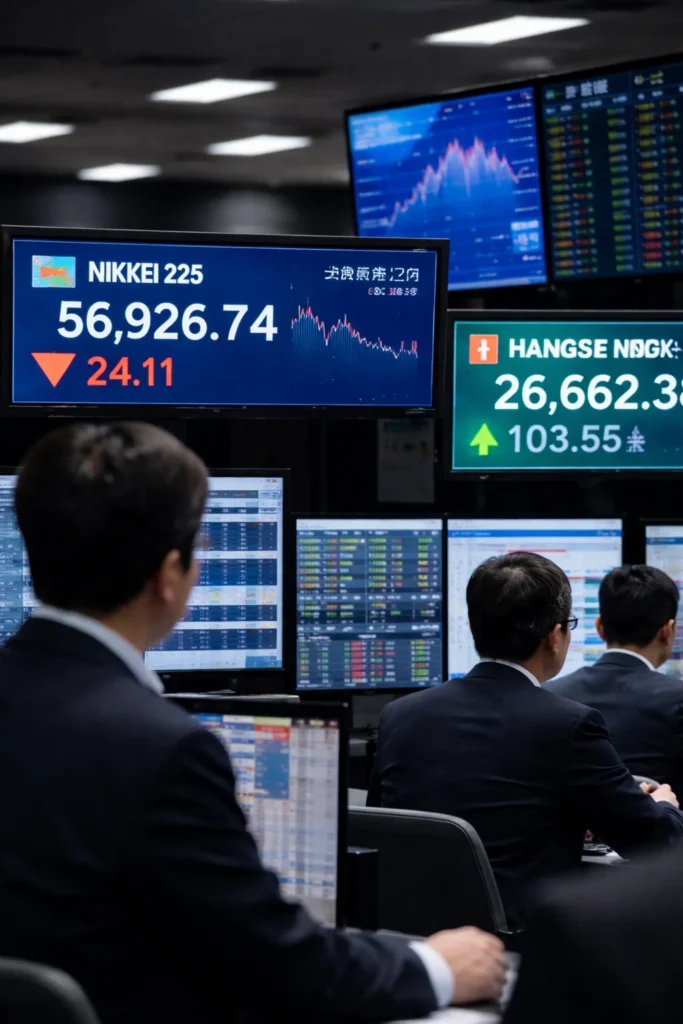
Asian equities started the week in a holding pattern as the Lunar New Year period thinned liquidity across the region. With mainland China, South Korea and Taiwan shut for the holiday and Hong Kong and Singapore running half-day sessions, many desks leaned cautious rather than directional. The quieter tone was echoed in the United States, where markets were closed for Presidents’ Day, removing a major source of global volume.
| Market | Level | Move | What mattered |
|---|---|---|---|
| Nikkei 225 (Tokyo) | 56,923.44 | -0.03% | Japan GDP undershot expectations, reinforcing a “slow-growth” narrative. |
| Hang Seng (Hong Kong) | 26,662.38 | +0.4% | Holiday-thinned trade left moves modest despite last week’s volatility. |
| Shanghai Composite | — | Closed | Mainland holiday closure reduced regional price discovery. |
| WTI crude | $62.86 | -0.05% | Energy drifted in narrow ranges as demand signals stayed mixed. |
| Brent crude | $67.69 | -0.09% | Traders kept focus on macro data and risk sentiment. |
Levels reflect early Asia trade around 03:30 GMT.
The central macro headline was Japan’s latest growth print, which came in softer than traders expected. Gross domestic product expanded by 0.1% in the final quarter of 2025 versus market forecasts near 0.4%, a miss that revived doubts about momentum in the world’s fourth-largest economy. Strategists argued the reading suggests earlier fiscal measures had not yet translated into a clear boost in public spending, leaving policy in the spotlight just as the new administration leans into a pro-growth agenda.
Elsewhere, last week’s tech-led slide still hovered in the background. The sell-off was driven by renewed skepticism over how quickly massive spending on AI infrastructure will translate into durable cash returns. That theme doesn’t disappear in a holiday week; it simply trades quieter. Investors now have a fresh focus point with the India AI Impact Summit opening in New Delhi, drawing global executives and policymakers into a broader debate about AI’s economic promise, social risks, and energy footprint.
In the United States, a slightly softer inflation profile helped steady risk appetite into the long weekend. The latest data showed headline and core measures cooling, a detail that markets typically interpret as giving the Federal Reserve more room to consider rate cuts later in the year—if disinflation continues rather than stalling. For traders, the key is less about one print and more about whether the “trend” keeps leaning in the right direction.
| Pair | Level | Move vs prior close |
|---|---|---|
| USD/JPY | 153.08 | Dollar softer; yen firmer |
| EUR/USD | 1.1867 | Little changed |
| GBP/USD | 1.3641 | Modest dip |
| EUR/GBP | 0.8699 | Fractionally higher |
Thin holiday conditions can exaggerate small moves—watch liquidity as Asia reopens fully.
Commodities reflected the same “steady but watchful” mood. Gold eased after a recent bounce, but continued to hover above the psychologically important $5,000 per ounce level, supported by falling real yields and expectations that easier policy could return later this year. If you want a single read-through on how macro policy expectations have been feeding the metal, a recent Reuters report on gold’s surge above $5,000 captures the cross-currents investors have been trading.
The near-term question for Asian markets is whether calm holds once regional trading desks return at full strength. With Japan’s growth print disappointing, the policy response will be watched closely, while the global AI debate continues to shape sentiment across megacap tech and the supply chains that feed it. For now, the market’s message is simple: with liquidity thin and catalysts concentrated later in the week, price action can drift—until it doesn’t.
Transocean stock: rigs, contracts and earnings focus Bitcoin price today: key catalysts and ETF chatter More markets coverage on Swikblog
Image alt text suggestion (hero): “Trading screens show mixed Asian market moves as Lunar New Year closures reduce liquidity.”

Make Swikblog your go-to source on Google for reliable updates, smart insights, and daily trends.