
A once-thriving seaside amusement park that defined generations of family holidays in North Wales has re-emerged in public conversation, as interest grows in Britain’s abandoned leisure landmarks. Ocean Beach Funfair in Rhyl — located around 90 minutes from Manchester — shut its gates permanently on September 2, 2007, after 53 years of operation at its final site, marking the end of one of the UK’s most recognisable coastal attractions.
At its peak, the park was a centrepiece of Rhyl’s tourism economy, drawing visitors from across the country with its mix of rollercoasters, bumper cars, ghost trains and spinning rides. For many, it was not just a fairground but a defining part of childhood — a place where summer holidays, day trips and seaside traditions came together in one vibrant space.
The story of Ocean Beach stretches back even further. The amusement park’s origins date to the late 19th century, when Rhyl began developing into a popular holiday resort following the arrival of the railway in 1848. Initially located near Marine Lake, the fairground expanded rapidly as visitor numbers grew, eventually relocating in 1954 to a larger site along the west promenade to accommodate bigger rides and increasing demand.
From innovation to decline
Ocean Beach was once at the forefront of amusement innovation in Britain. It featured the country’s first tubular steel rollercoaster and became known for iconic attractions such as its 1950s ghost train, the Jet Stream ride and a rare circular water chute — believed to be the last of its kind in the world. Towering above it all was the Pepsi-Cola Loop, one of the park’s most recognisable and photographed rides.
The fairground enjoyed its golden era throughout the 1970s, 1980s and 1990s, when traditional seaside holidays still brought large crowds to towns like Rhyl. Coaches arrived regularly, trains were packed with visitors, and the promenade buzzed with activity during peak seasons.
But by the early 2000s, the landscape had shifted. Changing travel habits, particularly the rise of affordable overseas holidays, reduced reliance on UK seaside resorts. At the same time, maintaining ageing rides became increasingly expensive, and visitor numbers began to fall steadily.
The situation worsened in July 2005, when a rollercoaster accident injured five people after one car was struck from behind and derailed. While described by management as the park’s first major incident in decades, the event damaged its safety reputation at a time when public confidence was already fragile.
Efforts to secure significant investment for new attractions failed, leaving the park unable to modernise. By 2007, operators concluded that continuing operations was no longer financially viable.
Closure, abandonment and transformation
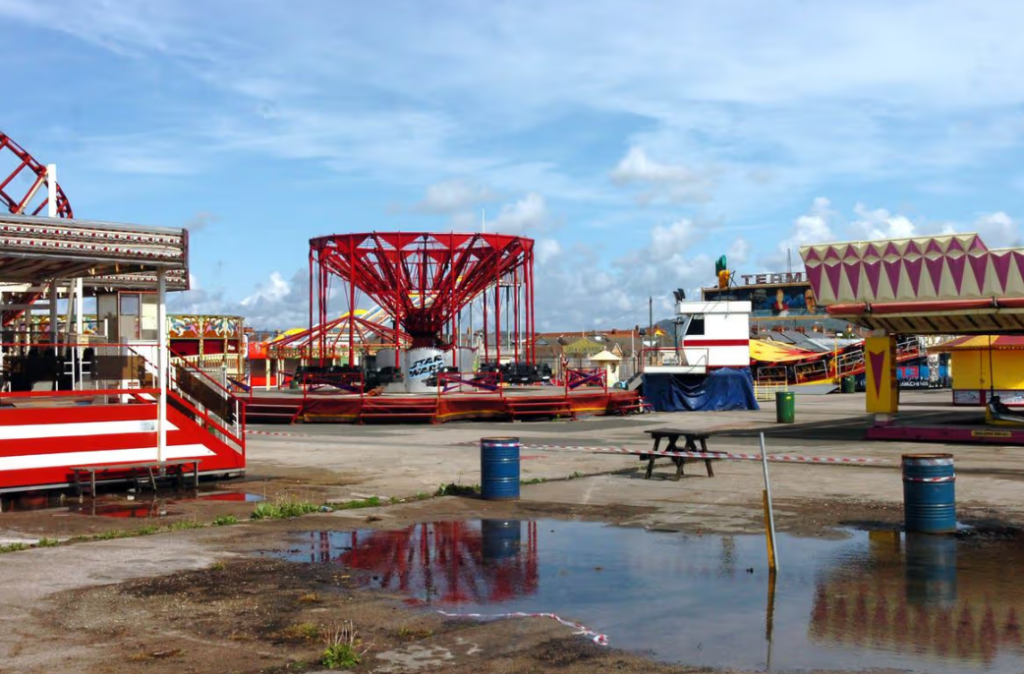
When Ocean Beach closed, it left behind more than empty space. For years, the site stood in a state of eerie abandonment, with rusting rides and skeletal structures exposed to the coastal elements. The once lively park became a symbol of decline — a stark contrast to its earlier decades of colour and noise.
Redevelopment plans were proposed multiple times, including a mixed-use scheme involving housing, leisure and retail starting in 2009, but these failed to materialise. It was not until 2015 that plans for a retail-focused development were approved, leading to the creation of Marina Quay.
From 2017 onwards, the former amusement park site was gradually transformed into a retail park, with major chains such as Aldi and Greggs opening outlets where rollercoasters once stood. The shift reflects a broader trend seen across UK seaside towns, where traditional attractions have given way to commercially stable developments aimed at year-round footfall.
While Rhyl continues to evolve as a coastal destination, the disappearance of Ocean Beach remains deeply felt. The fairground’s closure is often cited as a turning point in the town’s modern history — a moment when a central part of its identity quietly disappeared.
Today, little physical trace of the amusement park remains. Yet for many across Wales and north-west England, Ocean Beach endures in memory — a place defined not just by its rides, but by the sense of excitement, community and tradition it once brought to the seafront. More about Rhyl’s coastline and visitor attractions can be explored via Visit Wales.
You may like: White House Easter Egg Roll 2026: How to watch, time and highlights

Make Swikblog your go-to source on Google for reliable updates, smart insights, and daily trends.