
Search interest in the word “astronaut” has surged by more than 300% worldwide as NASA’s Artemis II mission reaches one of its most dramatic phases — a live, historic flyby of the Moon that is unfolding in real time.
The spike comes as millions of viewers tune in globally to watch the first crewed lunar mission in over 50 years. For many, it’s not just another space update — it’s a rare moment where history, science, and human exploration collide live on screen.
NASA’s Orion spacecraft, carrying four astronauts — Reid Wiseman, Victor Glover, Christina Koch, and Canadian Space Agency astronaut Jeremy Hansen — is now deep into its mission, pushing beyond limits last set during the Apollo era.
At approximately 1:56 p.m. ET, the crew surpassed the farthest distance ever traveled by humans from Earth, breaking the Apollo 13 record set in 1970. Within minutes, search activity began to spike sharply as audiences rushed online to understand the significance of the milestone.
Historic Moon Flyby Drives Global Search Surge
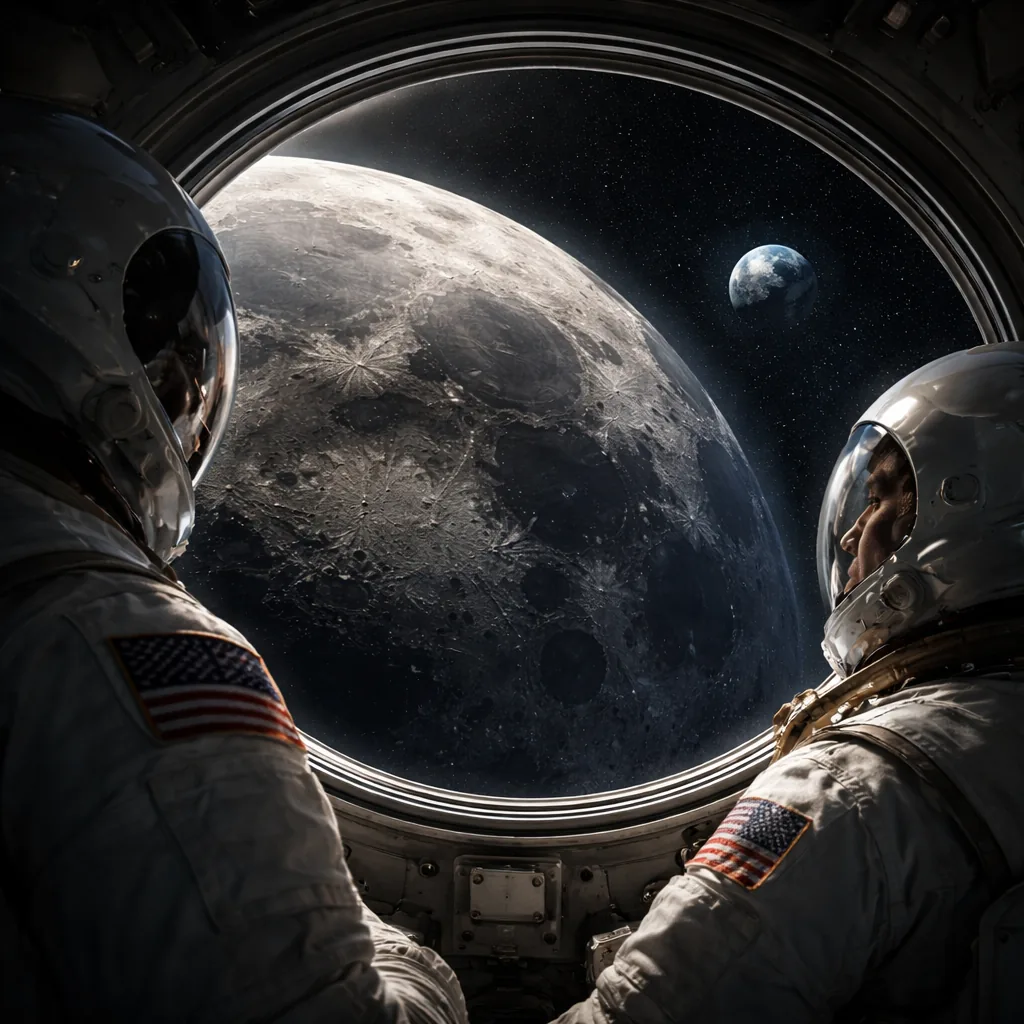
The defining moment of the mission is a seven-hour lunar flyby, during which the crew is observing the Moon from a distance of roughly 4,000 miles. Observations began around 2:45 p.m. ET, marking the start of one of the most closely watched space events in decades.
From this vantage point, astronauts are capturing a full-disc view of the Moon — something rarely experienced by human eyes — while documenting geological features that scientists have only studied through robotic missions until now.
Among the most significant observations so far is the Orientale Basin, a massive crater nearly 600 miles wide that lies at the boundary between the Moon’s near side and far side. The crew has already shared images of this region, offering a perspective never before seen directly by humans.
The near side of the Moon, familiar from Earth, appears marked by dark patches formed by ancient lava flows. But as the spacecraft approaches the far side — the portion permanently hidden from Earth — astronauts are beginning to witness terrain that has remained largely unexplored visually by human observers.
“The moon we are looking at is not the moon you see from Earth,” astronaut Christina Koch said during early observations, highlighting the stark difference between the two hemispheres.
NASA has identified around 35 geological features for the crew to study during the flyby. Working in pairs, the astronauts are using high-resolution cameras with multiple zoom lenses to photograph impact basins, color variations, and surface textures while describing their observations live to scientists back on Earth.
These real-time descriptions are considered critical. Human eyes can detect subtle color differences on the lunar surface — variations that may reveal mineral composition — in ways that satellite instruments cannot fully replicate.
The mission is also packed with key milestones that are fueling public interest. Around 7:02 p.m. ET, Orion is expected to reach its closest approach to the Moon, followed shortly by its maximum distance from Earth — approximately 252,000 miles.
At 6:44 p.m. ET, communication between the spacecraft and Earth will temporarily drop for about 40 minutes as Orion passes behind the Moon — a moment reminiscent of Apollo missions that adds both tension and excitement for viewers.
Later in the evening, astronauts are expected to witness a rare solar eclipse lasting more than 50 minutes, visible only from their unique position in space. This event is anticipated to generate another surge in online engagement as new visuals are released.
Why Astronauts Are Dominating Global Searches
The surge in “astronaut” searches reflects more than just curiosity about the mission — it signals a renewed global fascination with human spaceflight.
Unlike robotic missions, Artemis II puts people at the center of the story. Viewers are not just watching a spacecraft; they are following individuals experiencing deep space firsthand, sharing reactions, images, and insights as the mission unfolds.
The crew itself represents a milestone. Christina Koch is set to become the first woman to travel this far into space, while Victor Glover is the first Black astronaut assigned to a lunar mission. Jeremy Hansen marks Canada’s participation in human lunar exploration, adding an international dimension that is resonating globally.
Live coverage has also played a major role in driving search traffic. NASA’s continuous broadcast allows audiences to follow each stage of the mission — from onboard footage to astronaut commentary — creating a sense of immediacy rarely seen in past space programs.
Search trends show users actively looking for terms like “NASA live stream,” “Artemis II live,” and “moon flyby,” indicating a strong intent to watch and understand the event as it happens. You can follow the ongoing mission coverage directly on the official NASA livestream.
Another factor behind the spike is the mission’s broader significance. Artemis II is not just a standalone flight; it is a critical test mission for future lunar landings, including planned missions targeting the Moon’s south pole later this decade.
The data collected during this flyby — from surface observations to spacecraft performance — will directly inform those upcoming missions. In that sense, today’s surge in attention is tied not just to what is happening now, but to what it represents for the future of human exploration.
Inside the spacecraft, the mission has also offered glimpses of daily life in deep space. From shared meals — including tortillas, eggs, and even “cosmic brownies” — to technical challenges like managing onboard systems, these human details are adding depth to the story and making astronauts more relatable to audiences on Earth.
As the flyby continues toward its final stages, the combination of record-breaking distance, never-before-seen lunar views, and real-time global engagement is keeping “astronaut” firmly at the top of trending charts — a reminder that, even decades after Apollo, humanity’s journey into space still has the power to capture the world’s attention.
You may like reading this update on the Claude AI outage, login errors, and chat failures in 2026.

Make Swikblog your go-to source on Google for reliable updates, smart insights, and daily trends.