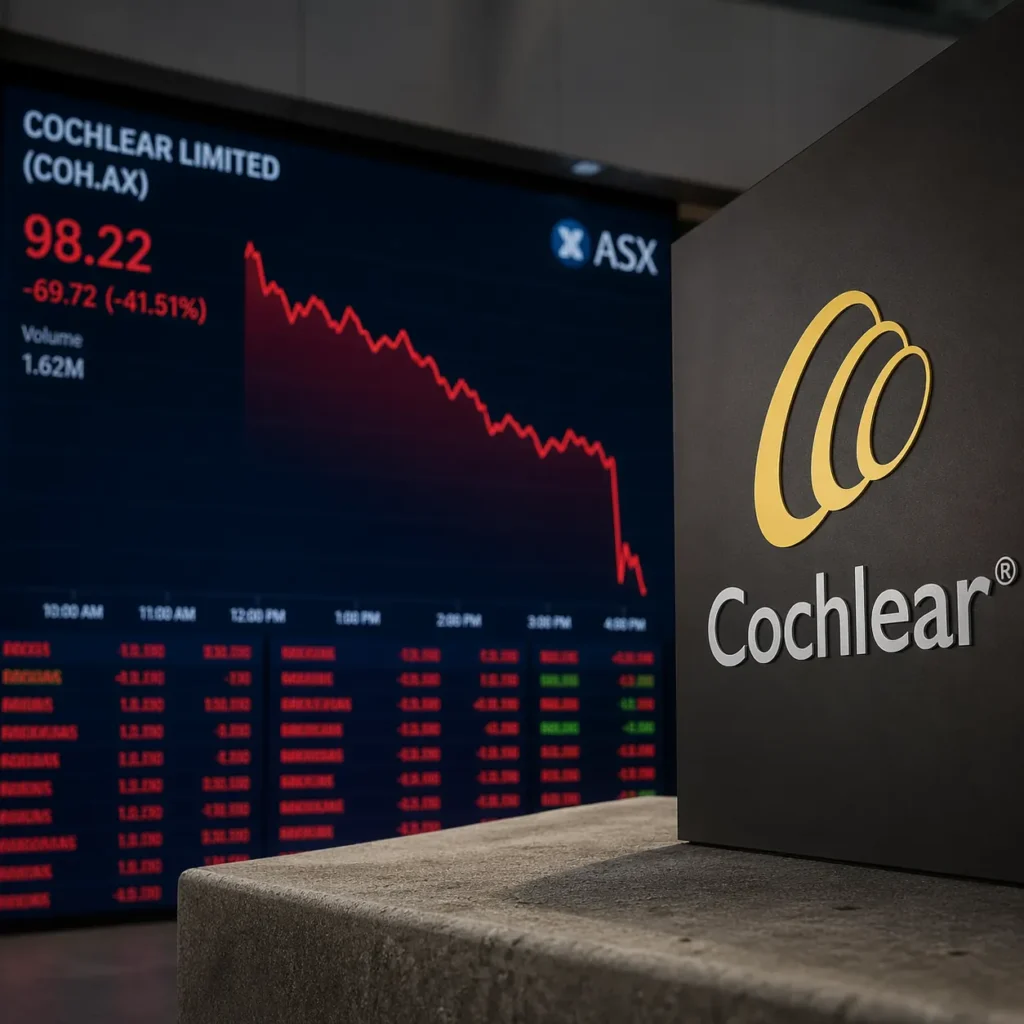

Cochlear Ltd (ASX: COH) stunned the Australian share market on April 22 after investors dumped the stock following a sharp downgrade to its profit outlook, sending the hearing implant maker into its steepest one-day fall since listing in 1995. For a company that has long been treated as one of the ASX’s premium healthcare names, the scale of the sell-off was striking not just because of the percentage decline, but because it exposed how quickly market confidence can crack when growth assumptions change.
At the centre of the shock was a major reset in earnings expectations. Cochlear said it now expects full-year FY26 net profit to come in between A$290 million and A$330 million, well below its earlier guidance of A$435 million to A$460 million. That is a reduction of roughly A$130 million to A$170 million, depending on which end of the range is used. For investors, that kind of downgrade is not a minor adjustment. It signals that conditions in several of the company’s most important markets have worsened faster and more broadly than expected.
Key numbers behind the sell-off
- Company: Cochlear Ltd
- ASX ticker: COH
- Share price fall: about 40% intraday on April 22
- Old FY26 profit guidance: A$435m to A$460m
- New FY26 profit guidance: A$290m to A$330m
- Implied downgrade: about A$150m at the midpoint
- Potential receivables hit: up to A$10m
- Historic context: biggest single-day drop since the company’s IPO in 1995
What makes this story more than a routine profit warning is the mix of pressures hitting the business at the same time. Cochlear pointed to weaker demand, higher costs, unfavourable foreign exchange movements and uncertainty linked to conflict in the Middle East. On their own, any of those factors could weigh on earnings. Together, they create a far more complicated picture for a global medical device company whose performance depends not only on patient demand, but also on hospital capacity, surgery schedules, cross-border operations and stable billing conditions.
The demand issue appears to be especially important in the United States, where consumer sentiment has weakened sharply. Cochlear indicated that adults and seniors are becoming more cautious about discretionary healthcare decisions. That matters because while hearing implants can be life-changing, many procedures still depend on patients feeling financially comfortable enough to move forward. When confidence drops, treatment decisions can be delayed, and for a company reliant on consistent procedure volumes, that can hit revenue faster than many investors expect.
Europe is presenting a different kind of problem. In several developed markets, including the UK and Germany, the challenge is not only softer conditions but also a growing backlog in surgeries. That means even where demand exists, procedures are not always being performed quickly enough to support the sales pace the company had previously expected. For a business like Cochlear, slower surgery throughput can become a bottleneck that drags on near-term performance, regardless of the strength of the long-term market opportunity.
The Middle East has added another layer of risk. Cochlear flagged that the conflict involving Iran could affect fourth-quarter sales and may force the company to provision for some receivables, with a potential net profit impact of up to A$10 million. That detail may seem small compared with the broader downgrade, but it matters because it shows the pressure is not confined to demand alone. Investors are now looking at a business facing operational friction, geopolitical disruption and possible collection risk at the same time.
Currency has also played a role. An unfavourable exchange rate environment can squeeze profitability for global healthcare companies, especially when manufacturing, sales and reporting are spread across multiple markets. In better trading conditions, currency headwinds can often be absorbed. In a weaker demand setting, they become harder to offset, particularly when management is already dealing with softer implants sales and rising uncertainty across regions.
This is where the market’s reaction becomes easier to understand. Cochlear has historically attracted a premium valuation because investors viewed it as a high-quality growth company with a strong competitive position, pricing power and a durable place in medical technology. But premium stocks usually come with premium expectations. When those expectations break, the de-rating can be brutal. Wednesday’s plunge was not just a response to lower profit guidance. It was a repricing of confidence.
The company has said it will move to tighten its cost base and create more room to keep investing in growth. Strategically, that is the right signal to send. Management is trying to reassure investors that while the near-term environment is difficult, the broader growth story has not disappeared. Still, the market will want more than strategy language. It will want evidence that demand can stabilise, surgery volumes can recover and margins can hold up better than feared.
For investors, the next phase is likely to revolve around execution. Can Cochlear rebuild credibility after such a sharp downgrade? Can it navigate weak US sentiment, procedure delays in Europe and geopolitical disruption without further cuts? Those questions now matter more than the company’s long-term reputation as a healthcare leader. Once trust in the forecast weakens, every update becomes more closely scrutinised.
There is also a broader lesson here for the ASX. Healthcare stocks are often treated as safer corners of the market, especially when compared with cyclical sectors. Cochlear’s collapse is a reminder that even high-quality healthcare businesses are not immune to changing consumer behaviour, hospital bottlenecks and global instability. Defensive does not always mean protected.
That does not automatically make Cochlear a broken company. It remains a major name in implantable hearing technology with a recognised brand and an established global footprint. But after a fall of this size, the burden of proof has shifted. Investors will now look for hard signs of stabilisation rather than giving the company the benefit of the doubt.
For readers tracking market-moving healthcare stories, this sell-off is likely to remain one of the defining ASX moments of the year. You can follow more developments in our stock market news section. For official company updates and investor materials, readers can also refer to Cochlear’s Investor Centre.

Make Swikblog your go-to source on Google for reliable updates, smart insights, and daily trends.