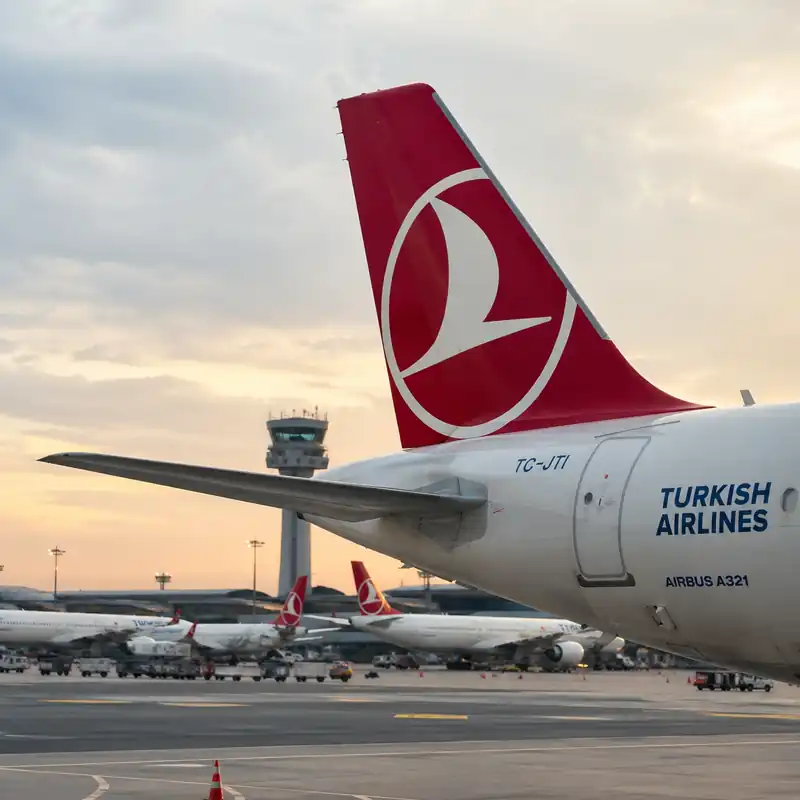

Turkish Airlines is preparing a major reshuffle of its international flying programme in 2026, with 18 overseas routes being removed from its schedule and more than 100 weekly flights cut as the carrier sharpens its focus on efficiency, stronger markets and operational reliability.
The adjustment, which begins in May 2026, affects a wide mix of destinations across Africa, Europe, the Middle East and Central Asia. While some routes are expected to be paused for the northern summer season, others may stay suspended into late 2026 or even early 2027.
For an airline known for operating one of the world’s broadest international networks, the move is not a simple retreat. It looks more like a selective reset: trimming weaker or more complex routes while protecting stronger city pairs from its Istanbul hub.
Turkish Airlines trims routes across several regions
The affected network includes several destinations in Africa, where Turkish Airlines has spent years building a deep presence. Services linked to Kinshasa, Luanda, Libreville, Lusaka and Freetown are among those being removed or restructured. Some multi-stop services are also being simplified, with onward sectors dropped while larger gateways remain in place.
One of the clearest examples is the Juba route, which is scheduled to end on May 2, 2026. Instead of continuing onward, the service will terminate in Asmara. Lusaka flights are set to end on May 10, while Freetown services are expected to stop from June 6.
The changes are not limited to Africa. Turkish Airlines is also removing or delaying services to destinations including Havana, Aqaba, Najaf, Kirkuk, Turkistan, Billund, Leipzig, Bissau, Hurghada and Ferghana. In some cases, planned summer resumptions have been cancelled before they returned to the timetable.
That makes the 2026 adjustment broader than a normal seasonal tweak. The airline is not just reducing frequency on a handful of routes; it is redrawing parts of its international map where demand, cost or operational conditions may no longer justify regular service.
The heaviest impact is expected in May and June, when the airline is reportedly withdrawing more than 140 weekly departures. Across the full schedule period, more than 100 weekly flights will be removed, creating noticeable changes for passengers who rely on Istanbul as a transfer point to secondary cities.
For travellers, the immediate effect will be fewer direct or one-stop options to some smaller markets. Passengers booked on suspended routes may need to reroute through partner airlines, nearby airports or alternative hubs, depending on the destination and travel date.
Why the airline is changing its 2026 network
The route cuts come at a time when global airlines are paying closer attention to aircraft utilization, crew availability, fuel costs and route profitability. A destination may look attractive on a route map, but if it requires complex scheduling, weak load factors or low yields, it can quickly become difficult to justify.
Turkish Airlines has built its strength around Istanbul’s position between Europe, Asia, Africa and the Middle East. That model still gives the carrier a powerful advantage, but it also requires constant fine-tuning. Not every route can perform equally across seasons, and long multi-sector flights can become inefficient when passenger demand is uneven.
Industry data from the International Air Transport Association shows airlines continue to focus on matching capacity with profitable demand, particularly as operating costs and geopolitical risks remain important factors for the sector.
Regional instability is another important part of the picture. Turkish Airlines has continued to suspend services to several Iranian cities, including Isfahan, Mashhad, Shiraz and Tabriz. Tehran flights are tentatively listed to resume from June 1, 2026, but the airline has indicated that operations remain dependent on real-time safety and airspace assessments.
When airspace conditions are uncertain, airlines often need to protect flexibility. Cancellations, diversions and longer flight paths can raise costs and create knock-on disruption across the wider network. By taking a cautious approach, Turkish Airlines is trying to avoid building a summer schedule around routes that may be vulnerable to sudden changes.
The airline’s decision to cut some destinations while keeping larger gateways also suggests a more disciplined growth strategy. Instead of flying everywhere at the same intensity, Turkish Airlines appears to be concentrating aircraft and crew on routes where demand is deeper and more predictable.
That does not mean the carrier is stepping back from expansion altogether. In fact, while it reduces parts of its passenger network, Turkish Airlines is investing in its future pilot pipeline through its flight academy in Aydin, Turkey.
The Turkish Airlines Flight Academy has signed an agreement with Textron Aviation for 10 additional Cessna Skyhawk aircraft. The academy already operates 66 Skyhawks and has added 51 aircraft over the past five years, showing that training capacity remains a long-term priority for the group.
The new aircraft are expected to support rising pilot demand across Europe and the wider aviation market. For Turkish Airlines, strengthening in-house training capacity can reduce dependence on external pilot supply and help prepare for future fleet and network growth once market conditions are more favourable.
This contrast is important. On one side, Turkish Airlines is cutting 18 international routes to improve near-term efficiency. On the other, it is expanding training infrastructure to support long-term growth. That combination points to a carrier trying to become leaner without giving up its larger ambitions.
For the aviation market, the Turkish Airlines move is a reminder that growth is no longer measured only by the number of destinations served. Airlines are increasingly judged by how effectively they use aircraft, protect margins and respond to uncertain conditions.
For passengers, the most practical step is to check bookings carefully if travelling from May 2026 onward, particularly on routes involving Africa, Iran, Iraq, Jordan or smaller European cities. Schedule changes may continue as the airline reviews regional conditions and demand trends.
Turkish Airlines still remains one of the most connected global carriers, but its 2026 route cuts show that even the largest network airlines are willing to trim capacity when the economics or operating environment change. The latest reductions are best understood as a network clean-up rather than a loss of ambition — a move designed to protect efficiency today while preparing for future growth tomorrow.
For more aviation updates and route news, visit Swikblog.
You may like: Alaska Air Stock Slides as Fuel Shock Sparks Losses and Guidance Cut

Make Swikblog your go-to source on Google for reliable updates, smart insights, and daily trends.