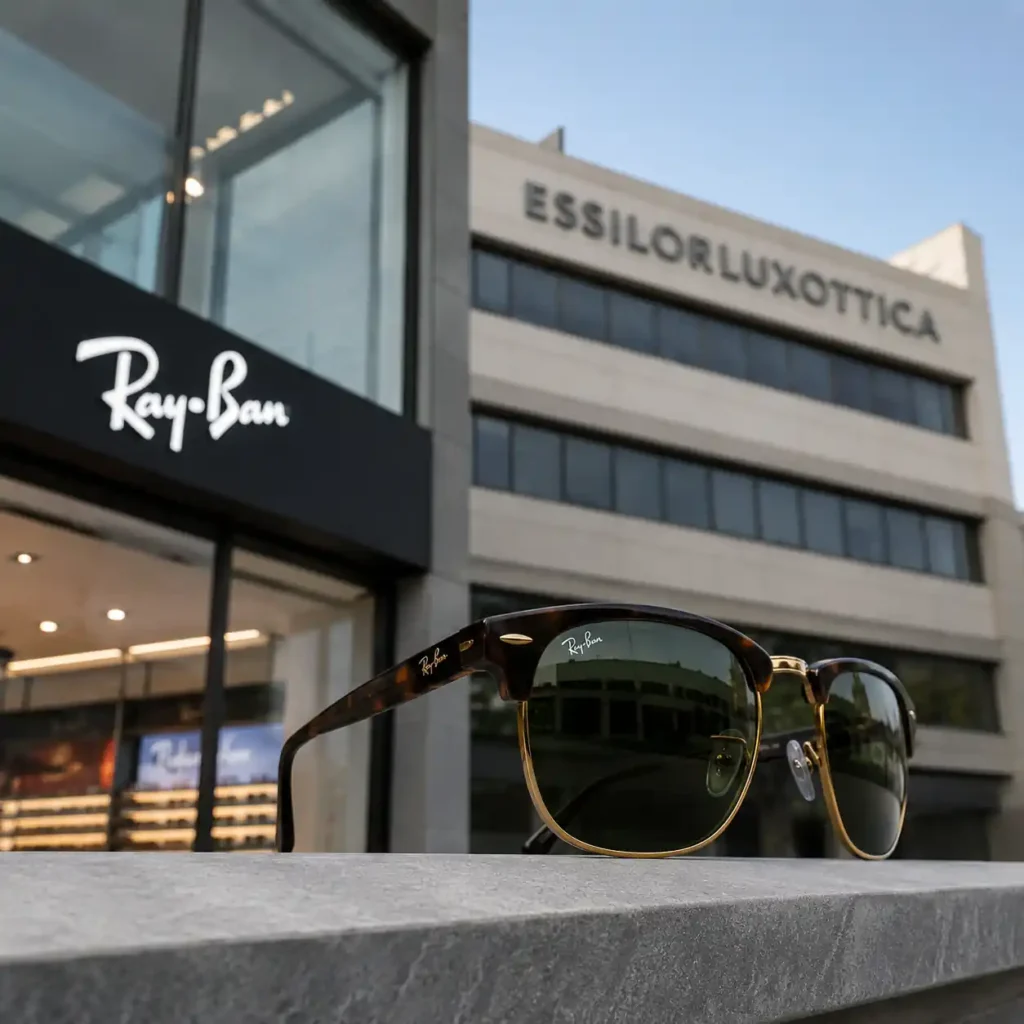

A legal dispute inside the family behind Ray-Ban has placed a major European business empire under fresh scrutiny, as Rocco Basilico challenges the approval of a roughly €10 billion Delfin stake transfer that could shift influence over EssilorLuxottica’s largest shareholder.
The case, filed in Luxembourg, centers on Delfin Sarl, the holding company created by late Italian billionaire Leonardo Del Vecchio to manage his family’s investments. Delfin is not an ordinary family vehicle. It is the biggest shareholder in EssilorLuxottica, the eyewear powerhouse behind Ray-Ban, Oakley, Persol, Sunglass Hut and LensCrafters. It also holds stakes in key Italian financial names including Assicurazioni Generali and Banca Monte dei Paschi di Siena.
At the heart of the dispute is a planned sale of two 12.5% stakes in Delfin. Luca Del Vecchio and Paola Del Vecchio agreed to sell their holdings to Leonardo Maria Del Vecchio, one of the founder’s six children. If the transaction goes through, Leonardo Maria’s stake would rise to 37.5%, making him the largest shareholder in Delfin and giving him a much stronger position inside the family-controlled investment group.
Basilico, the son of Leonardo Del Vecchio’s widow Nicoletta Zampillo, is challenging how the deal was approved. He argues that Delfin shareholders used the wrong voting threshold at an April 27 meeting. According to the dispute, the approval was passed using a 75% threshold, while Basilico claims Delfin’s statutes required more than 88% support for transfers involving third parties.
That difference matters. Basilico owns 12.5% of Delfin’s voting rights and capital. If the higher threshold was required, his opposition could have been enough to block the transaction. He is asking the Luxembourg court to declare the April 27 decisions invalid.
The legal challenge also questions a separate dividend decision approved at the same meeting. The measure would reportedly require Delfin to distribute at least 80% of annual net profit for 2025, 2026 and 2027 after Leonardo Maria completes the purchase. Basilico argues that the dividend proposal was not part of the original agenda. The payout policy is significant because larger dividends could help Leonardo Maria fund the buyout of his siblings’ stakes.
Delfin has rejected Basilico’s claims, saying the legal challenge is unfounded and will not affect the stake transfer. Still, the filing adds another layer of uncertainty to a family succession process that has remained closely watched since Leonardo Del Vecchio’s death in 2022.
The dispute is bigger than a private family disagreement because Delfin’s ownership position gives it major influence over EssilorLuxottica. Any change in Delfin’s internal power structure can raise questions about the long-term governance of the eyewear group, especially at a time when EssilorLuxottica is expanding beyond traditional glasses into smart eyewear and AI-enabled devices.
EssilorLuxottica’s partnership with Meta Platforms has become one of the company’s most important growth stories. Ray-Ban Meta smart glasses have pushed the group deeper into wearable technology, combining classic eyewear design with cameras, audio features and artificial intelligence tools. That shift has made governance stability even more important for investors, as the company competes in a market where consumer technology, fashion and AI are increasingly overlapping.
Basilico himself has direct links to that technology push. He previously served as chief wearables officer at EssilorLuxottica and was involved in the company’s smart glasses strategy with Meta. He also served as president of Oliver Peoples before leaving the company in January. His background makes the dispute more notable because it connects family ownership, corporate governance and one of EssilorLuxottica’s most closely watched growth areas.
Read More
There is also a separate ownership dispute involving Basilico’s 12.5% stake in Delfin. Leonardo Maria has challenged Basilico’s right to full ownership of the stake transferred from Nicoletta Zampillo, with the disagreement tied to how Leonardo Del Vecchio’s succession plan should be interpreted. That parallel conflict shows how complicated the post-founder transition has become.
For EssilorLuxottica, the operational business remains strong. The company controls some of the most valuable names in global eyewear and has a retail network that gives it direct access to consumers across major markets. But investors often react sharply when governance questions emerge around a controlling shareholder, particularly when the business is entering a new phase of technology-led growth.
Shares of EssilorLuxottica moved lower after the legal challenge became public, reflecting concerns that the Delfin dispute could delay the planned ownership shift or prolong uncertainty around the Del Vecchio family’s control structure. The transaction is expected to close by June 27, the fourth anniversary of Leonardo Del Vecchio’s death, though the court challenge could affect that timeline if Basilico succeeds.
The case now places attention on the Luxembourg court and whether it agrees with Basilico’s argument over voting thresholds and shareholder procedure. A ruling in his favor could slow or disrupt Leonardo Maria’s plan to consolidate influence. A rejection of the claim would clear the way for one of the most important ownership changes inside Delfin since the founder’s death.
For readers following global business, luxury stocks and technology-linked consumer brands, the Ray-Ban family dispute is a reminder that succession battles can matter far beyond private wealth. When a family holding company controls a major listed business, internal disagreements can quickly become market-moving events.
More coverage on global companies, markets and business leadership can be found on Swikblog.

Make Swikblog your go-to source on Google for reliable updates, smart insights, and daily trends.