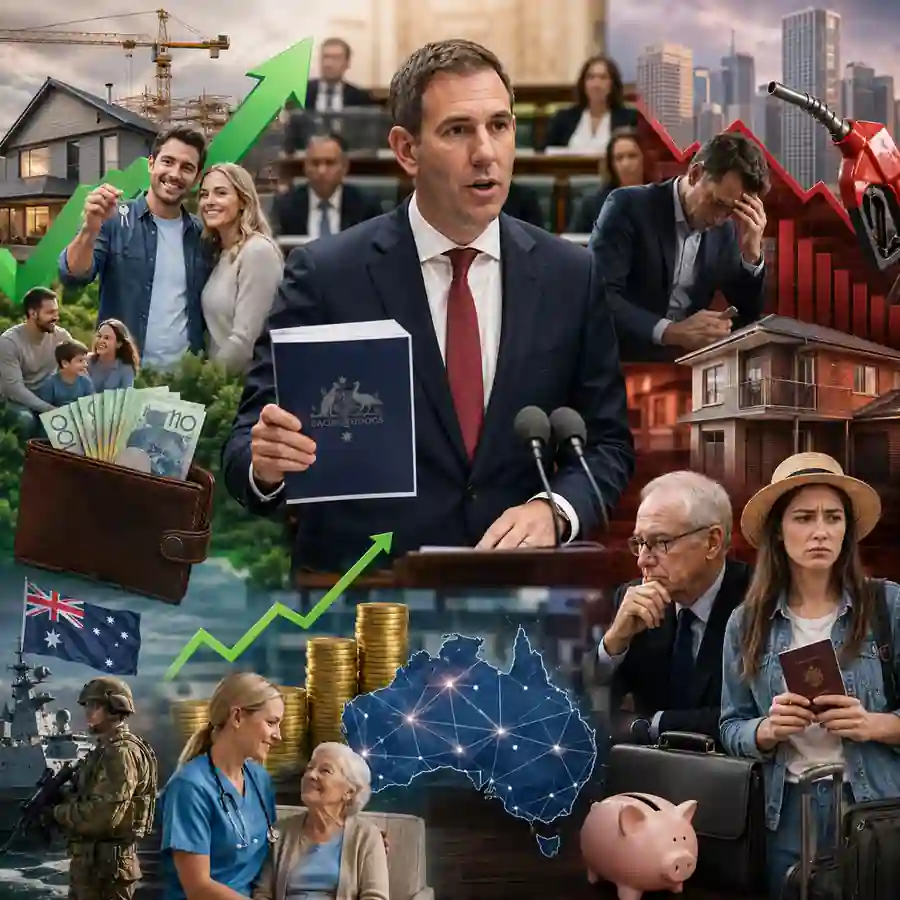

Australia’s Federal Budget 2026 has delivered one of the clearest political and economic dividing lines in recent years, handing support to workers and home buyers while increasing pressure on investors, landlords and wealth structures already facing tighter conditions.
Key Points
- Workers gain from tax relief aimed at easing cost-of-living pressure.
- Home buyers receive support through housing affordability and supply measures.
- Investors and landlords face pressure from tougher tax settings and reduced property advantages.
- Motorists remain exposed to higher petrol prices as global fuel uncertainty continues.
- Defence, health and aged care receive stronger funding under Budget 2026.
- Family trusts and wealth structures come under closer scrutiny as the government targets tax fairness.
Treasurer Jim Chalmers has framed the package as a reform budget aimed at younger Australians, workers and first-home buyers, but the measures also bring fresh pressure for investors, family trusts and motorists already dealing with higher costs.
The budget comes at a time when households are already dealing with higher living costs, expensive fuel and uncertainty in the global economy. The conflict in Iran and the wider global fuel crisis have added another layer of pressure, making petrol prices and inflation a major concern for Australian families.
For the government, the challenge is simple but difficult: deliver cost-of-living relief without weakening the national budget position further. That is why Australia Budget 2026 combines tax support for workers with tougher rules targeting investment advantages and some wealth structures.
The official Federal Budget documents are available through the Australian government’s budget website. You can read the full budget papers here.
Workers, home buyers and essential services move to the front of Budget 2026
Income earners are among the biggest winners from Australia Budget 2026. The government is putting more money back into workers’ pockets through tax relief measures designed to help households manage rising grocery, rent and utility bills.
This remains politically important because cost-of-living relief continues to dominate voter concerns across Australia. Even if the tax measures do not fully offset inflation, the government is positioning itself as prioritising workers and middle-income households during a difficult economic period.
Home buyers also receive major support in Federal Budget 2026. Housing affordability remains one of the country’s biggest social and economic challenges, especially for younger Australians trying to enter the property market for the first time.
The budget includes measures aimed at increasing housing supply, supporting first-home buyers and reducing pressure in a market where prices and rents remain elevated across major cities.
But the housing package also creates clear losers. Landlords and property investors are expected to face tougher conditions as the government moves to reduce some tax advantages linked to investment property and capital gains. While many first-home buyers may welcome the shift, investors argue that higher costs could eventually place additional pressure on rental supply.
Investors more broadly are also facing increased scrutiny. Changes linked to capital gains tax treatment and investment structures signal that the government wants wealthier Australians and asset owners to contribute more under the new framework.
Family trusts are also under closer attention as part of the government’s push to create what it describes as a fairer and more sustainable tax system.
Defence stands out as another major winner. With geopolitical tensions rising globally, Australia is increasing spending on military capability, defence infrastructure and national security programs. The government is presenting the investment as essential long-term protection rather than short-term political spending.
Health and aged care also receive substantial funding support. Hospitals, emergency care systems, aged care providers and frontline services are expected to benefit from additional investment as Canberra attempts to strengthen essential services under growing demand.
However, many older Australians may still feel the pressure of rising everyday costs. Pensioners and retirees continue to face higher prices for food, energy and healthcare, leaving some households questioning whether the support measures go far enough.
Financial markets and policy analysts are closely watching whether Australia Budget 2026 can slow inflation without damaging consumer spending and housing confidence. Investors are also assessing how changes to tax settings and investment structures could affect long-term returns across property and equity markets.
📚 Read More From Swikblog
Investors, motorists and travellers face a tougher outlook
The broader economic outlook remains one of the weaker areas of Budget 2026. Growth expectations continue to face pressure from global uncertainty, inflation risks and ongoing fuel market disruption linked to international tensions.
That means Australia Budget 2026 may provide targeted relief, but it cannot fully remove the financial strain many households continue to experience.
Motorists remain under pressure despite the government’s focus on fuel supply and energy security. Petrol prices are still expected to stay elevated, meaning many Australian drivers may not feel immediate relief at the pump.
Electric vehicle owners are in a stronger position. EV support and cleaner transport initiatives continue to form part of the government’s longer-term economic and environmental strategy, making EV drivers one of the smaller but notable winners in the package.
Gas companies also benefit from the budget’s focus on energy security and domestic supply stability. The government appears willing to back gas production as a practical response to continuing global energy instability.
Green hydrogen, however, has lost momentum in this year’s budget. The sector received less attention and support than many clean-energy investors and industry advocates had hoped for.
The National Disability Insurance Scheme remains another sensitive issue. The government is attempting to control rising NDIS costs and reduce waste within the system as part of broader budget repair efforts.
Any changes affecting disability support are likely to face strong public scrutiny from participants, carers and advocacy groups over the coming months.
Travellers are also expected to feel the impact of Budget 2026, with passport and travel-related costs projected to rise further. Australians planning overseas trips are already facing expensive airfares, accommodation and insurance costs, adding to broader household pressure.
Tobacco revenue is listed among the weaker areas for government finances as declining smoking rates and illegal tobacco activity continue to affect tax collections.
Fraudsters and financial scams are another target within the package, with stronger compliance and enforcement measures aimed at protecting public funds and improving tax collection efficiency.
Businesses receive a more positive outcome overall. Federal Budget 2026 includes support measures designed to improve productivity, encourage investment and strengthen economic activity.
Small businesses are also expected to benefit from targeted relief and investment incentives, while high-skill migrants remain a priority as Australia attempts to fill labour shortages in key industries.
Victoria stands out as one of the major state-level winners due to infrastructure and spending commitments included in the package.
The PNG Chiefs NRL project also receives support, reflecting Australia’s growing focus on sport diplomacy and regional relationships across the Pacific.
In contrast, Inland Rail appears to have lost priority under the latest funding plans, raising fresh uncertainty about the long-term timeline of the major infrastructure project.
The overall budget balance remains relatively stable, signalling that the government is attempting to fund new spending priorities without significantly worsening the fiscal position.
Ultimately, Australia Budget 2026 is more than a spending plan. It represents a political statement about who the government believes should receive support first and who should contribute more during a difficult economic period.
Workers, home buyers, defence, health services, aged care, businesses and EV drivers emerge in stronger positions. Investors, landlords, family trusts, travellers, motorists and parts of the clean-energy sector face a more difficult path ahead.
The real judgement on Federal Budget 2026 will come over the next year. If wages improve, inflation eases and housing pressure begins to stabilise, the package may be viewed as a successful economic reset. But if petrol prices, rent and grocery costs continue climbing, many Australians may remember the budget less for its support measures and more for the financial pressure that remained after it was delivered.

Make Swikblog your go-to source on Google for reliable updates, smart insights, and daily trends.