
China’s newest rail landmark is not just another station added to the country’s vast transport map. Chongqing East Railway Station has opened as a mega-sized high-speed rail hub built on a scale that shows how aggressively China is still expanding its railway network.
The station covers around 1.22 million square metres, making it larger than 170 standard football fields. It has also been compared with an area more than twice the size of Vatican City, giving travellers a clearer sense of just how massive the project is.
Located in Chongqing, one of western China’s most important inland cities, the station began full operations on June 27, 2025. Its opening marked the end of a long development process that started with early planning in 2011, followed by construction beginning in 2018 and major works being completed in spring 2024.
Unlike many older railway terminals that grew gradually over decades, Chongqing East has been planned as a complete modern transport complex from the start. It is designed to combine high-speed rail, urban metro access, passenger services and commercial functions under one enormous roof.
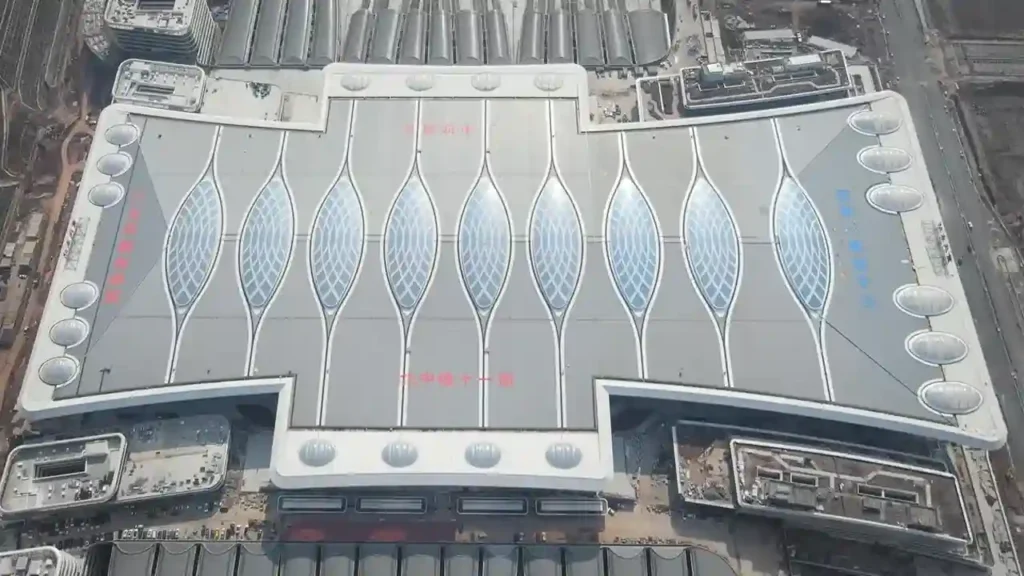
According to Xinhua, the station has 15 platforms and 29 tracks, with a total construction area of 1.22 million square metres. The building spans eight floors, while its huge roof alone covers around 120,000 square metres and weighs about 16,500 tonnes.
The station is expected to handle up to 300,000 passengers a day, placing it among the most important high-speed rail gateways in China’s western region. During peak travel periods, that capacity could help ease pressure on other transport hubs while giving Chongqing stronger links to major economic centres across the country.
The numbers behind the build are equally striking. Around 2 million cubic metres of concrete and 366,000 tonnes of steel were used in the project, reflecting the huge engineering effort required to create a rail hub of this size in Chongqing’s challenging landscape.
Chongqing is famous for its mountains, bridges, steep roads and dense urban layout. Building a giant railway station on the outskirts of a city with more than 10 million people required far more than simply laying platforms and tracks. Engineers had to account for terrain, passenger movement, metro integration, road access and long-term urban development around the site.
The design of Chongqing East Railway Station also marks a shift away from the traditional image of a train station. Instead of a compact terminal built only for boarding and departures, the station looks and operates more like an airport-style transport hub. Large halls, wide transfer corridors and direct metro links are intended to make the experience smoother for passengers moving between local and long-distance services.
That airport-style design is important because the station is built mainly around high-speed rail services. By focusing on fast intercity trains, officials expect the hub to operate more efficiently, even though some older railway stations may have more platforms or serve a broader mix of train types.
From Chongqing East, high-speed journeys to several major Chinese cities are expected to become more convenient. Travel to Beijing and Shanghai takes around six hours, while Wuhan can be reached in about three hours. Shorter regional routes, including Wanzhou and Qianjiang, are expected to take roughly one hour.
These travel times show why China continues to treat high-speed rail as a serious alternative to short-haul flights. For many domestic trips, rail can offer city-centre connectivity, fewer airport-style delays and easier transfers to local transport. A station like Chongqing East is designed to make that system work at a much larger scale.
The project also reflects China’s broader strategy of using transport infrastructure to support regional growth. Chongqing is a major inland manufacturing, logistics and commercial centre. A larger high-speed rail gateway could strengthen its role as a connection point between western China and the country’s coastal economic regions.
Read More
Chongqing East is not only about passenger movement. It has also been developed as a business and commercial centre, which means shops, services and future surrounding development are likely to become part of the station’s wider economic role. This is increasingly common in modern rail planning, where major stations are treated as urban districts rather than standalone buildings.
The construction process also showed how China is bringing automation into large infrastructure projects. State media reports said robotic and intelligent systems were used for tasks including welding, glass installation and floor-levelling work. These tools helped workers manage difficult building conditions, including Chongqing’s hot summer climate and the safety risks linked to such a large roof structure.
For passengers, the most visible benefit will be convenience. Direct metro connections mean travellers can move from high-speed rail services into the wider Chongqing transport network without relying only on taxis or private cars. That kind of integration is central to making a mega-station practical rather than overwhelming.
The station’s opening also comes at a time when many countries are debating how to modernise transport without expanding airport dependency. China’s answer has been to keep building high-speed rail corridors and large interchange stations capable of absorbing huge passenger demand.
Chongqing East Railway Station is therefore more than a record-breaking structure. Its size makes headlines, but its real importance lies in how it connects rail, metro, business activity and urban planning in one place. Bigger than 170 football fields, the station gives China a new symbol of scale, speed and long-term transport ambition.
For readers following global transport and travel developments, Swikblog also covers major mobility stories such as the London Tube strike disruption, where city transport systems and passenger movement remain central to the story.

Make Swikblog your go-to source on Google for reliable updates, smart insights, and daily trends.