
Belfast is pushing ahead with one of its most visible climate and community projects after confirming that 293,516 trees have been planted across the city under its One Million Trees initiative.
The programme, launched in December 2020, is designed to change how Belfast looks, feels and responds to environmental pressure over the next decade. Alongside the tree planting total, the council has also delivered 4,232 linear metres of hedging, adding new habitat corridors for birds, insects and small wildlife across public spaces.
The long-term target remains ambitious: one million native trees by 2035 and 30 percent tree canopy cover by 2050. For a growing urban centre, that target is not just about making streets and parks more attractive. It is about cooling neighbourhoods, improving air quality, protecting biodiversity and giving residents better access to nature close to home.
The latest update was discussed at Belfast City Hall on May 15, 2026, where council officers outlined how planting work has expanded from major tree schemes into smaller community-led projects, including new orchards in neighbourhoods with limited canopy cover.
That local focus matters because Belfast’s tree cover is not evenly spread. Ardoyne currently has only 4.6 percent canopy cover, while Bellevue has the city’s highest level at 43.9 percent. The difference shows why the council is now prioritising areas where residents have historically had less access to tree-lined streets, shaded spaces and green infrastructure.
A new community orchard programme has become a key part of that strategy. Approved through a council motion in November 2025, the project aims to create an “edible landscape” by working with schools, residents and local organisations to plant fruit trees in shared spaces.
Several of the first orchard schemes have already taken root. At Shaw’s Bridge, Malone Tornadoes, Ulster’s first mixed-ability rugby team, helped plant 14 apple, pear and plum trees in a previously underused area. The club also supported wider improvements around the site, including clean-up work and fencing upgrades.
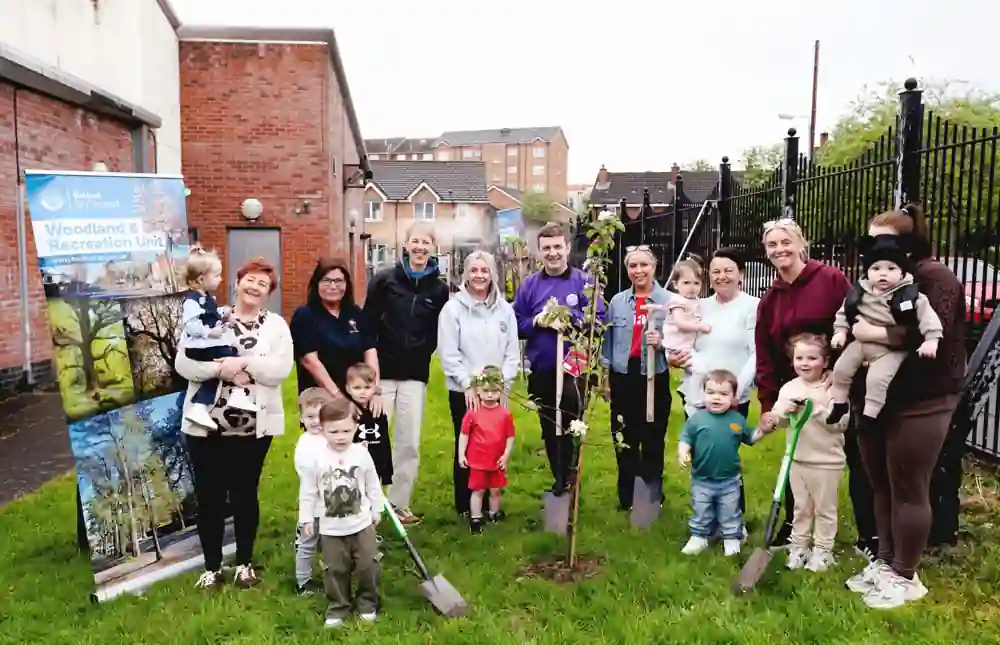
In Ardoyne, the Flax older people’s group worked with council woodland officers to plant fruit trees at Ardoyne Community Centre. The project is expected to benefit residents of different ages and will later be supported by orchard management training and healthy food workshops once the trees begin to produce fruit.
Holy Cross Nursery School has also joined the effort, with pupils helping plant fruit trees as well as around 150 native trees to form a hedge. The new planting will create habitat for wildlife while also providing natural screening from a nearby car park.
Additional orchard work has been completed in east Belfast in partnership with L’arche, extending the project beyond south and north Belfast and showing how smaller planting schemes can be adapted for different communities.
The One Million Trees initiative is supported by partners including the National Trust, Woodland Trust and Belfast Hills Partnership. The involvement of established conservation organisations gives the programme added expertise at a time when tree survival, species selection and long-term maintenance are just as important as planting numbers.
Urban trees play a major role in helping cities adapt to climate change. The Woodland Trust says trees in towns and cities can help reduce flooding, clean polluted air, provide shade, support wildlife and improve people’s wellbeing.
Read More
- Visit Swikblog Homepage
- Ebola Outbreak in Congo: 65 Deaths, 246 Suspected Cases
- Smoking Monkey Pizza Files Chapter 11 Bankruptcy After Store Closure
- Texas Roadhouse New Texas Locations 2026: Full List of Cities
- Toronto FIFA Fan Festival Tickets: World Cup 2026 Free Pass Release
- Belfast March for Jesus: No Israeli or UK Flags
That wider public health benefit is central to Belfast’s approach. Fred Cobain, Chair of the council’s People and Communities Committee, said the projects are helping create a greener, healthier and more connected city while giving residents places to enjoy nature on their doorstep.
The council is also encouraging people to explore existing green spaces through free guided walks in south Belfast parks, including Lagan Lands East, Lower Crescent Parks and Lagan Meadows. These walks are intended to connect residents with local biodiversity and highlight the value of protecting urban nature.
The next major phase of orchard expansion is expected during the annual planting season from November to March. That timing is important because trees planted during cooler, wetter months usually have a better chance of establishing strong roots before warmer weather arrives.
For Belfast, the real test will be long-term care. Many cities have launched tree-planting campaigns, but the most successful programmes are those that protect young trees through watering, maintenance, community stewardship and careful planning. A million-tree target only becomes meaningful if those trees survive and mature.
Still, Belfast’s progress so far suggests the initiative is moving beyond symbolic climate action. By combining native tree planting, hedging, orchards, school projects, sports clubs and older people’s groups, the city is building a model that links environmental recovery with community life.
The project also gives Belfast a stronger identity in the wider movement toward greener cities. As climate pressures grow, local councils are increasingly expected to deliver practical changes that residents can see and feel. In Belfast, that change is already visible in parks, schools, community centres and once-overlooked public spaces.
Readers following climate and nature stories can also read Swikblog’s coverage of Japan’s historic cherry blossom climate record, which looks at how environmental change is affecting natural cycles around the world.
With nearly 300,000 trees already planted, thousands of metres of hedging completed and new orchards beginning to grow, Belfast’s One Million Trees initiative is becoming more than a council target. It is slowly reshaping the city’s relationship with nature, neighbourhood by neighbourhood.

Make Swikblog your go-to source on Google for reliable updates, smart insights, and daily trends.