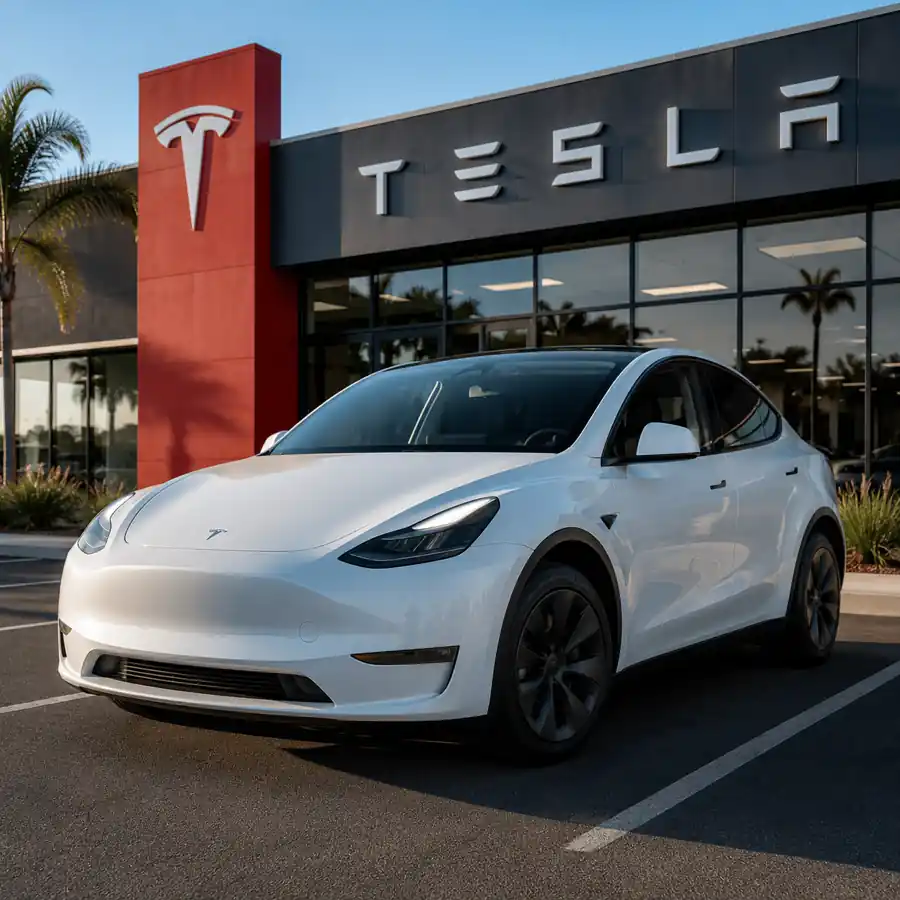

Tesla has made the Model Y more expensive for some buyers in the United States, raising prices on premium versions of its best-selling electric SUV for the first time in nearly two years. The move is small in dollar terms, but important for Tesla, its customers and investors watching whether the company is regaining pricing power after a long period of EV discounts.
The price changes appeared on Tesla’s US website on May 16. The company increased the Model Y Premium Rear-Wheel Drive by $1,000, taking its starting price to $45,990. The Model Y Premium All-Wheel Drive also rose by $1,000 and now starts at $49,990. The more expensive Model Y Performance All-Wheel Drive received a smaller $500 increase, lifting its starting price to $57,990.
Tesla did not raise prices across the entire lineup. The entry-level Model Y Rear-Wheel Drive remains at $39,990, while the base Model Y All-Wheel Drive continues to start at $41,990. That makes this a targeted increase rather than a full lineup reset.
The update was first reported by Reuters after the new prices appeared on Tesla’s website. According to Reuters, Tesla did not give a reason for the change.
Tesla protects the cheaper Model Y while lifting premium trims
The most interesting part of Tesla’s latest move is not only that prices increased, but where they increased. By keeping the two lower-priced Model Y versions unchanged, Tesla appears to be protecting the SUV’s mass-market appeal while pushing more revenue from customers choosing higher-end versions.
That strategy gives Tesla two advantages. First, the company can still advertise a sub-$40,000 starting price for the Model Y in the US. Second, it can improve pricing on trims that likely carry better margins because buyers are already paying more for stronger performance, upgraded features or longer-range configurations.
For buyers, the difference is clear. Someone shopping for the lowest-cost Model Y will not see an immediate price change. But customers looking at the Premium Rear-Wheel Drive, Premium All-Wheel Drive or Performance All-Wheel Drive will now pay more before taxes, fees, financing costs or optional upgrades are added.
This matters because EV buyers are already sensitive to monthly payments. Even a $500 or $1,000 increase can affect affordability when interest rates, insurance and charging equipment costs are included. Tesla’s decision to avoid raising prices on the cheapest trims suggests the company understands that pressure.
The Model Y remains one of Tesla’s most important vehicles globally. It is the product that helped Tesla move from a luxury EV maker into a broader consumer car brand. Because of that, even a modest price adjustment can become a signal for the wider electric vehicle market.
Why this price hike stands out after years of EV discounts
Tesla spent much of the past two years using price cuts and incentives to defend demand. Those reductions helped make Tesla vehicles more accessible, but they also raised concerns about shrinking margins. Investors have repeatedly questioned whether Tesla could keep selling more cars without sacrificing profitability.
The latest Model Y price increase changes the tone. Instead of cutting prices to pull in buyers, Tesla is raising prices on trims where it may see stronger demand or better margin opportunity. That does not mean the EV market is suddenly booming again, but it does suggest Tesla may be more confident about its premium Model Y order book.
The move also comes after another major Tesla pricing decision in 2025. In August last year, the company raised the price of its most expensive Cybertruck model by $15,000 in the United States despite softer-than-expected sales and recalls. That earlier move showed Tesla was willing to defend pricing on premium products even when broader demand looked uneven.
Now, the Model Y increase extends that approach to Tesla’s most important mainstream SUV. The difference is that Model Y carries far more weight than Cybertruck because it is central to Tesla’s delivery volume, brand reach and EV market share.
There may be several reasons behind the latest pricing move. Tesla could be responding to stronger demand for premium trims. It may also be trying to offset cost pressure, improve average selling prices or rebalance the lineup after earlier discounts. Since Tesla has not publicly explained the decision, the safest reading is that this is a selective margin move rather than a broad statement that EV demand has fully recovered.
For Tesla shareholders, the key issue is whether buyers accept the higher prices. If premium Model Y demand stays stable, the increase could support margins and improve confidence around Tesla’s core auto business. If demand slows, Tesla may have to return to incentives or future price adjustments.
Tesla’s stock often reacts to signals around deliveries, margins and pricing because the company’s valuation depends on more than vehicle sales alone. Investors also price in expectations for autonomous driving, robotics, battery technology and energy products. Still, the auto business remains the foundation of Tesla’s revenue, making every Model Y pricing move important.
Swikblog recently covered how Tesla investors are already debating the company’s valuation, including the balance between its EV business and future AI-driven growth. You can read that analysis here: Tesla at $360 Today: $588 Upside or $152 Crash as AI Bet Divides Wall Street.
Read More
- Visit Swikblog Homepage
- Puffins Found Dead After Deadly Storms as Breeding Season Begins
- Belfast Plants 293,516 Trees Under 1 Million Trees Initiative
- Hackney Half Marathon 2026 Road Closures: East London Streets Shut
- Kingston Power Outage Leaves 13,432 Customers Affected
- NTSB Wimberley Plane Crash Report: 5 Killed
For the broader EV market, Tesla’s price increase may also influence rivals. When Tesla cuts prices, competitors often feel pressure to respond. When Tesla raises prices, it can give other EV makers more breathing room, especially if they are trying to improve profitability rather than chase volume at any cost.
Still, competition remains intense. Traditional automakers continue to push new electric SUVs, while global EV players are forcing the industry to stay aggressive on price, range and features. That means Tesla cannot raise prices too aggressively without risking its value advantage.
The latest Model Y update is therefore best seen as a careful test. Tesla is not making every Model Y more expensive. It is raising prices only where it believes customers may be less price-sensitive. That is a more disciplined approach than a broad hike and a more confident signal than another discount.
For now, the key numbers are simple: Premium Rear-Wheel Drive is now $45,990, Premium All-Wheel Drive is $49,990, and Performance All-Wheel Drive is $57,990. The base Rear-Wheel Drive remains $39,990, and the base All-Wheel Drive remains $41,990.
If demand holds, Tesla’s first Model Y price increase in two years could become an early sign that the company is moving away from the deepest phase of the EV price war. If buyers push back, it may prove to be only another short-term pricing experiment from a company known for changing prices quickly.

Make Swikblog your go-to source on Google for reliable updates, smart insights, and daily trends.