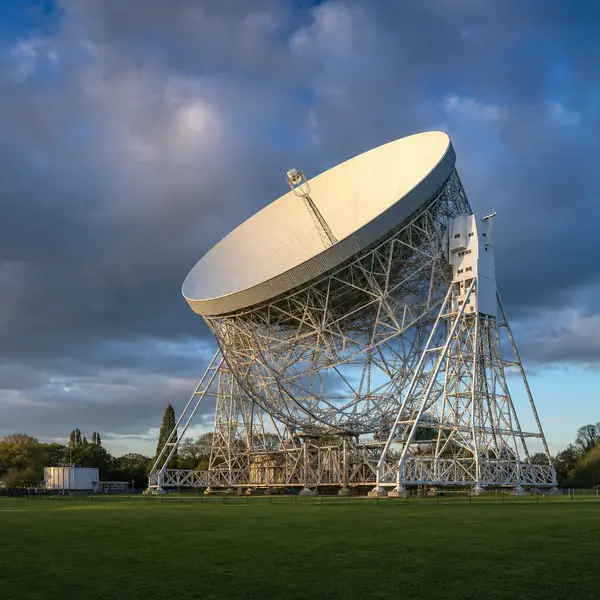

Jodrell Bank Observatory could lose its scientific operations after UK Research and Innovation decided to withdraw future funding from the e-MERLIN radio telescope network. Its current agreement ends in March 2028, meaning observations may stop on 1 April 2028 unless alternative financial support is secured.
The loss of the reported £2.8 million annual budget places 28 jobs at risk and could affect nearly 3,000 researchers who use the facility. However, neither the permanent closure of the observatory nor the shutdown of its public visitor attraction has been confirmed.
Why is Jodrell Bank losing its funding?
The Science and Technology Facilities Council, part of UKRI, reviewed its particle physics, astronomy and nuclear physics portfolio after forecasting higher operating costs. Pressures include energy prices, staffing expenses, exchange-rate movements and a growing range of scientific commitments.
STFC’s core budget is expected to remain flat between 2026 and 2030 while costs rise. The science budget covering these disciplines will decrease by 2.7% over four years as the organisation attempts to reach a sustainable financial position by 2029-30.
The official UKRI funding announcement confirms that live projects can continue until their existing agreements expire. For e-MERLIN, the present support remains in place through March 2028.
What is e-MERLIN and why does it matter?
e-MERLIN combines seven radio telescopes across England, including the Lovell and Mark II telescopes at Jodrell Bank and dishes at Pickmere, Darnhall, Knockin, Defford and Cambridge.
Signals from these sites are combined to create an instrument with the resolving power of a telescope hundreds of kilometres wide. It can examine distant objects in exceptionally fine detail, with resolution comparable in some applications to the Hubble Space Telescope.
The network investigates star and planet formation, galaxy evolution and the influence of supermassive black holes. Its work complements discoveries involving extreme phenomena such as black hole jets moving at extraordinary speeds.
e-MERLIN also contributes to a wider European network. Removing the UK telescopes would reduce its geographic reach and could weaken the detail available in some observations of stars, galaxies and black holes.
Why is the Lovell Telescope historically important?
Established in 1945, Jodrell Bank became one of the birthplaces of modern radio astronomy. Its Grade I-listed Lovell Telescope has operated for nearly 70 years and remains the world’s third-largest fully steerable radio telescope following repeated technical upgrades.
The site tracked early space missions and monitored Soviet activity during the Cold War. Its scientific, architectural and cultural importance earned it UNESCO World Heritage status in 2019.
Jodrell Bank has trained generations of astronomers while helping the public understand space science. Interest in events such as the Lyrid meteor shower visible across the UK demonstrates the wider value of facilities that connect public curiosity with professional research.
Will the Jodrell Bank visitor attraction close?
Not necessarily. UKRI’s decision concerns future funding for e-MERLIN’s research operations. It does not confirm that the exhibitions, First Light Pavilion, gardens, cafés or other public facilities will close.
The loss of scientific activity could create wider challenges for the site, but the visitor centre’s future requires separate clarification. Describing the entire attraction as certain to shut in 2028 would therefore be premature.
Which other astronomy projects are affected?
The decision forms part of broader UK science cuts. British participation at the James Clerk Maxwell Telescope in Hawaii will end, while support is being withdrawn from two instruments planned for the Extremely Large Telescope in Chile. Funding connected with the Vera C. Rubin Observatory will also be reduced.
UKRI will continue supporting the Square Kilometre Array Observatory headquarters at Jodrell Bank. That international headquarters is separate from financing the Lovell Telescope and e-MERLIN’s observing work.
Read More
Rare 3-Planet Parade 2026: Venus, Jupiter and Mercury Align
Australia Blood Moon 2026: Rare Total Lunar Eclipse Turns Sky Red
What happens before April 2028?
Jodrell Bank’s leadership intends to challenge the decision and seek another funding model. Possible outcomes include institutional partnerships, government support or a reduced plan that keeps the Lovell Telescope operating in some form.
The present deadline leaves about 20 months to find a solution. Jodrell Bank therefore faces a serious closure risk, but the end of its scientific work is not yet inevitable.

Make Swikblog your go-to source on Google for reliable updates, smart insights, and daily trends.