
State Highway 3 through Awakino Gorge will close completely for four days in August, disrupting the main road connection between Taranaki and Waikato and placing further pressure on Mōkau businesses that rely on passing traffic.
The closure will begin at 6am on Saturday, 22 August and continue until 6pm on Tuesday, 25 August 2026. It covers the section between the rest area near the Historic Tunnel and the intersection of SH3 and Manganui Road.
RNZ’s corrected headline describes it as the eighth recent closure, although different reports have used different totals depending on which weather incidents and repair shutdowns were counted.
Why Awakino Gorge must close completely
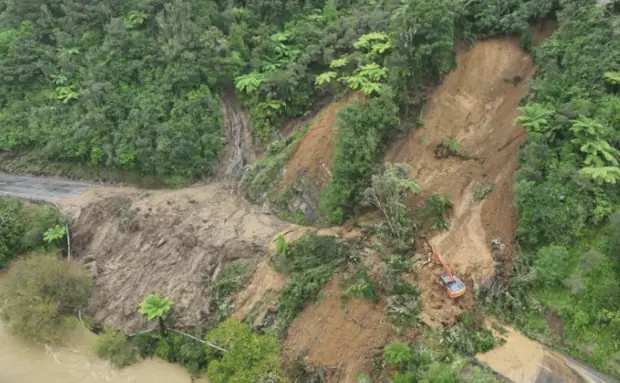
Crews will use the shutdown to install three culverts beneath the road at the large slip site created by severe weather in April. Water has been accumulating beneath the damaged slope and flowing across the highway.
The culverts will carry water away, improve drainage and support efforts to stabilise the area. Their installation is an important step towards restoring two-lane access through this section of SH3.
NZ Transport Agency Waka Kotahi incident controller Kendra Ludeke said a full closure was the last available option. The gorge is narrow, while the road beside the slip is already restricted to one lane.
Heavy machinery will occupy the remaining carriageway as crews make deep excavations and open trenches. There is not enough space for vehicles to pass safely around the equipment or through the worksite.
Closing the road should also allow the culverts to be installed faster than attempting the same operation around controlled traffic.
Detour and travel impact
NZTA’s recommended alternative is the SH1–SH4 route. There is no convenient local bypass, meaning travellers between Taranaki and Waikato will face a considerably longer journey.
Motorists should allow additional time and fuel. Freight operators may need to revise delivery schedules, while emergency services and people travelling for work, medical appointments or flights must plan ahead.
The installation is weather-dependent. If conditions prevent the work from proceeding, it is expected to be rescheduled for Saturday, 29 August, through Tuesday, 1 September.
Drivers should check the official NZTA Journey Planner shortly before departure because access and safety controls can change quickly around an active slip.
Mōkau businesses count the cost
For Mōkau businesses, another closure means losing customers who normally stop while travelling along SH3.
River Run Cafe owner Dev Rawat said previous shutdowns left the business with almost no customers and forced it to close. A recent disruption reportedly resulted in five days without normal trade.
Rawat said repeated closures made it difficult to pay staff and bills. He wants the government to consider compensation or another form of financial relief for affected local businesses.
Mōkau Butcher owner Bryan Lester accepted that the culvert work must be completed but described the commercial impact as severe. During an earlier closure, he reportedly served only five customers over an entire day.
Lester said he may shut the butcher shop during the four-day closure because remaining open with so little passing traffic may not be financially worthwhile.
Why the route remains vulnerable
New Plymouth Mayor Max Brough said closures at Awakino Gorge were becoming routine. Although the work is necessary, he highlighted the absence of an easily accessible alternative route for Taranaki.
The effect extends beyond delayed journeys. Tourism operators can receive cancellations, suppliers face longer delivery times and small businesses may lose trade before a scheduled closure even begins.
Recent flooding and road closures across Nelson Tasman similarly showed how severe weather can isolate communities and expose weaknesses in regional transport connections.
The planned NZ$1.8 billion Waikato Expressway extension also reflects the wider economic importance of safer and more reliable North Island highway links.
What happens after the closure?
The culvert installation is focused on repairing damage caused by April’s severe weather and helping return this stretch of SH3 to two lanes. However, NZTA has not announced a final date for completing the full restoration.
Infrared cameras and other sensors are being used to monitor movement around the slip. Restrictions or short-notice closures may still be required if changing conditions reach established safety thresholds.
This repair work is separate from the NZ$50 million Awakino Gorge resilience package announced in May. That longer-term programme remains in development and is intended to reduce the corridor’s exposure to future slips and weather-related disruption.
Installing the culverts should improve drainage and allow the next recovery stage to proceed, but it will not eliminate every future closure risk. Travellers and local businesses will continue watching for progress on two-lane access after the scheduled reopening on 25 August.

Make Swikblog your go-to source on Google for reliable updates, smart insights, and daily trends.