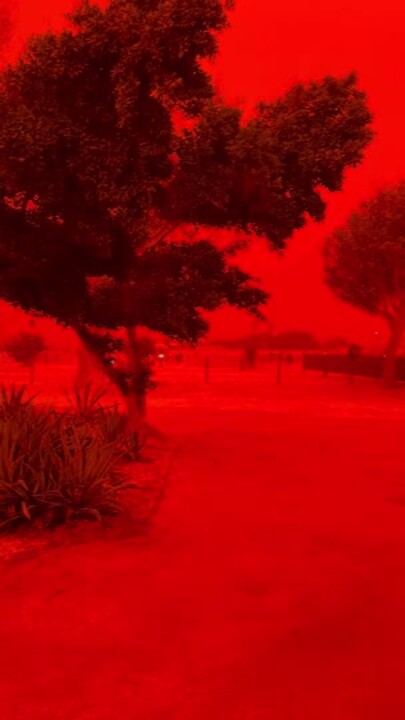

The sky over parts of Western Australia turned an intense, almost surreal crimson as Tropical Cyclone Narelle swept across the region, creating one of the most striking weather scenes seen in recent years. Residents in coastal areas like Shark Bay and Denham reported daylight fading into a deep red haze, with visibility dropping sharply as dust filled the air.
The phenomenon, widely shared across social media, quickly drew global attention. What appeared apocalyptic at first glance was, in fact, the result of a powerful combination of atmospheric physics and extreme weather conditions.
Cyclone Narelle fuels dramatic red sky event
At its peak, Cyclone Narelle reached Category 4 intensity, bringing winds of up to 250 km/h as it moved along Western Australia’s coastline. The storm’s low-pressure system acted like a massive vacuum, lifting large quantities of fine desert dust from the inland regions into the atmosphere.
This dust, rich in iron oxide, carries a natural reddish pigment. As the particles spread through the sky, they filtered sunlight in a way that allowed red and orange wavelengths to dominate, creating the striking visual effect.
According to updates from Australia’s Bureau of Meteorology, the cyclone followed an unusual path, making landfall across multiple regions and causing widespread disruption, including power outages affecting 600+ properties and significant structural damage in coastal towns.
The science behind the blood-red sky
Under normal conditions, the sky appears blue because shorter wavelengths of light scatter more easily through the atmosphere. However, when the air is filled with larger particles like dust or smoke, a different process known as Mie scattering takes over.
During the cyclone, the dense cloud of dust blocked shorter blue wavelengths, allowing longer red and orange wavelengths to pass through more prominently. The effect was amplified further by the low angle of the sun, which forced sunlight to travel through a thicker layer of atmosphere.
The result was a deep, almost suffocating red glow that turned daytime conditions into something closer to dusk, even during peak daylight hours.
Severe impacts across Western Australia
Beyond the dramatic visuals, Cyclone Narelle left a trail of destruction. In Exmouth, strong winds tore roofs from buildings and damaged emergency infrastructure, while in Carnarvon, essential services were disrupted and fuel stations suffered heavy losses.
Farmers across the Gascoyne region reported severe agricultural damage, with nearly 60% of winter crops affected by a combination of dust storms and intense rainfall. Authorities also issued warnings for flash flooding in Perth, with forecasts predicting 50–100 mm of rainfall as the system moved inland.
The storm also had ripple effects beyond Australia. Operations at major liquefied natural gas facilities, including Chevron’s Gorgon and Wheatstone plants, were temporarily halted, tightening global supply concerns.
More than a visual spectacle
While the red sky itself posed no direct danger, it served as a clear signal of the cyclone’s intensity. The same winds responsible for lifting dust into the sky also created hazardous conditions on the ground, including falling debris, reduced visibility, and structural risks.
The phenomenon also echoes a long-standing weather saying — “red sky at morning, sailor’s warning” — which reflects how certain atmospheric conditions can signal incoming storms. In this case, the crimson sky marked the peak of a powerful system already impacting the region.
As Cyclone Narelle weakens into a subtropical system and moves toward the Southern Ocean, emergency services continue to assess damage and warn residents of ongoing risks from flooding and unstable structures. The red haze may have lifted, but its impact across Western Australia is likely to be felt for days to come.

Make Swikblog your go-to source on Google for reliable updates, smart insights, and daily trends.