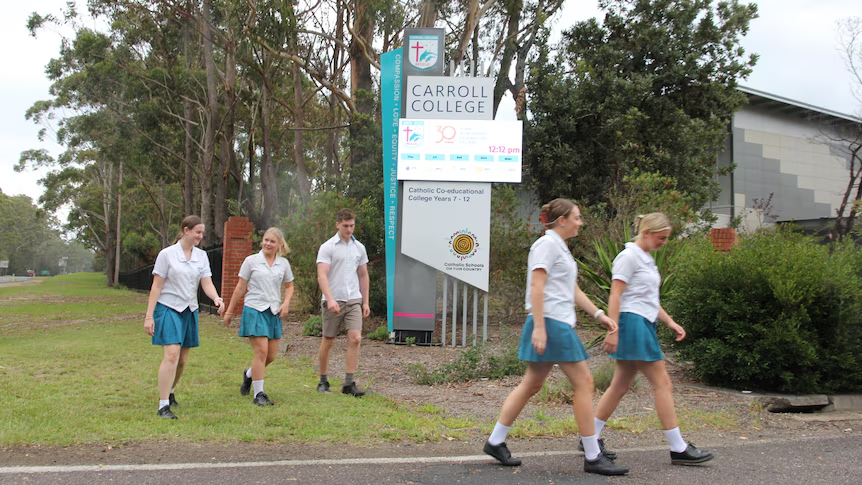

Students at Carroll College in Broulee can now walk or cycle to school under a six-month access trial that began in Term 2 of the 2026 school year. The change follows Eurobodalla Shire Council’s formal decision on 24 March 2026 to rescind a restriction dating back to the college’s opening in 1994.
For more than three decades, the school operated on the understanding that students could not enter or leave the campus on foot or by bicycle because of safety concerns around George Bass Drive.
A review found that the original council restriction had not been included in the school’s development consent conditions. This raised questions about whether it had been legally enforceable, although the college had treated it as a binding requirement.
Rather than relying on that uncertainty, councillors formally removed the 1994 motion and approved a controlled trial with a designated route and temporary safety measures.
Why the 1994 restriction was formally removed
Road conditions near Carroll College were considerably different when the Broulee campus opened in 1994. George Bass Drive had a speed limit of 100 kilometres per hour, while pedestrian facilities around the school were limited.
The restriction was introduced in response to those conditions, and the school continued to follow it for approximately 32 years.
During discussions with the council in early 2026, school representatives learned that the restriction did not appear among the formal conditions attached to the college’s development consent.
Moruya Parish Priest Father Joshua Scott said the school had previously understood that the restriction was enforceable. Its absence from the development conditions created an opportunity for the arrangement to be reconsidered.
Eurobodalla Shire Council nevertheless took formal action to provide clarity. At its meeting on 24 March 2026, the council rescinded the old motion and approved a six-month pedestrian and bicycle access trial beginning in Term 2.
The decision and its conditions are recorded in the Eurobodalla Shire Council meeting minutes for 24 March 2026.
How students must travel during the trial
The approval does not allow students to choose any route or cross George Bass Drive directly outside the school entrance.
Students participating in the trial must travel along the western side of George Bass Drive for approximately 600 metres. They then cross near the Broulee Road roundabout using the existing pedestrian refuge.
This route uses infrastructure already available in the area and avoids an uncontrolled crossing immediately outside Carroll College.
A temporary grass pathway supports the route, while signs are being used to direct students and identify the approved access arrangement.
The college is responsible for maintaining the pathway during the trial. Students and families must also follow the school’s access instructions and any safety requirements applying to the route.
Electric bicycles, scooters and other motorised personal transport devices are not permitted under the trial. The approval applies to walking and conventional bicycles rather than powered transport devices.
Read More
Road improvements supported the access change
Several changes around the campus helped make the trial possible. The speed environment near the school is lower than it was in 1994, and a 40km/h school zone now operates during designated times.
The Broulee Road roundabout and its pedestrian refuge provide a safer crossing option than the facilities available when the original restriction was introduced.
These improvements do not eliminate every risk. Students must still travel beside a busy regional road, and conditions can be affected by traffic volumes, visibility, weather and driver behaviour.
The trial therefore provides a way for the school and council to assess pedestrian movements, cycling behaviour and traffic conditions before considering any longer-term arrangement.
The importance of motorists observing reduced speeds near campuses has been highlighted by the enforcement of 40km/h school-zone rules and penalties in Adelaide. Wider road-safety concerns have also prompted changes such as the return of solo highway patrols by Victoria Police after an 11-year pause.
What the trial means for students and families
Carroll College principal Andrew Kenneally estimated that about 40 local families could initially benefit from the access change.
Students living near the campus now have an alternative to travelling by bus or being driven by a parent or carer. For some families, that may reduce short car journeys and make daily travel arrangements more flexible.
Year 12 student Lukas Muir, who lives close to the school, welcomed the opportunity to use his mountain bike for the journey. He said cycling would also reduce the cost associated with travelling by car.
Student Aimee Harris said walking and cycling could encourage students to be more active instead of spending every school journey in a vehicle.
The change may also give older students more independence when travelling to and from lessons, sport or other activities. However, the access remains a monitored trial rather than a permanent entitlement.
Permanent access will depend on the trial results
No permanent pedestrian crossing near the Carroll College entrance should be treated as approved at this stage.
The current arrangement relies on temporary signage, the maintained grass pathway and the designated crossing point near the Broulee Road roundabout.
Any permanent access solution will depend on the safety outcomes observed during the six-month trial, as well as the council’s review of how the route operates.
That assessment may consider student participation, traffic movements, pathway conditions, crossing behaviour and whether additional infrastructure is needed.
For Carroll College families, the March 2026 decision ended the uncertainty surrounding a restriction followed since 1994. It also introduced a structured way for local students to walk or cycle to school while safety remains under review.

Make Swikblog your go-to source on Google for reliable updates, smart insights, and daily trends.