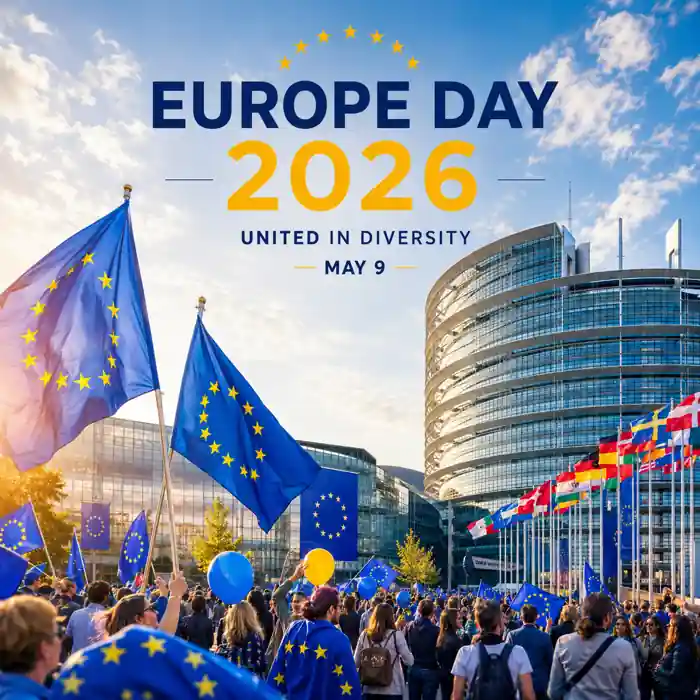

Europe Day 2026 will be celebrated across the European Union on Saturday, May 9, 2026, marking one of the most important symbolic dates in modern European history. The annual celebration honors peace, unity, democracy, and cooperation among European nations while commemorating the historic Schuman Declaration of 1950, the proposal that laid the foundation for today’s European Union.
From Brussels and Strasbourg to Frankfurt and Luxembourg, Europe Day events in 2026 will include open-door visits to EU institutions, cultural festivals, live music performances, educational programs, food exhibitions, family activities, and public discussions about Europe’s future.
The 2026 edition is especially significant because it marks 40 years since Spain and Portugal joined the European Union, as well as four decades of official Europe Day celebrations and the first public use of the EU flag and anthem.
What Is Europe Day?
Europe Day is observed every year on May 9 to celebrate European unity, peace, and cooperation. The date commemorates the famous speech delivered by French Foreign Minister Robert Schuman on May 9, 1950.
Known as the Schuman Declaration, the speech proposed placing French and German coal and steel production under a common authority. At the time, Europe was recovering from the devastation of World War II, and the proposal aimed to make future wars between European nations impossible.
The idea eventually led to the creation of the European Coal and Steel Community, which evolved into the modern European Union.
Today, Europe Day has become a symbol of peace, democratic cooperation, economic partnership, cultural diversity, freedom of movement, and shared European identity.
Why Europe Day 2026 Is Important
Europe Day 2026 arrives during a period of major geopolitical and economic challenges for Europe. EU leaders have increasingly emphasized the importance of unity, energy security, economic resilience, technological independence, and democratic stability.
The 2026 celebrations are designed not only to commemorate history but also to encourage citizens to engage with the future of Europe.
- 40 years since Portugal and Spain joined the EU in 1986
- 40 years of official Europe Day celebrations
- The anniversary of the first public use of the EU flag and anthem
European institutions say the celebrations will focus on bringing citizens closer to the European project while showcasing how the EU works in daily life.
Europe Day 2026 Events in Brussels
Brussels will host the largest Europe Day celebrations in 2026, with several major European Union institutions opening their doors to the public.
On Saturday, May 9, 2026, visitors can explore EU institutions between 10:00 AM and 6:00 PM CEST.
Participating institutions include the European Parliament, European Commission, European Council, Council of the European Union, European External Action Service, European Economic and Social Committee, and European Committee of the Regions.
Activities in Brussels will include guided tours of EU buildings, interactive exhibitions, meetings with EU representatives, educational workshops, cultural performances, music and dance shows, food tastings from EU countries, and family-friendly entertainment.
One of the biggest attractions will be the evening Iris Tipik Electro Night, where DJs will transform Brussels’ Place des Palais into an open-air dance floor.
Events in Strasbourg, Frankfurt and Luxembourg
The Europe Day celebrations will continue across several important European cities.
In Strasbourg, France, the European Parliament will host an open day on May 17, 2026, allowing visitors to tour parliamentary spaces and learn more about EU lawmaking.
The European Central Bank in Frankfurt, Germany, will organize a full day of public activities, exhibitions, and discussions about Europe’s financial system.
Meanwhile, Luxembourg’s celebrations in Wiltz will highlight cross-border cooperation, citizen participation, cultural diversity, and regional development.
Europe Day Activities for Families and Children
Europe Day 2026 is designed to be inclusive and family-friendly, with many activities aimed at children and young visitors.
Visitors can expect games, quizzes, creative workshops, balloon artists, magicians, educational activities about Europe, interactive geography and history zones, music, and storytelling performances.
Schools and universities across Europe are also expected to organize debates, exhibitions, classroom activities, and cultural programs focused on European cooperation and democracy.
The History Behind Europe Day
The origins of Europe Day go back to the aftermath of World War II, when European leaders sought ways to prevent future conflict.
On May 9, 1950, Robert Schuman proposed that France and Germany — historically bitter rivals — share control over coal and steel production.
This initiative led to the creation of the European Coal and Steel Community in 1951, founded by France, West Germany, Italy, Belgium, the Netherlands, and Luxembourg.
The success of the project encouraged deeper political and economic cooperation, eventually leading to the formation of the European Union. In 1985, European leaders officially adopted May 9 as Europe Day.
How Europe Day Is Celebrated Across Europe
Europe Day celebrations vary from country to country but generally include public events focused on culture, education, and civic participation.
Common Europe Day traditions include flying the EU flag, open-door events at government institutions, street festivals, concerts, European food fairs, public debates, school activities, and performances of “Ode to Joy,” the EU anthem.
Many cities also organize “Europe Villages,” where visitors can explore exhibits from different EU countries in one location.
What Europe Day Represents Today
For millions of Europeans, Europe Day is more than a symbolic anniversary. It represents decades of peace and cooperation after centuries of conflict on the continent.
“United in Diversity.”
Supporters of the EU view Europe Day as an opportunity to celebrate democracy, human rights, economic integration, freedom to travel and work across borders, cultural exchange, and international cooperation.
The day also serves as a reminder of the challenges Europe faces, including economic uncertainty, migration issues, climate change, security concerns, and geopolitical tensions.
Can You Visit EU Institutions on Europe Day?
Yes. One of the most popular parts of Europe Day is the annual “Open Doors Day,” when EU institutions allow the public to visit buildings that are normally closed to tourists.
Visitors can enter parliamentary chambers, tour meeting rooms where EU leaders negotiate policies, participate in discussions and workshops, meet policymakers and staff, and learn how EU decision-making works.
Most activities are free and open to all ages.
How to Celebrate Europe Day 2026
Even if you cannot travel to Brussels or Strasbourg, there are many ways to celebrate Europe Day from anywhere in the world.
- Watch virtual tours of EU institutions
- Listen to European music playlists
- Cook dishes from different European countries
- Attend local cultural festivals
- Join online discussions about Europe
- Learn about European history and politics
- Share messages supporting peace and cooperation
Many organizations also provide downloadable educational resources, posters, maps, quizzes, and classroom materials for students and teachers.
Europe Day 2026 Key Facts
| Event | Details |
|---|---|
| Date | Saturday, May 9, 2026 |
| Main Celebration | Brussels, Belgium |
| Founded From | Schuman Declaration of 1950 |
| Purpose | Celebrate European unity and peace |
| Major Activities | Open houses, concerts, tours, festivals |
| Special Anniversary | 40 years of Europe Day celebrations |
Europe Day 2026 will bring together millions of people across Europe to celebrate unity, democracy, peace, and cultural diversity. From major public events in Brussels to local festivals across EU member states, the occasion highlights both Europe’s historical achievements and its future ambitions.
As Europe continues to navigate political, economic, and global challenges, Europe Day remains a powerful reminder of how cooperation transformed a once-divided continent into one of the world’s most interconnected regions.
You may like: Mission Seniors Home Fire Forces Emergency Evacuation of Residents Overnight

Make Swikblog your go-to source on Google for reliable updates, smart insights, and daily trends.