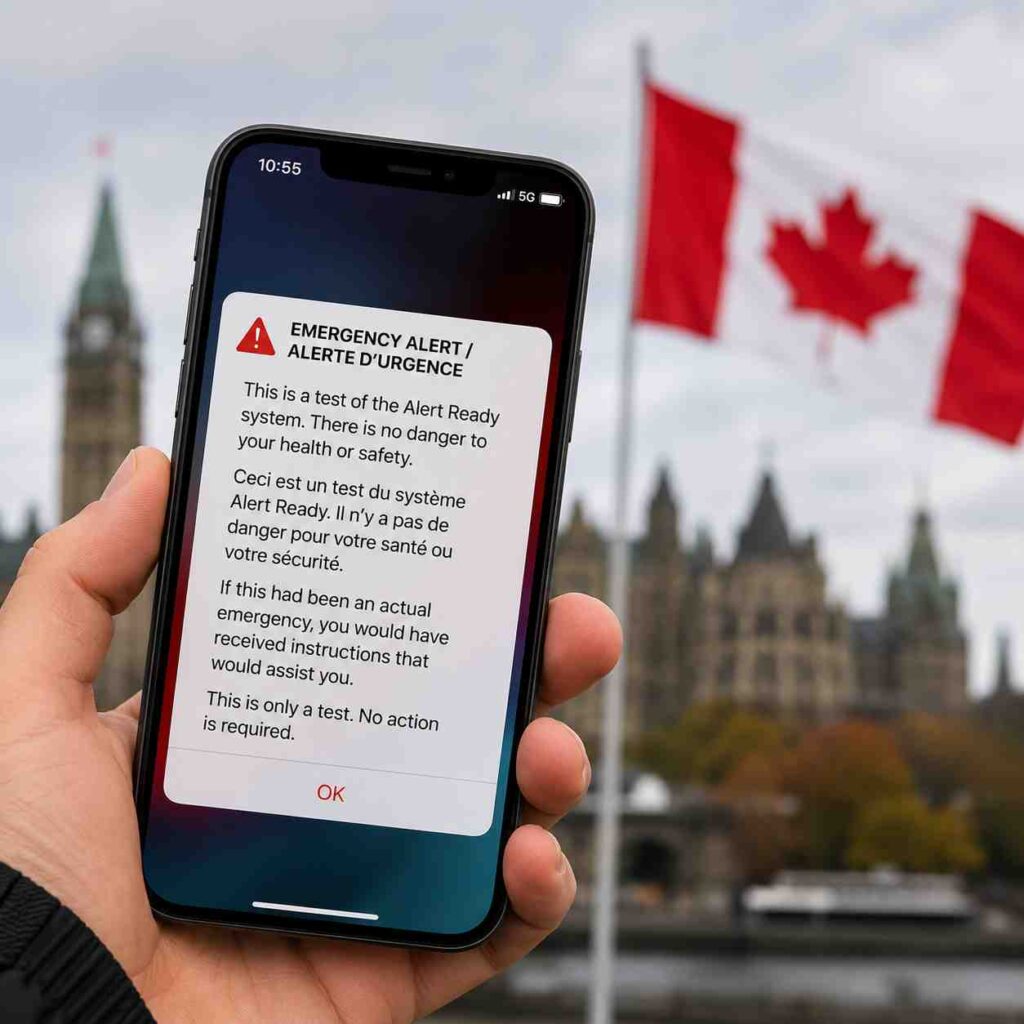

Canada’s Alert Ready test sent loud emergency alerts to millions of phones today, catching users off guard as the nationwide system activated across mobile devices, television and radio during Emergency Preparedness Week.
The test was scheduled for Wednesday, May 6, 2026, across most provinces and territories as part of Emergency Preparedness Week. Canadians with compatible wireless devices connected to LTE or 5G networks received a test message, while the same alert was also broadcast through radio and television channels.
In New Brunswick, the test was set for 10:55 a.m. local time. Similar tests were scheduled across the country on Wednesday and Thursday, with each province or territory following its own timing. Quebec was the only province or territory without a scheduled test time listed.
Phones, TVs and radios carried the same emergency warning tone
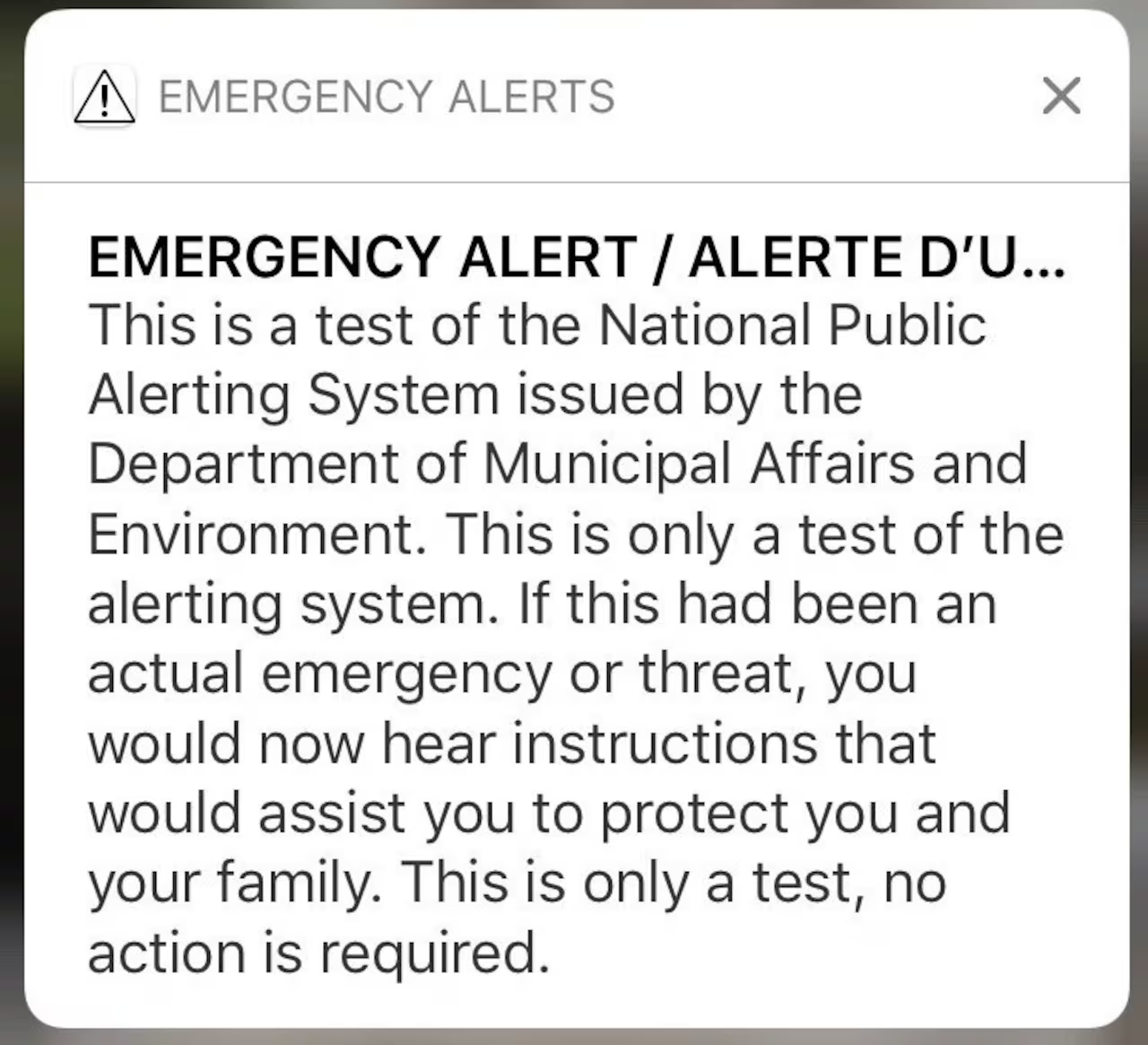
The Alert Ready test used the same attention-grabbing sound associated with real emergency alerts. That tone is deliberately sharp because the system is designed for urgent situations where people may need to act quickly, such as tornadoes, wildfires, floods, dangerous storms, civil emergencies or Amber Alerts.
The message made clear that the alert was only a test. Residents were told that no action was required, and that in a real emergency the alert would include instructions to help protect themselves and their families.
The official Alert Ready emergency alert system says public tests are conducted to make sure Canadians can receive critical alerts effectively. Public Safety Canada also identifies Alert Ready as part of the National Public Alerting System, which sends warnings through wireless networks, television and radio.
There is no opt-out option for these emergency alerts. That applies to both tests and real alerts, because the system is intended to reach as many people as possible when public safety is at risk.
Read More
Perth Bushfire: Herdsman Lake Fire Alert and Smoke Warning
Japan School Bus Crash Leaves Student Killed
New Zealand Universities Hit by Global Canvas Hack
The test comes as emergency alerts become more important across Canada
Canada’s emergency alert system is no longer a background public-safety tool that people rarely notice. Extreme weather, wildfire seasons, severe storms and missing-person emergencies have made fast public warnings more visible and more important.
According to reporting from The Canadian Press, the Alert Ready system had issued 28 alerts in Canada as of April 30, 2026, covering emergencies including Amber Alerts and tornado warnings. That figure shows why officials continue to test the system before disaster conditions demand instant communication.
The alerts are distributed through broadcasters, wireless providers and emergency management organizations. When an alert is issued, compatible phones in the affected area receive the message automatically if they are connected to a participating LTE or 5G network.
Some users may not receive the alert if their phone is off, out of coverage, connected only to Wi-Fi, incompatible with the system or using older network technology. Others may receive it slightly later depending on carrier delivery and device settings.
For many Canadians, the test was a brief interruption. For emergency officials, it was a system-wide check of one of the country’s most important public warning tools. A failed alert during a real wildfire, tornado or child abduction could leave people without critical information at the exact moment they need it most.
The timing also aligns with Emergency Preparedness Week, which encourages Canadians to understand local risks, prepare emergency kits and discuss family safety plans. The Alert Ready test is one visible part of that wider push, but officials regularly remind residents that emergency readiness also depends on household planning.
A phone alert can warn people within seconds, but families still need to know where to go, how to contact each other and what supplies they may need if power, transport or communications are disrupted.
Today’s test also served as a reminder that emergency alerts are not ordinary notifications. They are reserved for situations where public safety officials believe immediate public awareness is necessary. That is why the tone is loud, why the message appears prominently, and why users cannot silence the system entirely through a standard unsubscribe setting.
For Canadians who heard the alarm today, the key point is simple: the message was only a test, but the system behind it is built for real emergencies. The next time that same tone sounds, it may carry instructions that matter far beyond a brief disruption.

Make Swikblog your go-to source on Google for reliable updates, smart insights, and daily trends.