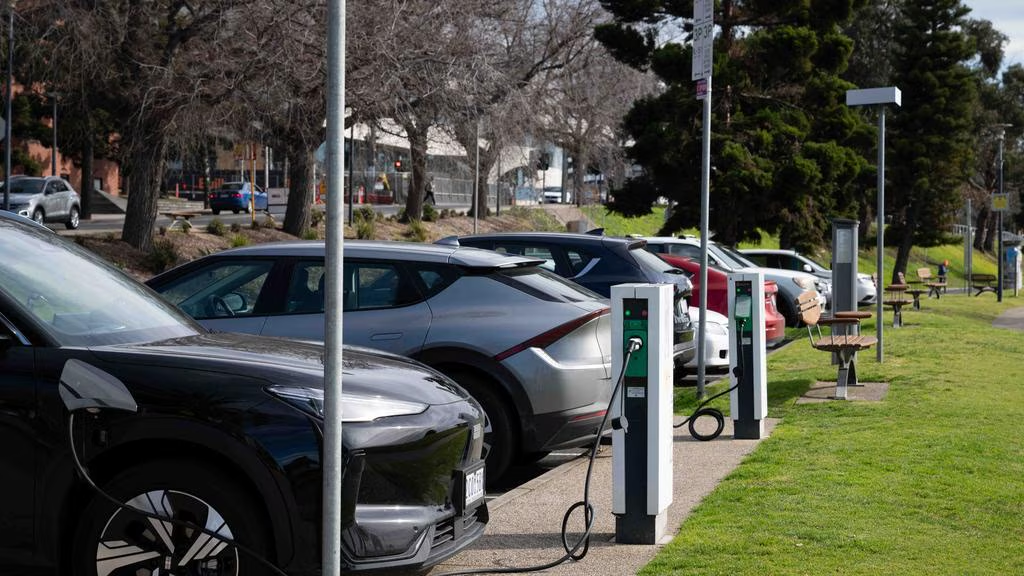

Australia’s electric vehicle push is running into a critical bottleneck, with drivers reportedly waiting up to six hours to access chargers over the Easter holiday period, exposing deep gaps in the country’s charging infrastructure just as EV demand surges by as much as 40–50%.
The delays, seen across major travel corridors including routes between Melbourne and Sydney, have triggered warnings of a growing “disaster” as the number of EVs on the road rises far faster than the availability of public charging points. In some locations, up to 10 vehicles queued for just three chargers, while even large hubs with multiple fast-charging stalls struggled to cope.
The strain comes at a time when Australia has an estimated 300,000 to 350,000 electric vehicles competing for roughly 5,000 public charging sites, leaving around 40 to 45 vehicles per charger — a ratio significantly behind global leaders such as China and Norway, where infrastructure was built ahead of demand.
The surge in interest has been driven in part by persistently high fuel prices, with petrol holding above A$2 per litre and diesel exceeding A$4 in some areas. Carmakers have reported a sharp shift in consumer behaviour, with buyers increasingly opting for electric models instead of petrol vehicles, accelerating the transition beyond early adopters.
Infrastructure lag meets rapid EV adoption
While governments and private operators have committed billions to expand the charging network, the rollout has struggled to keep pace with demand. The federal government’s A$500 million “Driving the Nation” fund and a separate A$40 million kerbside charging initiative aim to close gaps, while New South Wales is backing more than 100 fast-charging zones featuring ultra-fast 240kW chargers.
Private networks are also scaling up, with operators such as NRMA, BP, Evie and Ampol planning thousands of new installations by the end of 2026. Yet one of the biggest hurdles remains the electricity grid itself, where connecting a new fast charger can take 12 to 18 months due to technical and regulatory constraints.
That delay is now colliding with a rapid rise in EV ownership. Industry data shows registrations climbing sharply, with electric vehicles accounting for a growing share of new car sales. Inquiries from buyers have also jumped, with some manufacturers reporting increases of around 50% following global fuel shocks.
The mismatch is most visible during peak travel periods, when demand concentrates at key highway charging hubs. Even well-equipped sites can become overwhelmed within hours, turning routine charging stops into extended delays that disrupt journeys and erode confidence in the system.
Why charging access is becoming the next battleground
Beyond highway congestion, the issue is increasingly shifting into cities, where a large share of Australians lack access to home charging. In areas such as Sydney’s eastern suburbs, around 60% of residents live in apartments or townhouses and roughly half are renters, making reliance on public infrastructure unavoidable.
Researchers argue that kerbside charging could play a crucial role in addressing this gap. These chargers, typically installed on street infrastructure such as power poles or footpaths, offer slower but more affordable charging options at 7–22kW, with some higher-powered units reaching 30–50kW.
Data from Sydney council trials covering 94 kerbside charging spaces showed strong usage, with more than 27,000 charging sessions recorded over six months. Chargers located near apartments and retail areas performed best, particularly when parking rules ensured access for active users.
The findings also revealed a preference for faster DC kerbside chargers, which were used up to four times a day compared with once daily for slower AC units, delivering significantly higher energy throughput. However, usage patterns showed a concentration in daytime and evening hours, raising concerns about increased pressure on the grid during peak demand periods.
Experts suggest pricing signals and smarter charging coordination could help shift usage towards periods of abundant solar power, reducing strain on infrastructure and lowering costs for drivers. Without such measures, rising evening demand could require expensive upgrades to the electricity network.
The broader challenge now facing Australia is not just expanding the number of chargers, but building a system that matches how and when people actually use their vehicles. As analysis of EV charging trends suggests, the next phase of adoption will depend on reliability, accessibility and smart planning — not just headline investment figures.
For drivers caught in long queues, the transition to electric is already testing patience. And as EV uptake accelerates, the pressure on Australia’s charging network is likely to intensify unless infrastructure delivery can catch up with the speed of demand.
You may also like: Gina Maria’s Pizza collapses after 50 years under $2.9M debt and bankruptcy pressure

Make Swikblog your go-to source on Google for reliable updates, smart insights, and daily trends.