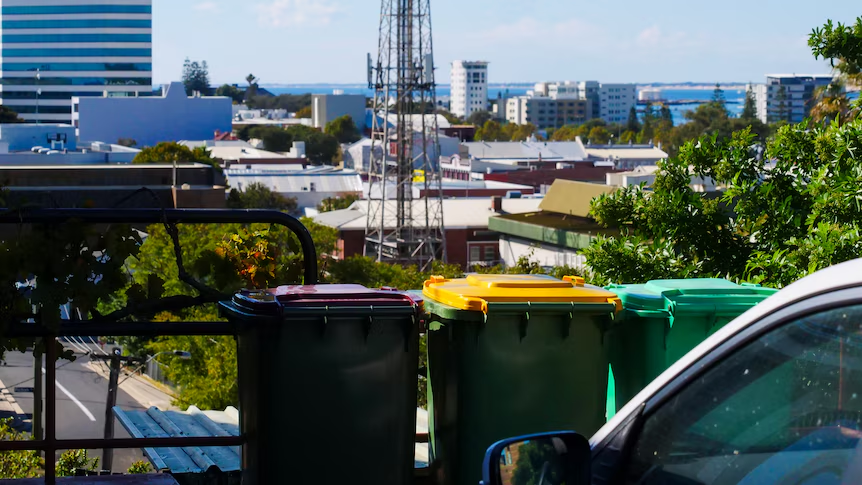

A flagship waste initiative in Western Australia is facing growing uncertainty as rising diesel prices and infrastructure failures push regional councils to reconsider the future of the FOGO system. In Bunbury, where the three-bin model was introduced more than a decade ago, councillors have voted to investigate whether the program remains financially viable after a series of setbacks.
The review comes at a critical moment. The WA government has been pushing to expand FOGO — food organics and garden organics — across Perth and Peel by the end of 2025 as part of its long-term waste strategy. But in the South West, the system is under strain, with mounting transport costs and the collapse of local processing undermining its effectiveness.
Bunbury councillors this week rejected a proposal to immediately scrap FOGO, but agreed to examine both the cost of maintaining the system and the possibility of reverting to a two-bin model. The move follows sharp criticism from councillor Karen Turner, who described the program as “a failure” after years of investment.
“We tried, we failed, and the right thing to do is stop,” she told the council, arguing that continuing to fund a struggling system would place unnecessary pressure on ratepayers.
The immediate trigger for the debate has been a breakdown in local processing capacity. Since late 2024, organic waste collected in Bunbury has no longer been consistently turned into compost, with thousands of tonnes instead being diverted to landfill or transported long distances for treatment. That shift has eroded both the environmental and economic case for the program.
To stabilise the system, the state government in February offered a $4.5 million support package, including a rebate of $95 per tonne to help councils send FOGO waste to Perth for processing. However, for regional councils, the cost of transport remains a major obstacle.
Diesel prices have emerged as a key pressure point. In the neighbouring Shire of Harvey, officials rejected the rebate offer, citing uncertainty over transport costs after fuel prices surged by $1.40 within weeks. For councils required to move waste around 200 kilometres, even short-term fuel volatility can significantly increase operating expenses.
Rising costs expose structural gaps
The Bunbury case highlights a broader challenge in waste policy: the gap between system design and real-world logistics. FOGO has been widely promoted as a way to reduce landfill use, cut emissions and create reusable compost. But its success depends heavily on reliable processing infrastructure and manageable transport costs — factors that vary sharply between metropolitan and regional areas.
In cities like Perth, where facilities are closer and economies of scale apply, the model has shown more stable results. The City of Rockingham reported positive early outcomes after introducing FOGO in 2023, while the City of Stirling has opted for a controlled trial covering 500 households before committing to a full rollout.
Regional councils, by contrast, face longer distances, fewer facilities and tighter budgets. When local processing fails, as it did in Bunbury, the system quickly becomes dependent on long-haul transport, exposing it to fuel price shocks and logistical bottlenecks.
Bunbury mayor Jaysen Miguel said the city remained committed to FOGO in principle, but emphasised that support was not unconditional. “Given there has been rising fuel cost at any time, the cost is expected to be up,” he said, noting the need to balance environmental goals with financial sustainability.
Future of FOGO now under review
The council is expected to make a decision in the coming months as it weighs whether to continue with the three-bin system or scale it back. The outcome could influence how other regional councils approach FOGO, particularly as cost pressures intensify.
The debate also raises questions about the pace of WA’s broader waste strategy. While the policy direction remains clear, the Bunbury experience suggests that implementation may require stronger infrastructure support and more resilient funding models to withstand external shocks like fuel price spikes.
For now, the future of FOGO in the South West remains uncertain — caught between environmental ambition and the practical realities of cost, distance and infrastructure. More details on the state’s long-term waste framework can be found in the Waste Avoidance and Resource Recovery Strategy 2030.
you may like: M4 crash in Wales leaves motorway shut for hours after collision
Make Swikblog your go-to source on Google for reliable updates, smart insights, and daily trends.