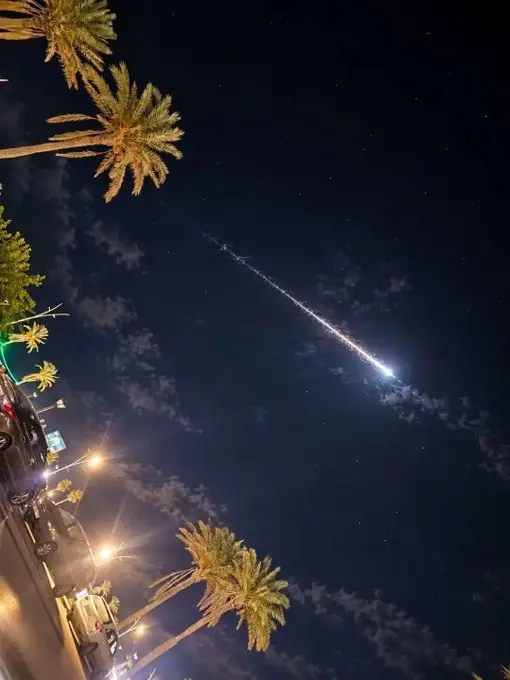
🌌 Introduction
Every October, the night sky offers a subtle but enchanting show: the Draconid meteor shower. Unlike many meteor showers best viewed in the pre-dawn hours, the Draconids can be seen earlier in the evening, making it more accessible for many observers. In 2025, conditions may offer an extra spark of interest due to predicted outbursts.

This guide covers:
- When the 2025 Draconids are active & peak
- Where on Earth you can see them
- How to maximize your viewing experience
- Scientific background & fun extras
Let’s get started.
⏰ When Is the Draconid Meteor Shower 2025?
- The Draconid meteor shower is active from October 6 through October 10, 2025 In-The-Sky.org+2EarthSky+2.
- The predicted peak time is 19:00 UTC on October 8 In-The-Sky.org+3EarthSky+3EarthSky+3, which corresponds to local times depending on your time zone.
- In past years and by meteor shower models, the Draconids are especially visible early in the evening (soon after nightfall) because the radiant of the shower reaches its highest point then EarthSky+2Royal Museums Greenwich+2.

Note on Moonlight:
2025’s Draconid peak coincides with a moon that may be in a waning phase, which can wash out faint meteors. Observers are encouraged to shield their view from moon glare or choose times when the moon is lower in the sky EarthSky.
🌍 Where Can You See It?
- Best visible from the Northern Hemisphere, where the Draconid radiant climbs higher in the evening sky Royal Museums Greenwich+2popastro.com+2.
- In many cases, observers farther south may still catch brighter meteors, but the rate tends to be much lower and meteors might be lower on the horizon.
- Ideal observation spots: away from light pollution, wide open sky view (no tall buildings, trees), minimal artificial lighting.
🌌 Sky Map — Draco, Ursa Major & Polaris
ℹ️ This guide is approximate for the Northern Hemisphere. The sky rotates counter-clockwise around Polaris. Use the slider to simulate time passing.

🔍 How to Watch: Tips & Techniques
- Find the radiant
The Draconids radiate from the constellation Draco (the Dragon). Stars like Eltanin and Rastaban in Draco are good reference points EarthSky+1. But you don’t need to stare at the radiant — meteors can appear anywhere in the sky. - Best timing
Because the radiant is highest just after dusk, go out early evening. Stay out at least a few hours to catch the full span of activity. - Let your eyes adjust
Spend ~20–30 minutes in darkness. Avoid using phones or bright lights. - Use wide view, not zooms
Don’t use a telescope or narrow field gear. The wider your view of the sky, the more likely you’ll see meteors. - Bring comfort & tracking tools
A reclining chair, blanket, star chart apps, and perhaps a red flashlight (less disruptive to night vision) help. - Photographing meteors
Use a DSLR or mirrorless camera with wide-angle lens, long exposure (15–30 sec), ISO 800-1600. Aim at the sky region away from the moon.
🧠 Daily Space Quiz
New set every day • 5 questions • Can you keep the streak going?
🔬 Scientific & Historical Insights
- The Draconids are produced by Comet 21P/Giacobini-Zinner, which leaves trails of debris. As Earth passes through these trails, small particles burn up in our atmosphere, appearing as meteors arXiv+4Wikipedia+4Royal Museums Greenwich+4.
- Typical visual counts are modest (a handful per hour), but in special years (when Earth intersects denser dust trails) outbursts can occur with tens to hundreds of meteors per hour Wikipedia+2arXiv+2.
- In 2025, models suggest a potential radar outburst of faint meteors from the 2012 debris trail, which could produce elevated meteor activity ﹣ most visible to sensitive equipment rather than naked-eye observers arXiv.

Make Swikblog your go-to source on Google for reliable updates, smart insights, and daily trends.