
By Chetan
Rio Tinto (RIO) shares jumped 3.64% today to 6,783 after the mining giant reassured investors that recent cyclone disruptions in Western Australia would not derail its full-year output targets. The stock reaction reflects growing confidence that the company can absorb short-term operational shocks while maintaining long-term production stability.
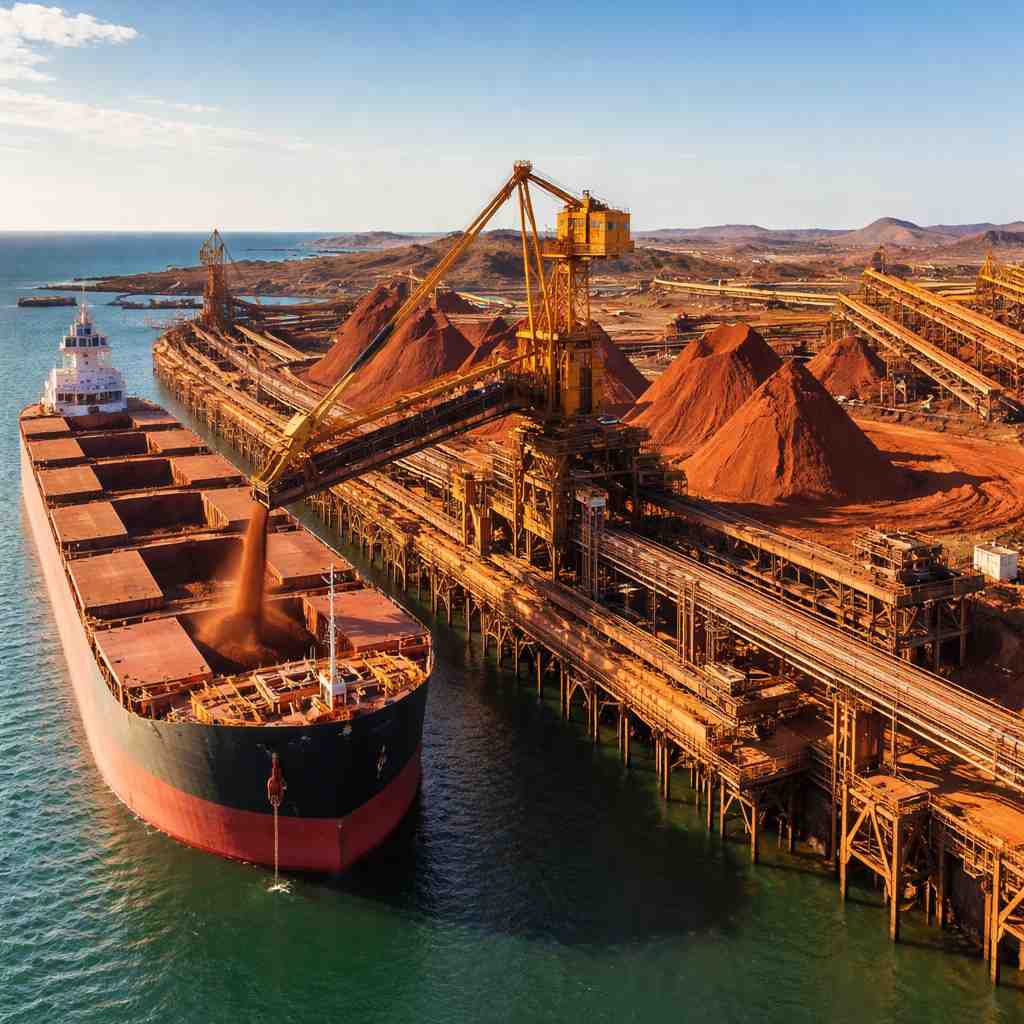
The company confirmed that iron ore port operations in the Pilbara region — one of the world’s most critical mining hubs — have largely resumed following Tropical Cyclone Narelle. Three of its four major port terminals, including East Intercourse Island, restarted ship loading on 28 March. The fourth terminal, Cape Lambert A, is currently under repair and expected to return to operations within days.
Operations had been halted from 24 March as the cyclone swept across the remote northwest Australian coastline. The Pilbara region is central to Rio Tinto’s iron ore exports, supplying global markets at massive scale, and any disruption there tends to draw immediate market attention.
8 Million Tonnes Hit, But Recovery Plan Limits Damage
Rio Tinto said the combined impact of Tropical Cyclone Narelle and an earlier weather event, Cyclone Mitchell in February, disrupted around 8 million tonnes of shipments. While that figure initially appears significant, the company has already identified a pathway to recover approximately half of the lost volumes.
More importantly, Rio Tinto left its full-year Pilbara shipment guidance unchanged at 323 million to 338 million tonnes. For investors, that was the key takeaway. Holding guidance steady signals that the disruption is operational rather than structural, and that management remains confident in execution despite weather volatility.
This ability to maintain output expectations despite external shocks is often seen as a sign of operational resilience, particularly for a company that relies heavily on its Pilbara network for earnings and cash flow generation.
Stock Still Under Pressure Despite Today’s Rally
Even with today’s gains, Rio Tinto shares remain down more than 7% since the escalation of the Iran war at the end of last month. The recent rebound therefore reflects partial recovery rather than a full turnaround, suggesting that broader geopolitical and commodity market pressures are still influencing investor sentiment.
However, Monday’s move indicates that markets are beginning to differentiate between temporary disruptions and long-term risk to production.
$2 Billion Government Deal Strengthens Long-Term Outlook
Beyond the cyclone recovery, Rio Tinto has also strengthened its long-term position through a major government-backed investment. The company recently secured a A$2 billion funding partnership with the Queensland and Australian federal governments to support the future of the Boyne aluminium smelter in Gladstone.
Under the agreement, both governments will invest over a 10-year period starting from 2030. In return, Rio Tinto has committed to investing A$7.5 billion into renewable energy generation and storage, helping transition the smelter toward cleaner power sources.
The Boyne facility, operational since 1982, is Australia’s second-largest aluminium smelter with a capacity exceeding 500,000 tonnes annually and supports over 1,000 jobs. Its current power contract expires in 2029, and uncertainty had previously surrounded its long-term viability due to rising energy costs and emissions concerns.
According to Rio Tinto Aluminium & Lithium CEO Jérôme Pécresse, the partnership is designed to ensure the smelter remains globally competitive while accelerating the decarbonisation of the energy system. He noted that the move positions Boyne to become one of the world’s first aluminium smelters powered by a combination of solar and wind energy.
More details on the partnership can be found in Rio Tinto’s official announcement via this release.
Resilience Meets Strategic Positioning
The combination of short-term recovery and long-term investment is shaping the current narrative around Rio Tinto. On one side, the company is demonstrating its ability to quickly restart critical infrastructure after extreme weather events. On the other, it is securing the future of key assets through government-backed clean energy initiatives.
For investors, this dual story matters. It suggests that while external risks such as cyclones and geopolitical tensions remain unavoidable, Rio Tinto’s operational flexibility and strategic planning may help cushion the impact and sustain growth.
As global demand for iron ore and aluminium continues to be influenced by infrastructure spending and the energy transition, Rio Tinto’s ability to maintain output while investing in cleaner production could remain a key factor driving sentiment in the months ahead.
You may like: BP shares rise today after upgrade points to 49% upside target

Make Swikblog your go-to source on Google for reliable updates, smart insights, and daily trends.