
Samsung Electronics shares slipped to ₩183,500, down ₩4,400 or 2.34%, as controversy surrounding a major electric-vehicle battery plant in Hungary added new uncertainty for investors watching the South Korean tech giant. The issue centers on allegations that workers at Samsung’s large battery manufacturing facility in the town of Göd were exposed to dangerous levels of toxic chemicals, sparking political tensions, environmental protests, and renewed scrutiny of Hungary’s strategy to become a global EV battery hub.
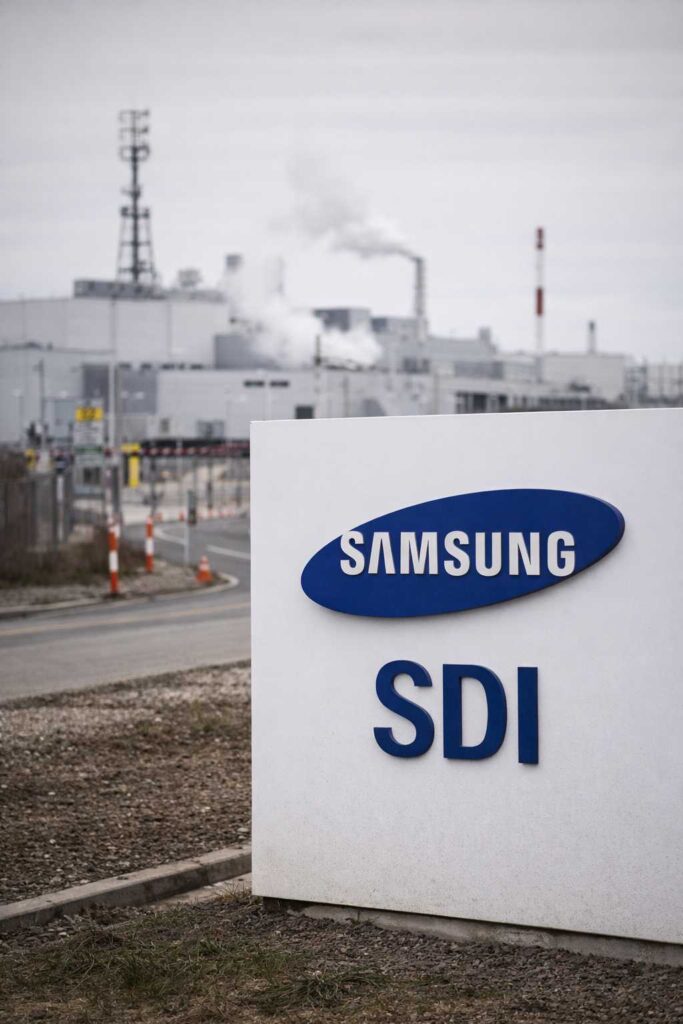
The factory, located about 25 kilometers from Budapest, has become one of the most prominent battery manufacturing sites in Europe since Samsung established the facility in 2017. Spanning roughly 50 hectares (123 acres), the plant forms a key part of the company’s role in the electric-vehicle supply chain. However, recent allegations reported by Hungarian investigative outlet Telex have raised concerns about worker safety and regulatory oversight at the facility.
Allegations of exposure to toxic chemicals
The controversy intensified after reports claimed that Hungarian security services produced an internal assessment in 2023 indicating workers may have been exposed to N-Methyl-2-pyrrolidone (NMP) at levels exceeding legal safety limits. NMP is a solvent commonly used in lithium-ion battery production, but it is known to pose serious health risks if handled improperly, particularly for pregnant women.
According to the report cited by Telex, the investigation suggested that the issue persisted for some time and that the company had not fully resolved the problem immediately. The findings also suggested attempts to conceal the extent of the exposure risks. Despite these concerns, the Hungarian government reportedly did not shut down the plant but instead gave Samsung time to address the safety issues.
Samsung has strongly rejected the allegations. The company stated that the factory complies with environmental and occupational safety standards and operates under strict regulatory oversight. In its response, Samsung emphasized that the plant follows all relevant guidelines and maintains transparent operational practices.
Political tensions ahead of Hungary’s election
The situation has become particularly sensitive because Hungary is approaching a general election scheduled for April 12. The controversy has turned into a political issue, with opposition figures using the case to criticize the government’s relationship with large foreign investors.
Prime Minister Viktor Orbán, who has governed Hungary for more than 16 years, dismissed the allegations as a “fake issue,” arguing that Hungary enforces some of the strictest environmental regulations in Europe. Orbán’s administration has heavily promoted the country as a center for electric-vehicle production, offering significant incentives to global manufacturers.
Opposition leader Peter Magyar has taken the opposite stance, promising to review the licenses of all battery factories operating in Hungary if his party wins the election. The dispute highlights how the rapid expansion of battery manufacturing has become intertwined with national economic strategy and political debate.
Massive subsidies and rapid expansion
The Samsung facility in Göd has benefited from substantial government support. Hungary provided more than €500 million in taxpayer subsidies to help build and expand the factory, part of a broader effort to attract EV battery investment into the country.
These incentives have helped transform Hungary into one of Europe’s fastest-growing battery production hubs. In addition to Samsung, Chinese battery giant CATL has also invested heavily in the country. While these investments have created thousands of jobs and strengthened Hungary’s role in the EV supply chain, they have also triggered concerns about environmental protection and industrial safety.
Local residents divided over the factory
Residents in the town of Göd appear divided over the presence of the massive industrial facility. Some locals worry about pollution and falling property values as the plant continues to expand. Others believe that authorities would intervene if serious safety problems existed.
One resident expressed concern that the factory had grown rapidly in size and that local communities lack transparency about what occurs inside the plant. Another resident said such a large industrial operation is likely subject to strict monitoring by regulators.
The local government has attempted to reassure residents, stating that official environmental tests conducted so far have not detected contamination. However, environmental activists remain skeptical about those assurances.
Environmental groups raise additional concerns
Local environmental group Göd-ERT, which was formed in 2020 to monitor the factory’s operations, commissioned independent testing of nearby water wells. According to the organization, those tests detected traces of NMP in local groundwater.
The group argues that the plant has repeatedly violated various regulations related to occupational safety and environmental protection. Activists say the factory has been fined multiple times for violations linked to industrial safety procedures and environmental compliance.
The situation has also created tensions between watchdog organizations and government authorities. Investigative outlet Atlatszo and members of Göd-ERT have reportedly faced probes into their funding, although no formal sanctions have been imposed.
Why investors are paying attention
For Samsung investors, the Hungary controversy highlights a broader challenge facing companies involved in the global electric-vehicle supply chain. As demand for EV batteries surges, manufacturers are racing to build large industrial facilities across Europe, North America, and Asia. However, those projects increasingly face scrutiny from environmental groups, regulators, and local communities.
Even if the allegations do not result in major regulatory action, the situation could increase compliance costs, trigger stricter inspections, or slow future expansion plans. Investors often react cautiously when environmental and safety controversies emerge around large manufacturing operations.
Market watchers following developments through outlets such as Yahoo Finance and Bloomberg say the story is unlikely to immediately affect Samsung Electronics’ core earnings. The company’s primary revenue drivers remain semiconductors, smartphones, and consumer electronics.
However, the controversy illustrates how geopolitical politics, environmental concerns, and industrial strategy can intersect in the fast-growing EV battery sector. For now, Samsung’s stock decline to ₩183,500 reflects a market responding cautiously to headline risk as investors wait to see whether the Hungary factory issue fades or evolves into a larger regulatory challenge.
You may also like Nvidia Stock Falls as AI Data Center Buzz Builds Around 50,000 GPU Order and Nebius Deal.

Make Swikblog your go-to source on Google for reliable updates, smart insights, and daily trends.