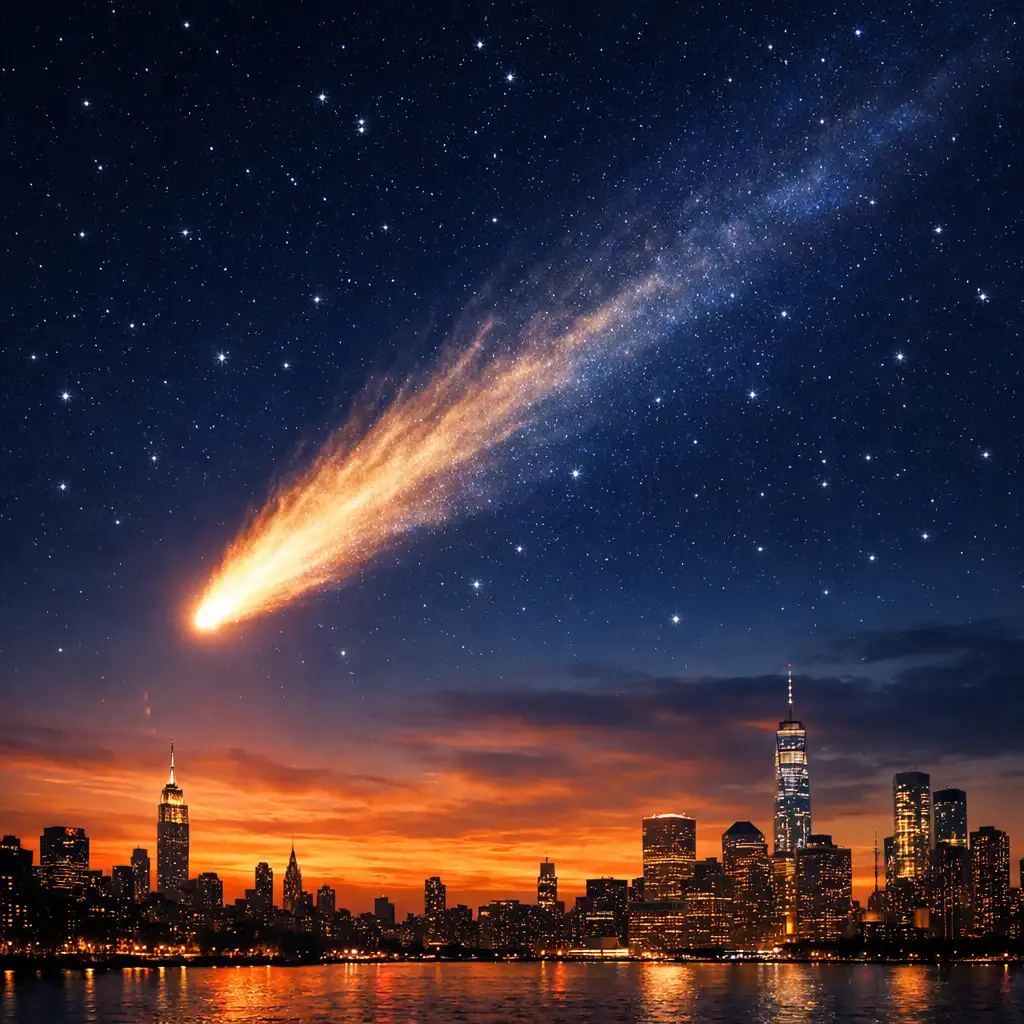

New York City could be just days away from witnessing a rare celestial event as Comet C/2026 A1 MAPS — a fast-moving “sun grazer” — heads into view after a close encounter with the sun. The comet, currently about 89 million miles from Earth, is expected to appear in the evening sky between April 5 and April 8, giving stargazers a narrow but exciting window to catch what could become one of the most talked-about sky events of 2026.
What’s driving the buzz is the comet’s path. Unlike typical comets, this one will swing unusually close to the sun, exposing it to intense radiation. That process can dramatically increase its brightness, causing it to glow and develop a long, visible tail. In the best-case scenario, experts say it could shine almost as bright as a nearby planet like Venus — something rarely visible from a city like New York.
The comet is estimated to be about a mile wide, but its visibility will depend less on size and more on how it reacts to the sun’s heat. As it passes, the frozen gases inside it may rapidly vaporize, creating the bright halo and streaking tail that make comets so striking in the night sky.
Best time and direction to watch the comet
Skywatchers in NYC will want to look toward the southwest sky shortly after sunset. The comet is expected to appear low on the horizon, making timing and location crucial. Rooftops, waterfronts, and open parks with minimal obstruction will offer the best chance of spotting it.
Experts recommend heading out just after dusk, before the comet dips too low. Binoculars could improve visibility, especially if the comet turns out dimmer than expected. While urban light pollution may limit clarity, even a faint sighting could be a rewarding experience for those patient enough to scan the sky.
But there’s a catch — and it’s a big one.
“Comets are notoriously fickle,” astronomers have warned. While this one has strong potential, there is no guarantee it will deliver a bright show. It could just as easily fade or even break apart as it passes close to the sun, leaving skywatchers with little more than a faint blur.
Why this comet is getting so much attention
Part of the excitement comes from that unpredictability. Comets are among the most dramatic objects in the solar system because they can suddenly brighten or disappoint without warning. This particular comet has all the ingredients for a spectacle — close solar pass, fresh material, and a favorable viewing window — but its final performance remains uncertain.
That uncertainty hasn’t stopped astronomers and enthusiasts from watching closely. Events like this don’t come often, especially ones that could potentially be visible over a major city skyline.
The timing also adds to the hype. April is shaping up to be a packed month for skywatching, turning what might have been a single event into a full cosmic lineup.
April sky events don’t stop with the comet
Later in the month, the Lyrids meteor shower will take over the night sky, running from April 14 to April 30 and peaking on April 21 and 22. During peak nights, viewers could spot up to 20 meteors per hour under clear conditions.
The best time to watch the Lyrids will be after 10 p.m., when the sky is darkest. While not the most intense meteor shower of the year, the Lyrids are known for producing bright streaks and occasional fireballs, making them a favorite among casual observers.
For those tracking multiple events, resources like Sky & Telescope provide regular updates and viewing tips throughout the month.
And April’s cosmic lineup doesn’t end there.
NASA’s major moon mission adds to the excitement
Adding a human spaceflight milestone to the mix, NASA is preparing for its first crewed moon mission in more than 50 years. The Artemis II mission is expected to launch this month from Kennedy Space Center in Florida, marking a major step forward in the agency’s plan to return humans to the lunar surface.
Unlike the historic Apollo missions, Artemis II will not land on the moon. Instead, astronauts will travel in a figure-eight path around Earth and the moon, testing critical systems for future missions.
The mission is designed as a precursor to Artemis III, which is currently targeted for a human moon landing later in the decade. If successful, it would mark the first time humans set foot on the moon since December 1972.
For many, the overlap of a potential comet sighting, a meteor shower, and a historic NASA mission makes April 2026 feel like a rare moment when space headlines move from screens into real life.
A rare chance to look up
In a city that rarely slows down, events like this offer a reminder to pause and look up. Whether Comet C/2026 A1 MAPS becomes a dazzling streak across the sky or a more subtle glow near the horizon, the opportunity itself is what makes it special.
Between April 5 and April 8, all eyes will be on the southwest sky. Clear weather, a bit of patience, and the right timing could turn an ordinary evening into something unforgettable.

Make Swikblog your go-to source on Google for reliable updates, smart insights, and daily trends.