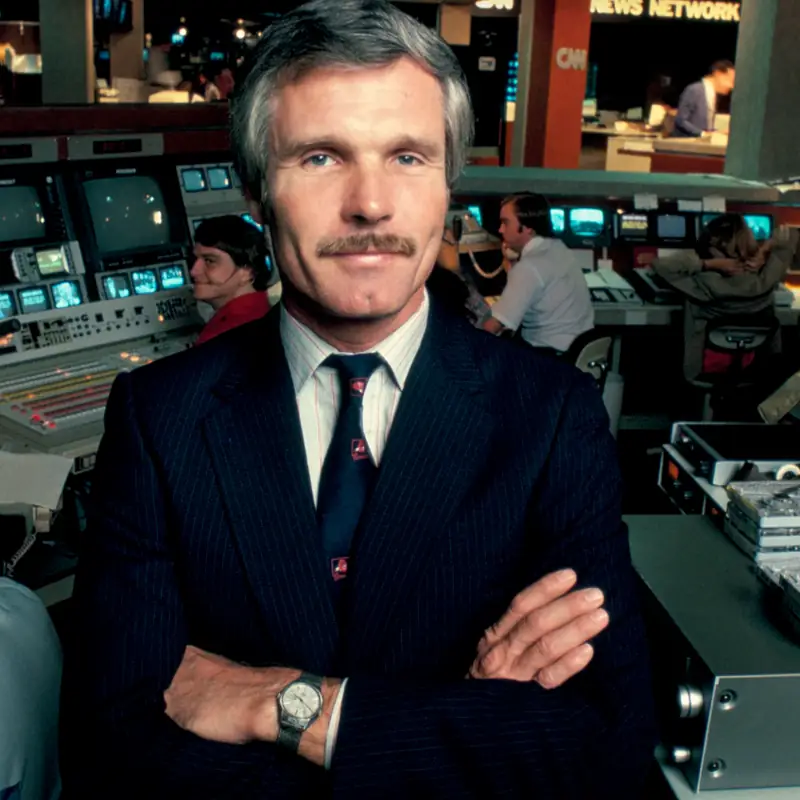

Ted Turner, the media pioneer who turned a risky cable experiment into CNN and changed how the world watches breaking news, has died at 87. His death brings renewed attention to one of the most unusual careers in American television: a billboard businessman who challenged the biggest broadcasters, built a global news brand, owned major sports teams and later became one of the country’s most visible philanthropists.
Turner’s biggest legacy is easy to see today. News is now instant, continuous and global. But when CNN launched on June 1, 1980, the idea of a 24-hour news channel was widely doubted. Most viewers still waited for evening bulletins from the major networks. Turner believed that was outdated. He wanted news available whenever people needed it.
That belief made CNN one of the most important media launches of the modern era.
From Atlanta Station Owner to Cable News Pioneer
Turner’s path into television began after personal tragedy. At 24, he took over his father’s outdoor advertising business after his father’s death. Rather than remain in billboards, Turner expanded into radio and then television, eventually buying a struggling Atlanta station, Channel 17, in 1970.
He filled the station with old films, sitcoms and sports. Then came the move that changed his future: in 1976, he sent the station’s signal by satellite, turning it into one of cable television’s first national superstations. That success helped Turner understand something many traditional executives missed — cable could reach audiences far beyond local markets.
Sports became another major part of his strategy. Turner bought the Atlanta Braves and later the Atlanta Hawks, using live games to build loyal viewers for his channels. It was business, but it was also classic Turner: bold, loud and ahead of the curve.
By the late 1970s, Turner was ready for an even bigger gamble. He wanted a full-time news network. Critics laughed at the idea. Some questioned whether there would be enough news to fill every hour. Others doubted whether viewers would tune in outside traditional news times.
Turner pushed ahead anyway.
CNN’s early years were not polished. The network struggled with technical problems, limited budgets and skepticism from rivals. Some critics mocked it with nicknames, but Turner and his team kept building. He later expanded the CNN brand with CNN2, which became Headline News, and CNN International, giving the network a global reach.
The turning point came during the Gulf War in 1991, when CNN’s live reporting from Baghdad showed the power of real-time television news. Viewers around the world watched history unfold as it happened. That moment helped prove Turner’s original idea: people did want live news, at any hour, from anywhere.
Read More
Turner’s influence soon stretched across entertainment as well. His company built or developed major cable brands including TNT, Turner Classic Movies and Cartoon Network. He also acquired MGM’s film library, giving his networks access to thousands of classic movies and making old Hollywood content valuable again for cable audiences.
A Complicated Life Beyond the Newsroom
Turner’s public image was never quiet. Known as “The Mouth of the South,” he was outspoken, competitive and often unpredictable. That personality made him one of the most recognizable business figures in American media.
In 1996, Turner sold his broadcasting empire to Time Warner in a deal worth billions. He stayed involved for a time, but later corporate changes, especially the AOL-Time Warner merger, weakened his influence. Turner eventually stepped away from the company he had built, later speaking openly about losing control of CNN, parts of his fortune and his role inside the media world.
His personal life also drew attention. Turner married actress Jane Fonda in 1991, and the two became one of America’s most talked-about couples. Their marriage ended after a decade, but both continued to describe the relationship with affection and respect.
Turner’s later years were shaped by philanthropy and conservation. In 1997, he pledged $1 billion to support United Nations causes, a remarkable commitment that led to the creation of the United Nations Foundation. He also supported nuclear disarmament, global health, environmental protection and endangered species work.
His conservation efforts became a major part of his identity. Turner owned millions of acres of land and became known for helping restore bison populations in the American West. His interest in the environment also reached popular culture through “Captain Planet,” the animated series created to teach children about protecting the planet.
In 2018, Turner revealed that he had Lewy body dementia, a progressive brain disorder. In early 2025, he was hospitalized with a mild case of pneumonia before recovering. He is survived by his children, grandchildren and great-grandchildren.
For CNN, Turner will always be more than a founder. He created the model that turned live news into a permanent part of daily life. For the wider media industry, his career remains a reminder that some of the biggest changes begin as ideas that experts dismiss.
Ted Turner did not just build a news channel. He helped create the world of nonstop information that people live in today.
External source: CNN

Make Swikblog your go-to source on Google for reliable updates, smart insights, and daily trends.