
Swikblog Energy Desk | Updated December 10, 2025
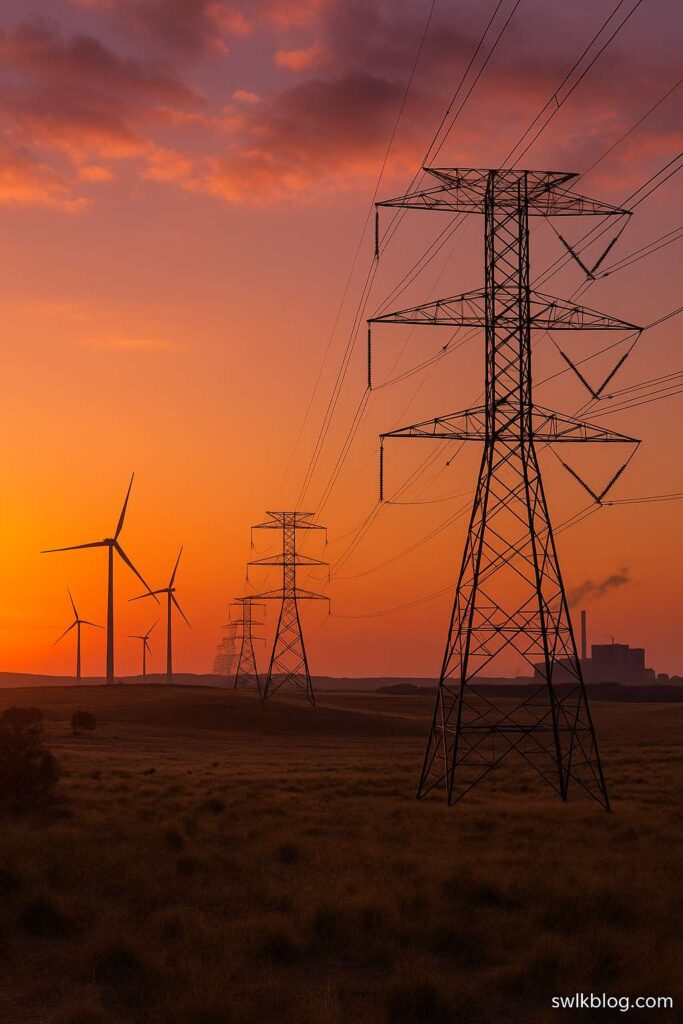
Australia’s transition away from coal has always been pitched as inevitable. Now the country’s energy market operator has put firmer numbers on what that shift will actually look like – and they are eye-watering. A new draft roadmap from the Australian Energy Market Operator (AEMO) says the main power grid will need to triple in capacity by 2050, with a fivefold increase in large-scale wind, solar and storage, and a capital bill of around $128 billion in today’s dollars.
The draft Integrated System Plan, released this week, covers the National Electricity Market that links Queensland, New South Wales, the ACT, Victoria, South Australia and Tasmania. AEMO argues that the cheapest way to meet rising demand is still clear: renewable energy as the bulk of generation, firmed by batteries and pumped hydro, and backed up by fast-start gas plants for the rare moments when the wind doesn’t blow and the sun doesn’t shine. Detailed analysis published by The Guardian shows renewables already provide close to half of the grid’s electricity, but the pace must accelerate sharply if the Albanese government’s target of 82% renewables by 2030 is to be met.
Tripling the grid for an electrified economy
Why does the grid need to become three times bigger in just 25 years? AEMO’s modelling points to a profound shift in how Australians will use power. Homes are expected to rely increasingly on electric heating and cooking, petrol cars will gradually give way to EVs, industry will electrify to cut emissions, and a wave of data centres will chew through huge amounts of electricity.
To keep up, the system operator says the National Electricity Market will require tens of gigawatts of new large-scale wind and solar farms, coupled with a surge in storage: grid-scale batteries, pumped hydro projects such as Snowy 2.0, and a rapid build-out of rooftop solar and behind-the-meter batteries on homes and businesses.
The draft plan also calls for thousands of kilometres of new transmission lines to connect renewable-rich regions with the cities. AEMO estimates roughly 6,000 kilometres of priority lines are needed, at a cost of about $9 billion, but argues those projects would more than pay for themselves through lower wholesale prices and avoided emissions. The message is blunt: build the poles and wires, or pay more later in higher bills and reliability risks.
Coal’s long goodbye – now stretched to 2049
Perhaps the most politically charged finding in the roadmap is that coal-fired power is now expected to remain in the mix until 2049. Earlier planning had most coal plants leaving the system well before the 2040s, but decisions in Queensland to extend the life of state-owned generators have pushed the final retirement date more than a decade later than once forecast.
Two-thirds of the existing coal fleet is still tipped to close in the next decade, often ahead of their current closure dates, as ageing plants struggle with reliability and the economics of competing with cheap solar. But a smaller rump of coal units is modelled to hang on as the grid’s back-up workhorses, ramping up and down to cover periods of low renewable output. Business coverage in outlets such as the Australian Financial Review underscores how sensitive that timetable is to politics, community opposition and project delays.
For climate groups, a 2049 coal exit date will feel uncomfortably late. For grid planners, it is framed as a risk management exercise: keep some firm generation on the system while transmission, renewables and storage catch up. The draft plan leaves open the possibility that coal could close sooner if replacement projects are delivered faster.
A $128 billion price tag – and the cost of delay
The headline number – $128 billion – covers transmission, generation and storage across AEMO’s “optimal development path”. Spread over decades and across millions of customers, it is not a one-off hit, but it is still a politically explosive figure in an era of rising living costs.
AEMO’s chief executive, Daniel Westerman, describes the roadmap as the least-cost
way to deliver a reliable, low-emissions grid. The operator emphasises that delaying projects will not save money; it will simply push up overall costs as old assets become more unreliable and emergency fixes become more frequent. Renewable industry groups have quickly adopted a simple slogan: the more we delay, the more we pay
.
Communities, meanwhile, will be asked to host an unprecedented wave of infrastructure – from high-voltage lines across farmland to rows of turbines and solar panels on ridgelines and plains. Earning a “social licence” for that build-out is now as central to the plan as the engineering.
What this means for households and business
For household budgets, the roadmap is not a short-term bill shock announcement but a signal of where policy is heading. In the long run, AEMO and independent analysts say a grid dominated by wind, solar and storage should be cheaper than clinging to ageing coal, because the “fuel” – sun and wind – is free once the capital is spent.
In the near term, the transition will feel messy. Some regions will see big construction projects and community fights over new lines. Coal workers will be looking for clarity on jobs, retraining and new industries. Businesses that rely on cheap, firm power will want confidence that the lights stay on as plants retire.
For many Australians, the most visible sign of the shift will be closer to home: more rooftop solar, smarter meters, home batteries and electric vehicles plugging into streets that were never designed for this level of demand. The national roadmap suggests that, if managed well, households can be part of the solution – lowering their own bills while strengthening the grid.
You may also like to read
For more on how big infrastructure decisions shape costs for households across our region, see our coverage of changing bank and interest-rate settings: Westpac lifts mortgage rates 30bps in New Zealand – what it means for borrowers .

Make Swikblog your go-to source on Google for reliable updates, smart insights, and daily trends.