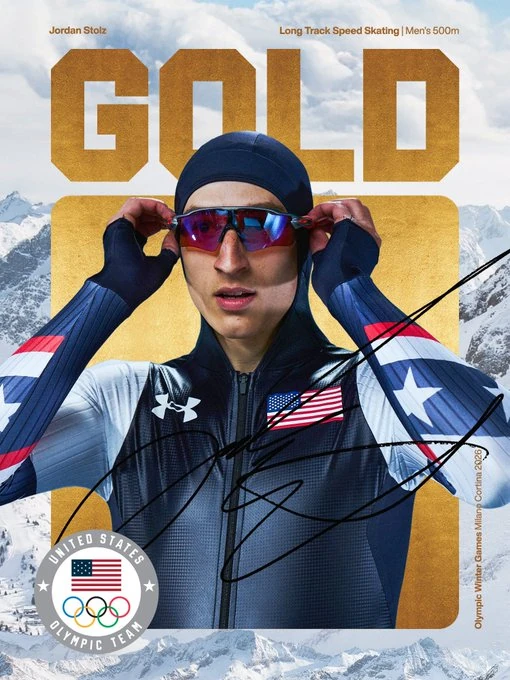

American speed skater Jordan Stolz continued his remarkable run at the Milano Cortina 2026 Winter Olympics by winning the men’s 500-meter speed skating final in an Olympic-record 33.77 seconds. The victory secured his second gold medal of the Games and further established the 21-year-old as one of the breakout stars of the competition.
The triumph came only days after Stolz claimed gold in the 1,000 meters, making him the first American speed skater since Eric Heiden in 1980 to win two Olympic gold medals at the same Winter Games.
A historic race from start to finish
The men’s 500-meter final turned into one of the fastest races in Olympic history. Canada’s Laurent Dubreuil briefly lowered the previous Olympic record of 34.32 seconds with a run of 34.26, but the milestone lasted only until the final pairing.
Skating against Dutch sprinter Jenning de Boo, Stolz faced intense competition from the opening meters. De Boo crossed the finish line in 33.88 seconds, becoming the first athlete to break the 34-second barrier in an Olympic men’s 500-meter race. Stolz responded moments later with an even faster time of 33.77, winning gold by just 0.11 seconds.
The result meant both skaters produced the first sub-34-second Olympic performances in the event’s history. Stolz also finished only 0.16 seconds away from the current world record, underlining just how extraordinary the race was.
Second Olympic title caps dominant performances
Stolz arrived in Italy as one of speed skating’s biggest names after setting the men’s 1,000-meter world record of 1:05.37 in Salt Lake City in 2024. Earlier in the Games, he captured Olympic gold in the 1,000 meters with another Olympic-record performance of 1:06.28.
Winning both sprint events places Stolz among the most successful American speed skaters in Olympic history and highlights the consistency that has made him the athlete to beat in international competition.
A rivalry to watch beyond Milan
The Milano Cortina Games also showcased a growing rivalry between Stolz and Jenning de Boo. The American finished ahead of the Dutch skater in both the 500-meter and 1,000-meter finals, while De Boo earned silver medals in each event.
With both skaters still early in their careers, their head-to-head battles are expected to remain a major storyline at future World Championships and Winter Olympic competitions.
A milestone for U.S. speed skating
Multiple individual Olympic gold medals at a single Winter Games are rare in speed skating. Stolz’s performances have revived one of Team USA’s proudest Olympic traditions while demonstrating how the sport continues to evolve with faster times and increasingly competitive fields.
Sports fans following other major international events can catch up on FIFA’s suspension of two USMNT staff members after the Belgium match or the latest developments involving Lionel Messi, Argentina and Cristiano Ronaldo.
Complete race results, official timings and medal standings from the Milano Cortina 2026 Winter Olympics are available through the official Olympics website.
Read More:
- Halifax Jazz Festival cancels Saturday night show after Broken Social Scene pulls out
- Obama Presidential Center museum tickets: Prices, dates and how to book
- Visit the Swikblog homepage for more latest news

Make Swikblog your go-to source on Google for reliable updates, smart insights, and daily trends.