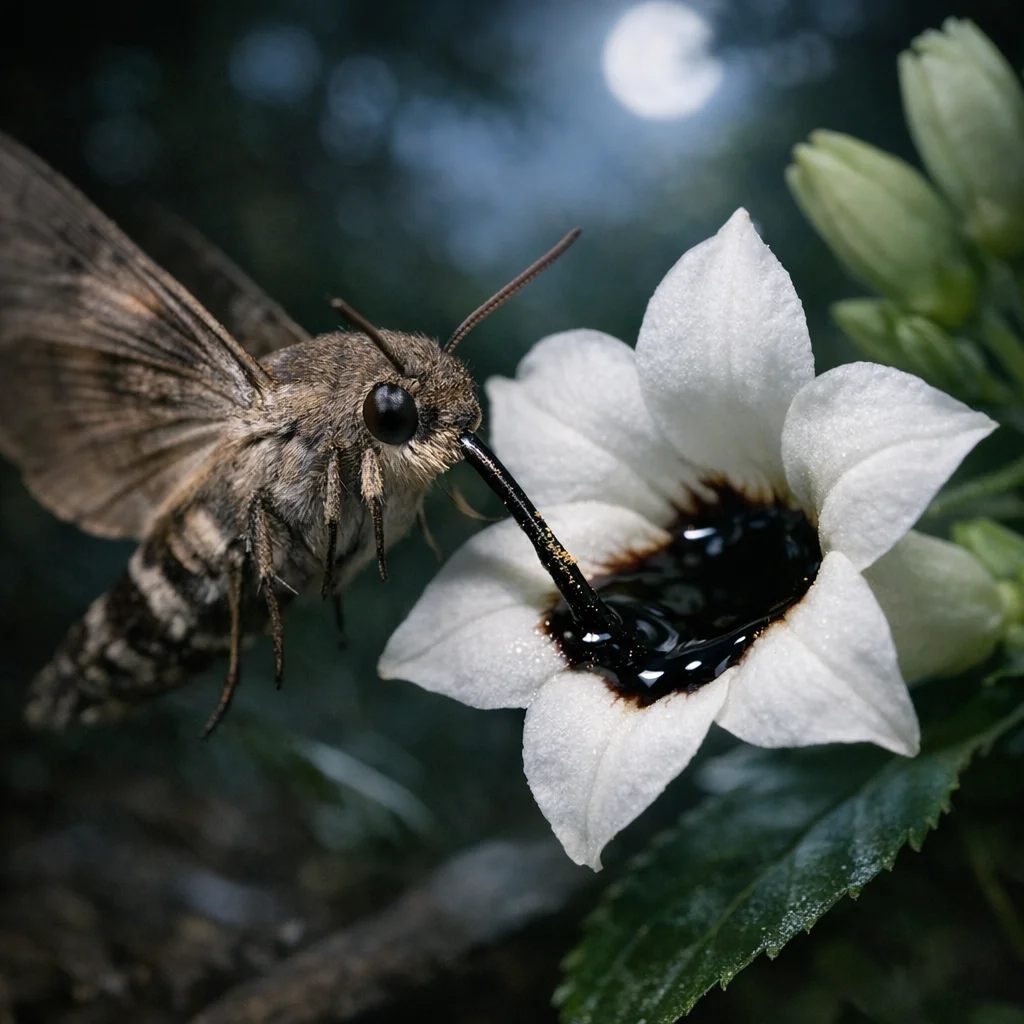

In a discovery that is quietly reshaping how scientists understand nature, researchers have confirmed something never seen before: nocturnal moths are pollinating flowers that produce colored nectar.
The breakthrough, published on April 3, 2026, in the peer-reviewed journal Ecology, comes from scientists Soma Chiyoda, Ko Mochizuki, and Atsushi Kawakita at the University of Tokyo. Their work centers on a rare Japanese plant, Jasminanthes mucronata, known for one striking feature—its unusual black nectar.
For decades, scientists believed colored nectar was designed mainly for daytime pollinators like birds and bees, which rely heavily on vision. But this new research flips that assumption, revealing that some of the most important pollination activity may be happening under the cover of darkness.
The team spent a total of 75 hours observing flower visitors across multiple sites in southern Japan, carefully tracking activity during both day and night. What stood out was consistent: nocturnal hawkmoths repeatedly visited the plant’s white, fragrant flowers, while daytime visitors were far less significant.
“I have always liked moths,” said lead author Soma Chiyoda, who has long studied their largely overlooked ecology. When he first encountered Jasminanthes mucronata, he suspected the plant might be adapted to attract moths. The pale color and strong scent were classic signals of night-pollinated flowers—but the presence of black nectar made the case unusual.
Still, observation alone was not enough. The researchers needed hard proof that the moths were actually pollinating the plant, not just feeding. That turned out to be one of the biggest challenges of the study.
Hawkmoths are fast, highly agile fliers, and early attempts to capture them using insect nets repeatedly failed. After several frustrating efforts, the team switched tactics and used light trapping. Eventually, they succeeded.
What they found confirmed their hypothesis. A captured hawkmoth carried pollen from Jasminanthes mucronata on its proboscis—the long, tube-like mouthpart it uses to drink nectar. It was direct evidence that the insect was acting as a pollinator.
That moment marked a scientific first. This is now the first confirmed case of a colored-nectar flower being primarily pollinated by nocturnal insects.
The implications are significant. Colored nectar has long fascinated researchers because nectar is typically transparent. When plants produce nectar in unusual colors—red, yellow, or even black—it is often assumed to function as a visual signal to attract pollinators. Until now, that assumption was tied almost entirely to daytime species.
This study suggests something more complex is at play.
If nocturnal moths are key pollinators, then colored nectar may not be purely about visibility. Scientists are now considering whether it could play roles in scent signaling, contrast under low light, or even chemical communication. It also raises the possibility that many plant traits previously explained through daytime interactions may have hidden nighttime functions.
Perhaps the biggest mystery remains unanswered: why does this plant produce black nectar?
The researchers are cautious. The current study does not explain the adaptive purpose of the dark nectar, and that question is now a major focus for future work. It could help repel certain visitors, enhance attraction for specific pollinators, or serve a role scientists have yet to imagine.
“We aim to use this plant as a model to explore the adaptive role of colored nectar at night,” Chiyoda said, pointing to a broader goal of understanding how such traits evolved.
The discovery also highlights how much of nature remains unexplored—not because it is hidden, but because it happens when humans are not usually watching.
Nocturnal ecosystems are notoriously difficult to study. Limited visibility, challenging field conditions, and the behavior of night-active species make research slow and technically demanding. As a result, many ecological interactions remain poorly documented.
This finding is a reminder that even familiar plants can hold secrets. Jasminanthes mucronata is not a newly discovered species, yet its relationship with hawkmoths had gone unconfirmed until now.
The real-world importance of such research extends beyond academic curiosity. Pollination is a cornerstone of biodiversity and food systems. Understanding how plants and pollinators interact—whether during the day or at night—helps scientists better predict how ecosystems respond to environmental changes.
As climate change, habitat loss, and declining insect populations continue to disrupt ecological balance, insights like these become increasingly valuable. They provide a clearer picture of resilience, adaptation, and the hidden connections that sustain life.
The study is already expected to spark new research into nighttime pollination and the evolution of floral traits. It may also encourage scientists to revisit long-standing assumptions about how plants communicate with pollinators.
Readers interested in the original research can explore more through the journal Ecology.
What makes this discovery compelling is not just the science, but the setting. A quiet mountain landscape in Japan. A moth hovering in the dark. A flower holding black nectar. And in that moment, a long-held belief in ecology begins to shift.
Sometimes, the biggest breakthroughs do not arrive with noise or spectacle. They happen quietly, in the dark—waiting for someone patient enough to notice.

Make Swikblog your go-to source on Google for reliable updates, smart insights, and daily trends.