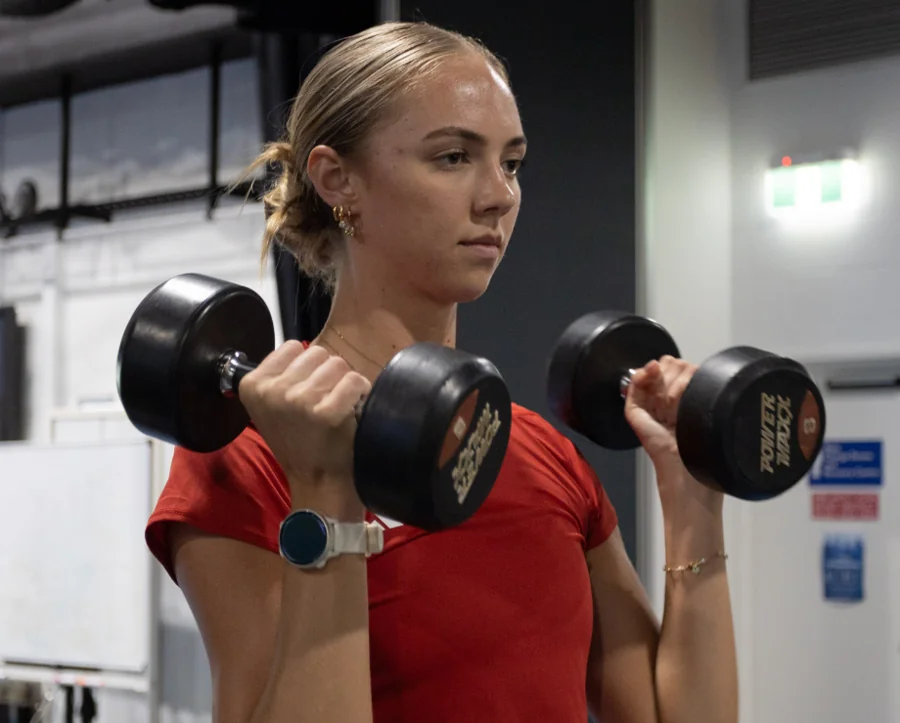

Australian high jumper Erin Shaw has described the frightening gym accident that left her needing spinal fusion surgery, months of rehabilitation and a long road back toward elite athletics.
The 21-year-old, who represented Australia at the 2023 World Athletics Championships in Budapest, suffered the injury during a routine strength session shortly before Christmas. Shaw was performing Bulgarian split squats, a demanding single-leg exercise commonly used in elite athletics training, when the movement went badly wrong.
She was carrying 135 kilograms across her back when she lost balance and collapsed under the weight.
“It crushed my spine,” Shaw said while reflecting on the accident that changed the direction of her career.
The original recovery feature from the New South Wales Institute of Sport can be read through the NSWIS report on Erin Shaw’s injury and rehabilitation.
The terrifying moments after Erin Shaw’s gym accident
Shaw said that after slipping during the exercise, she remained briefly bent forward with the loaded bar still pressing onto her back before eventually collapsing to the floor.
The pressure caused immediate damage to her spine and sent severe pain through her body. She described the sensation as intense cramping running up and down her back.
Shaw remained on the gym floor for around 45 minutes while waiting for paramedics to arrive. Her New South Wales Institute of Sport strength and conditioning coach, Chris Brandner, stayed beside her and told her not to move because of concerns about spinal damage.
As the pain intensified, even breathing became difficult because movement around her diaphragm triggered spasms through her back.
Despite the fear, Shaw could still feel and move her feet — an early sign that gave her some hope in a frightening moment. Mentally, however, the uncertainty was overwhelming. She later recalled wondering whether she would be able to walk again, let alone return to high jump.
Medical scans confirmed the seriousness of the injury. The disc between her T12 and L1 vertebrae had burst, ligaments around the area were badly damaged, and she had also fractured her L1 vertebra.
Doctors presented Shaw with two options. One involved avoiding surgery and spending months in a brace, though surgeons warned that path carried a lower chance of returning to elite competition. The second option involved spinal fusion surgery, with screws and rods inserted to stabilise the spine.
Shaw chose surgery because she wanted the strongest possible chance of competing again.
On Christmas Day, surgeon Dr Nathan Hartin operated on her spine at Sydney’s Royal North Shore Hospital. Metal rods were inserted on both sides of her spine, along with pedicle screws into the affected vertebrae. The surgery meant Shaw and her family spent Christmas in hospital instead of at home.
Read More
Erin Shaw’s painful recovery and return to training
After surgery, Shaw entered a physically and mentally demanding recovery period.
She was fitted with a specially moulded fibreglass brace that stretched from her shoulders to her hips and wrapped around her torso like a rigid corset. The brace was designed to keep her spine stable while the screws and rods healed into position.
For 10 weeks, Shaw wore the brace almost constantly except while sleeping. She described the experience as extremely uncomfortable, especially during the Australian summer, with the brace digging into her body whether she was sitting or standing.
Those first 10 weeks after surgery became some of the hardest of her life because of the pain, lack of movement and uncertainty about her future in sport.
Doctors remained optimistic because Shaw is young, highly conditioned and physically strong — all important factors in spinal recovery.
Her rehabilitation at the New South Wales Institute of Sport has since included bodyweight squats, seated gym work, swimming, controlled running and bike sessions inside heat chambers.
Shaw has said she is now focusing on “small wins” rather than looking too far ahead. Being cleared to swim and run again after only a few months became a major emotional boost, even though returning to jumping still feels distant.
The back injury came during an already difficult period in Shaw’s career. Earlier in 2025, she tore the patella tendon in her take-off knee while competing in Japan. She had not yet returned from that setback when the spinal accident happened.
Shaw said the earlier knee rehabilitation helped her understand that recovery is rarely simple or linear. That experience has now become part of the mental framework guiding her through a much bigger challenge.
Outside athletics, Shaw is studying a Bachelor of Psychological Science online through the University of New England. She also speaks German after spending two years studying in Germany during high school.
The injury has also changed the way she views sport and identity. Shaw has spoken about learning to separate who she is from what she does as an athlete, while also appreciating the support of family, friends, coaches and teammates more deeply.
Despite the severity of the injury, Shaw has made clear that retirement from high jump never seriously crossed her mind.
She represented Australia at the 2022 World Athletics Under-20 Championships in Colombia, finishing fourth with a clearance of 1.88 metres. A year later, she competed at the senior world championships in Budapest alongside Eleanor Patterson and Nicola Olyslagers.
Her personal best remains 1.90 metres, and she still hopes to eventually join Australia’s elite two-metre club in women’s high jump. Shaw also continues to dream of future world championships and a possible run toward the Los Angeles 2028 Olympics.
More athlete recovery stories and sports updates can be found in the Swikblog Sports section.
What makes Shaw’s story resonate is not only the seriousness of the injury, but the mindset she has shown since the accident. She has spoken with gratitude about being able to walk, swim and run again, even as the bigger goal of jumping remains further away.
For now, her comeback is being built through rehabilitation sessions, patience and the belief that her career is far from over.

Make Swikblog your go-to source on Google for reliable updates, smart insights, and daily trends.