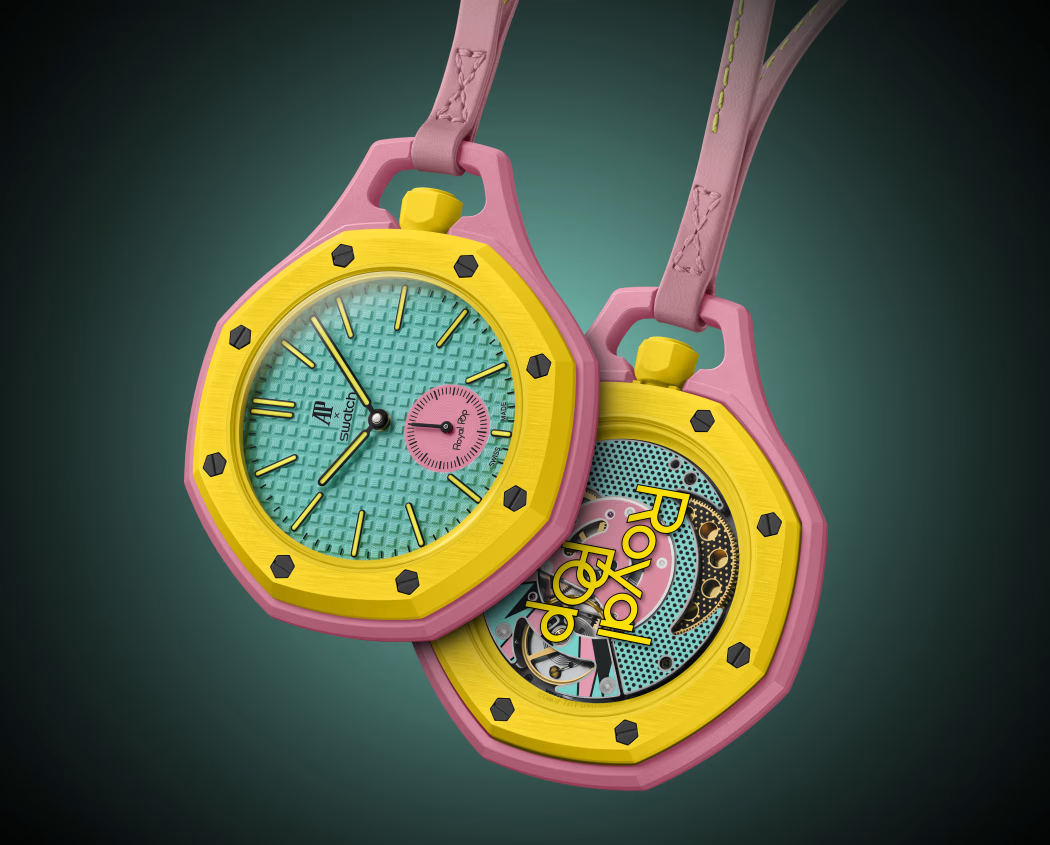

Swatch and Audemars Piguet have shown once again that the modern watch market is no longer driven only by movements, case finishing or heritage. Sometimes, a limited release with the right logo, the right price and just enough surprise can turn a small accessory into a full-scale buying frenzy.
The new Royal Pop collaboration between Swatch and Audemars Piguet became the latest example on Saturday, May 16, 2026, after shoppers crowded stores for a colorful pocket watch priced from about $400. What began as a niche collector launch quickly spilled into mainstream attention as long lines, resale listings and police crowd control turned the release into one of the most talked-about watch drops of the year.
The hype was not built overnight. In the days before the launch, watch fans were already speculating that the two Swiss brands could be preparing a more affordable version of Audemars Piguet’s Royal Oak, a model widely seen as one of the most important luxury sports watches ever made. That expectation made the final reveal even more surprising.
Instead of a Royal Oak-style wristwatch, buyers were offered a bright, playful pocket watch. For some collectors, that made the release disappointing. For others, it made the collaboration more interesting because it avoided the obvious route.
The debate did little to slow demand. According to The Wall Street Journal, Royal Pop watches that started at around $400 were quickly being listed by resellers for thousands of dollars. That gap between retail price and resale expectations explains why so many people rushed to stores as soon as the release went live.
One of the clearest signs of the frenzy came from Somerset Mall in Troy, Michigan. Hundreds of people gathered there hoping to buy the Swatch x Audemars Piguet pocket watch, but the situation became difficult to manage. Local reports and images from the mall showed large crowds inside the shopping center before police dispersed shoppers and the sale was cancelled.
The Troy scene gave the Royal Pop release a sharper news angle. It was no longer just a collector conversation about whether a pocket watch made sense. It became a story about how far consumers are willing to go for limited collaborations and how quickly hype can overwhelm physical retail stores.
Why a $400 Pocket Watch Created Such a Big Reaction
The Royal Pop watch sits in an unusual space. It is not a traditional Audemars Piguet product, and it is not a normal Swatch release either. That middle ground is exactly why it attracted so much attention.
Audemars Piguet represents high-end Swiss watchmaking, with many of its best-known models costing far beyond the budget of everyday buyers. Swatch represents accessibility, color and mass-market creativity. When those two names appear on one product, the result becomes more than a watch. It becomes a chance for ordinary consumers to buy into a luxury story at a much lower price point.
That formula has already worked for Swatch. The company’s Omega MoonSwatch collaboration created huge queues, instant resale premiums and a new kind of audience for Swiss watches. Royal Pop follows that same cultural pattern, but with a more divisive design choice.
Swikblog had earlier covered the build-up to the release in Swatch x Audemars Piguet Royal Pop Confirmed for May 16 Launch, when excitement was still focused on teasers, launch timing and speculation around what form the collaboration would take.
Now that the product is here, the conversation has shifted. The question is no longer whether the collaboration is real. The question is why a pocket watch, a format many people rarely use today, managed to create such an intense buying rush.
The answer lies partly in scarcity. Limited-edition products create urgency because buyers fear missing out. When that limited product also carries the Audemars Piguet name and a Swatch-level price tag, the pressure increases dramatically. Collectors want it for the brand connection. Resellers want it for the profit opportunity. Casual fans want it because everyone is suddenly talking about it.
Read More
- Visit Swikblog Homepage
- Puffins Found Dead After Deadly Storms as Breeding Season Begins
- Belfast Plants 293,516 Trees Under 1 Million Trees Initiative
- Hackney Half Marathon 2026 Road Closures: East London Streets Shut
- Kingston Power Outage Leaves 13,432 Customers Affected
- NTSB Wimberley Plane Crash Report: 5 Killed
The design also helped the story spread. A simple Royal Oak-inspired Swatch might have been easier to understand, but it would also have been more predictable. A rainbow-colored pocket watch is harder to ignore. It gives people something to argue about, photograph and share. In today’s digital market, that kind of reaction can be more valuable than quiet approval.
The Royal Pop release also shows how luxury marketing has moved closer to sneaker culture. Store lines, quick sellouts, resale premiums and online arguments are now common around watches that once would have been discussed mainly by dedicated collectors. A release can become successful not only because of what it is, but because of the public moment it creates.
That same scarcity-driven behavior has been visible across the broader watch market. Swikblog recently reported on another collector rush in Rolex ‘Pepsi’ GMT-Master II Discontinued: Prices Surge as Collectors Rush for Limited Supply, where limited availability and speculation pushed buyers toward the secondary market.
Royal Pop is very different from a Rolex GMT or an Audemars Piguet Royal Oak, but the buying psychology is similar. When consumers believe a product may be hard to get later, they act quickly. When resale prices rise, more people treat the item like an asset rather than a simple accessory.
Swatch Wins Attention, Audemars Piguet Reaches a New Audience
For Swatch, the launch strengthens its position as one of the most effective collaboration brands in the watch industry. The company understands how to make Swiss watch culture feel accessible without removing the excitement of exclusivity.
For Audemars Piguet, the partnership is more delicate. Luxury brands usually protect their image by staying rare, expensive and difficult to access. A $400 pocket watch puts the AP name in front of a much wider audience. That can be powerful, but it also invites criticism from purists who believe the brand should avoid mass-market hype.
Still, the attention is difficult to dismiss. Many people who may never enter an Audemars Piguet boutique are now discussing the brand because of Royal Pop. Younger buyers are seeing AP in a more playful context. Even negative reactions are keeping the product in the conversation.
The biggest challenge may be the buying experience. When a launch creates scenes like those reported at Somerset Mall, brands risk frustrating the very fans they hope to excite. Cancelled sales, crowd dispersals and unclear availability can leave collectors feeling shut out. If Swatch plans more high-profile collaborations, smoother store management and clearer release systems may become essential.
Even with those concerns, the Royal Pop launch has already delivered what most brands want from a limited release: visibility, urgency and cultural relevance. It turned a $400 pocket watch into a headline story. It forced watch fans to debate design, value and resale hype. It brought luxury branding into shopping mall corridors and social media feeds at the same time.
Whether the Royal Pop becomes a lasting collectible or a short-lived resale play will depend on supply, buyer interest and how the secondary market behaves after the initial rush. But its launch has already made one point clear: Swatch and Audemars Piguet did not need to release an affordable Royal Oak to dominate the watch conversation.
They only needed to create something unexpected enough to make people stop, argue and line up.

Make Swikblog your go-to source on Google for reliable updates, smart insights, and daily trends.