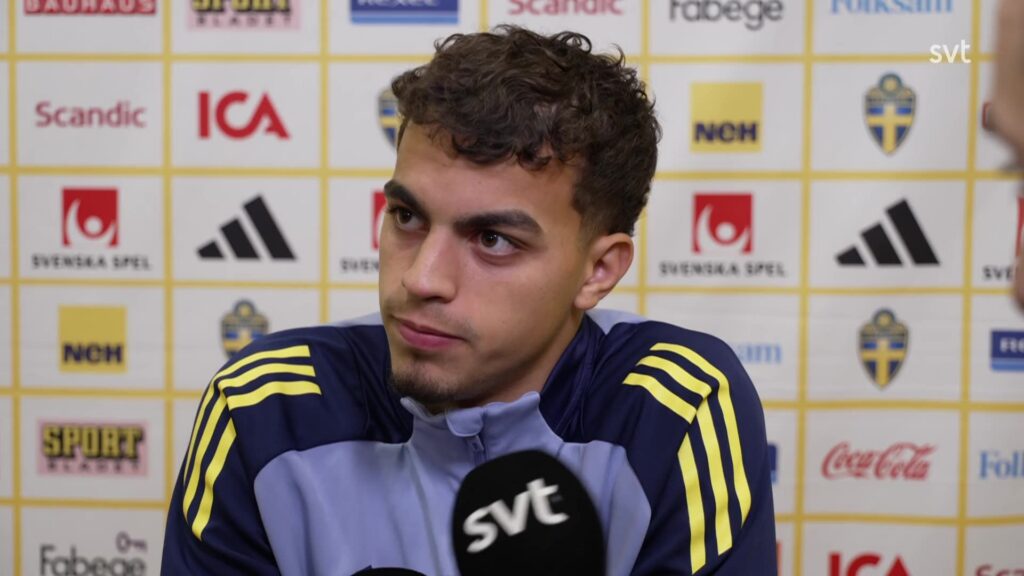

Yasin Ayari’s first World Cup appearance for Sweden carries a story far bigger than a Group F opener. The 22-year-old midfielder is preparing to face Tunisia, the country where his father was born and raised, in a match that turns Sweden’s tournament start into one of the more personal stories of the 2026 FIFA World Cup.
For most players, a World Cup debut is already the defining moment of a young career. For Ayari, it also places him directly opposite the national team he once could have represented. Tunisia had shown interest in bringing him into their setup before the 2022 World Cup cycle, but Ayari stayed with Sweden, the country where he was born, developed and eventually became a senior international.
The emotional centre of the story is his father, Azzouz Ayari. According to USA TODAY, Ayari’s father encouraged him to represent Sweden rather than Tunisia, telling Swedish outlet Aftonbladet that his son should give something back to the country that welcomed and developed him. That family advice shaped a decision that now comes full circle on the World Cup stage.
Ayari was born in Solna, Sweden, and came through Swedish football before joining Brighton & Hove Albion. He has grown into a serious midfield option for Sweden, and his inclusion in Graham Potter’s World Cup squad gives him the chance to make his biggest international statement yet. FIFA’s official tournament coverage has listed Sweden in Group F alongside Tunisia, the Netherlands and Japan, making this opener a significant early test for both teams.
FIFA’s 2026 World Cup coverage places Sweden in a difficult group where every early result could carry major weight. The Netherlands and Japan bring pedigree and structure, while Sweden arrive with attacking quality and Tunisia bring defensive discipline and tournament experience.
Ayari’s choice turned a normal fixture into a family moment
The reason this match stands out is not only Ayari’s dual eligibility. It is the way his decision was shaped by family, identity and gratitude. Ayari has Tunisian heritage through his father, but he has spoken clearly about feeling Swedish and wanting to represent Sweden at international level.
That makes the Tunisia match emotionally layered. On one side is the country that helped build him as a player. On the other is the country tied to his father’s childhood, family history and cultural roots. Few World Cup debuts ask a player to carry that much personal meaning before the first whistle.
Tunisia’s manager Sabri Lamouchi has also acknowledged the situation with respect. He described Ayari as a very good player and said he respected the midfielder’s decision, while making clear that any goodwill would come after the match. For Tunisia, Ayari represents the kind of dual-national talent that can shape modern international football, especially for nations competing to strengthen their squads before major tournaments.
Sweden will hope Ayari’s composure in midfield helps them control the tempo against a Tunisia side still chasing a historic World Cup breakthrough. Tunisia have never advanced beyond the group stage, and Lamouchi’s team enters the tournament knowing that a positive result against Sweden could immediately change the tone of their campaign.
Sweden, meanwhile, have bigger ambitions after returning to the World Cup with a squad led by major attacking names. Viktor Gyökeres and Alexander Isak give Potter’s team a sharp forward edge, but players like Ayari may be just as important in linking midfield control with Sweden’s front line.
The story also connects with the wider emotional side of the 2026 tournament, where family, cost and fan experience have already become part of the conversation. A recent father’s viral $3,000 World Cup ticket claim showed how personal the tournament can become for families following football’s biggest event.
A debut shaped by two countries
Ayari’s Sweden debut against Tunisia is not a story of rejection as much as it is a story of belonging. His father’s message gave the decision a moral weight: Sweden had given his son the platform, the training and the pathway, and representing that country became a way of honouring that journey.
That does not erase the Tunisian connection. In many ways, the match makes it even more visible. Ayari will walk into a World Cup stadium wearing Sweden’s colours, but the opponent across from him will carry a part of his family’s past.
For Sweden, the match is about points, momentum and surviving a competitive Group F. For Tunisia, it is about making a statement in a group where every margin matters. For Ayari, it is something more intimate: a first World Cup step taken against the country that once offered him another path.
That is why his debut has become one of the more human stories of the early tournament. It is a football decision, a family decision and a national identity story all arriving in the same match. When Sweden and Tunisia meet, Ayari will not only be starting a World Cup campaign. He will be standing between the country that raised him and the country that shaped his father’s story.

Make Swikblog your go-to source on Google for reliable updates, smart insights, and daily trends.