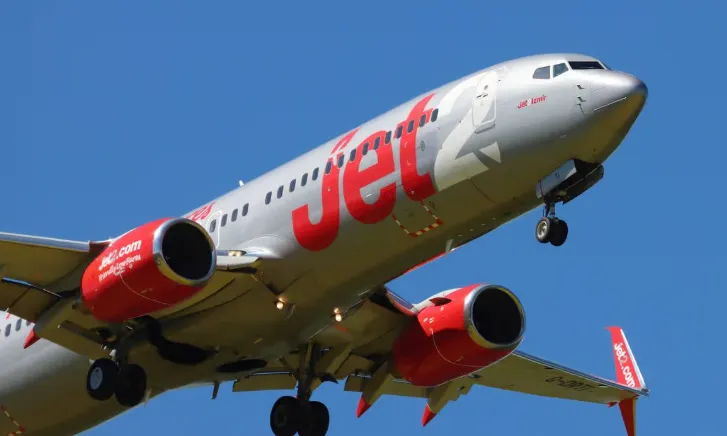

A Jet2 holiday flight from Liverpool to Palma de Mallorca was diverted to Manchester Airport on Thursday, 6 August 2026, after passengers reported an unusual vibration soon after takeoff and the crew declared a general emergency.
Flight LS3251 left Liverpool John Lennon Airport at about 8:00 a.m. BST. The Boeing 737-800, registered G-JZHX, later landed safely at Manchester at around 9:01 a.m. No injuries were reported.
Jet2 arranged another aircraft to continue the journey to Majorca while the original Boeing was taken out of passenger service for inspection. The diversion added several hours of disruption for holidaymakers but did not result in the Palma service being abandoned.
Flight LS3251 changed course shortly after takeoff
Flight-tracking information showed LS3251 heading south after leaving Liverpool before stopping its climb at roughly 15,000 feet. Around 11 minutes after departure, the aircraft changed direction near Shrewsbury and transmitted squawk code 7700.
The 7700 code is used internationally when a flight crew needs to alert air traffic control to a general emergency. It gives the aircraft priority handling but does not identify the cause or mean that a crash is expected.
The aircraft initially appeared to be returning towards Liverpool. Instead of landing there, it entered a holding pattern north of the airport at about 14,000 feet while the pilots assessed the situation and coordinated their next steps with air traffic control.
By about 8:36 a.m., the flight was heading for Manchester. The Boeing began its approach shortly before 9:00 a.m. and landed on runway 23L at approximately 9:01 a.m. Airport fire vehicles were positioned nearby as a precaution.
G-JZHX was able to leave the runway and taxi to the terminal. Passengers did not need to evacuate on the runway, and there were no reports of an onboard fire.
Passengers reported vibration as a bird strike was suspected
A passenger travelling with family described additional noise and a noticeable vibration after departure. The captain later told those onboard that the aircraft needed to land so the problem could be checked.
A possible bird strike was mentioned to passengers, and later discussion around the incident also pointed to that explanation. However, Jet2 did not publicly release a final engineering finding confirming the precise cause, so a bird strike should be treated as the reported or suspected cause rather than a formally established conclusion.
Bird strikes are a recognised aviation risk, particularly around takeoff and landing when aircraft operate at lower altitudes. Even when an aircraft remains fully controllable, unusual vibration, noise or other indications can lead pilots to land so engineers can inspect the engines, wings, nose and fuselage.
The precautionary response was different in cause but similar in principle to a separate Jet2 emergency landing in Portugal after a pilot medical incident, where the crew also changed the flight plan to get the aircraft safely on the ground.
Why the 7700 alert and Manchester response mattered
Squawk 7700 can be selected for technical faults, medical emergencies and other situations requiring priority assistance. It tells controllers that an aircraft needs special handling without revealing the specific problem.
That is why emergency vehicles waiting near the runway should not be interpreted as evidence that the aircraft was on fire or badly damaged. Airports routinely position rescue crews in advance when an emergency has been declared so they can respond immediately if help is needed after landing.
Similar emergency codes can appear during wider operational disruption. During Gatwick Airport disruption involving multiple 7700 alerts, several aircraft used the general emergency code while a runway problem affected normal operations.
The different altitude figures reported for LS3251 are also not necessarily conflicting. Tracking services can record separate points in the same event, such as the altitude when the aircraft stopped climbing, when the emergency code was transmitted and when it later entered a holding pattern.
Jetstar Baggage Allowance 2027: New Carry-On Rules, Fees and What Travellers Need to Know
Qantas Flight QF27 Turns Back to Melbourne After Mechanical Issue: Latest Update
Replacement aircraft continued the journey to Palma
Jet2 arranged a replacement Boeing 737 rather than cancelling the passengers’ trip. Initial information placed the revised departure at about 11:25 a.m., with a later update showing approximately 11:50 a.m. Such timings can move while an airline repositions an aircraft and crew and completes the required checks.
The replacement aircraft was identified as G-JZDD and was reportedly positioned from London Stansted to Manchester before taking over the Palma journey.
Passengers affected by a diversion should keep booking confirmations, boarding passes and receipts for reasonable expenses. Any right to assistance or compensation depends on the confirmed cause of the disruption and the eventual arrival delay, not simply on the fact that an emergency was declared.
Jet2 directs passengers to its official flight information service for current departure, arrival and disruption updates.
As of the latest publicly available information checked for this article, no injuries were reported and no later official statement had established a different confirmed cause for the diversion. The incident ended with G-JZHX safely at Manchester, technical checks underway and another aircraft arranged to carry passengers onward to Majorca.

Make Swikblog your go-to source on Google for reliable updates, smart insights, and daily trends.