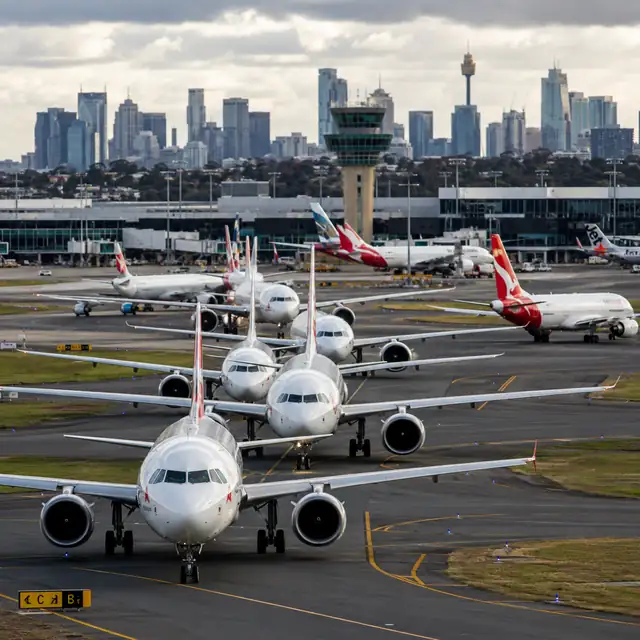

Passengers at Sydney Airport faced major disruption on Friday after air traffic control staffing shortages forced temporary capacity restrictions, delaying or cancelling services across Qantas, Virgin Australia, Jetstar and Rex.
Some flights were held for up to two hours, while domestic and international services to destinations including Perth, Cairns, Melbourne, Christchurch, Vietnam, Hong Kong and Seoul were affected. The disruption began during the morning peak and created knock-on problems as aircraft and crews fell behind schedule.
Why Sydney Airport flights were delayed
Airservices Australia said Air Traffic Flow Management measures were introduced from about 8.20am to 11.15am because of operational restrictions and the need to safely manage expected airborne and departure demand. Airlines were advised that staffing shortages were behind the reduced capacity.
The measures limit how many aircraft can arrive or depart within a set period. That helps controllers maintain safe spacing, but it can quickly produce queues at gates and on taxiways when a major hub is operating below normal capacity.
The disruption followed an earlier Sydney Airport delay event linked to reduced air traffic control capacity, underlining how sensitive the national network can be when movements through Sydney are restricted.
Qantas, Virgin, Jetstar and Rex services affected
Early figures reported by 7NEWS said more than 50 Qantas flights were delayed by up to 90 minutes and four were cancelled. Virgin Australia had 20 delayed services and two Melbourne flights cancelled, while 25 Jetstar flights were running late.
Later reporting from The Guardian put delays of up to 120 minutes across 75 Qantas and Jetstar flights combined, with four cancellations, while Virgin Australia had delays across 50 services. Rex passengers were also affected, with some travellers taken back to the terminal after aircraft waited on the tarmac for up to an hour.
A Qantas service to Christchurch scheduled for 10.20am reportedly did not begin taxiing until about 11.30am. A Vietnam-bound flight was delayed by more than 70 minutes, while Perth services were held for roughly an hour. International flights to Hong Kong and Seoul were also reported to be about an hour behind schedule.
One passenger booked on a 6.10am Cairns flight told 7NEWS the aircraft taxied for around 30 minutes before returning to the gate. The passenger said an onboard announcement referred to a radar issue and a backup radar problem. That account was specific to the flight and should not be treated as confirmation that radar failure caused the wider airport disruption; Airservices attributed its network measures to operational restrictions and demand management.
The broader effect of delays can extend beyond the airport itself. Late aircraft may miss later departure slots, crews can approach duty-time limits and connecting passengers may need to be rebooked. Similar capacity pressures also matter when looking at how Qantas and Virgin manage fares, seats and network capacity across Australia.
Airservices said the traffic-flow restrictions were removed after the morning period and capacity was restored. It also defended the professionalism of its air traffic controllers, describing the role as demanding and safety-critical and stressing the importance of staff wellbeing and psychosocial safety.
Read More
Zurich Airport flights grounded after radar failure disrupts departures
Brussels Airport flight cancellations after air traffic control strike
What passengers should know after capacity was restored
Airservices said no further significant delays were anticipated once normal capacity returned, but that does not mean every flight immediately returns to schedule. Aircraft rotations, crew availability, gate assignments and missed connections can keep individual services running late for several hours after the original restriction ends.
Passengers travelling through Sydney should check their airline’s latest flight status before leaving for the airport and allow extra time for connections. Travellers already affected by a cancellation or extended delay should deal directly with their airline for rebooking, refund or assistance options under the carrier’s conditions of carriage.
Official information about Australia’s air traffic network and airspace management is available from Airservices Australia. Flight-specific departure times should still be confirmed with the operating airline because network recovery can vary from one service to another.

Make Swikblog your go-to source on Google for reliable updates, smart insights, and daily trends.