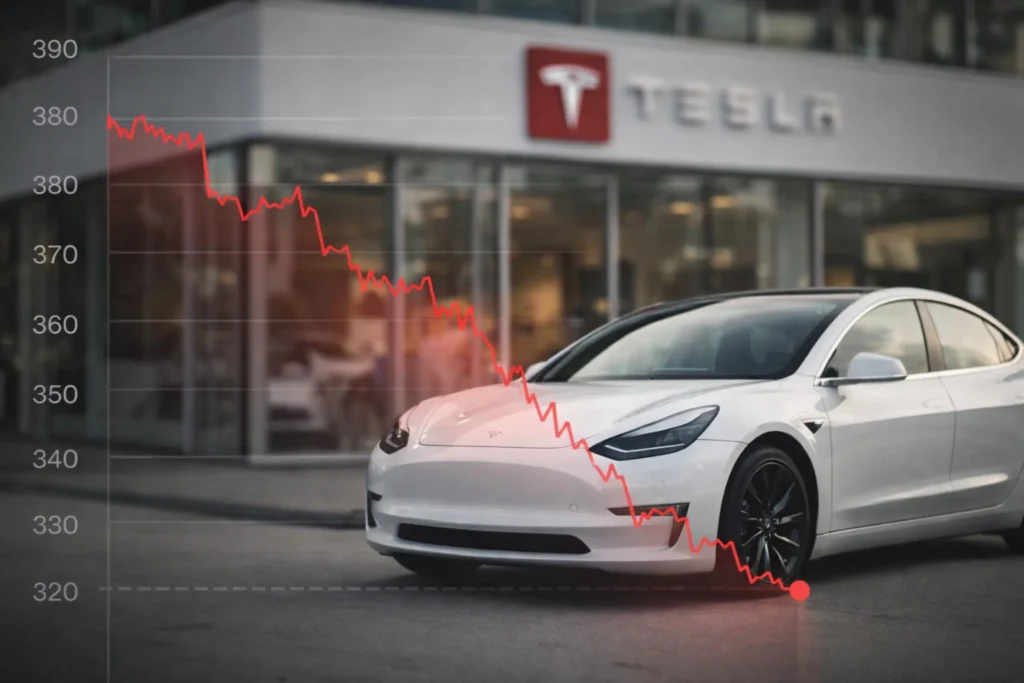

Tesla (TSLA) shares continued their downward trend on April 7, slipping toward the $340 mark and extending losses after a sharp bearish call from JPMorgan. The stock fell more than 3% in intraday trading, reflecting growing concerns on Wall Street around slowing demand, weakening earnings expectations, and valuation risks that analysts say remain stretched.
The biggest trigger came from JPMorgan analyst Ryan Brinkman, who reaffirmed an “Underweight” rating on Tesla and issued one of the most aggressive downside warnings in recent months. The firm now sees roughly 60% downside to a $145 price target by December 2026, advising investors to approach the stock with caution amid execution risks and a premium valuation that appears difficult to justify in the current environment.
The downgrade tone was reinforced by a sharp revision in earnings expectations. JPMorgan cut its projected quarterly earnings per share to $0.30, down from an earlier estimate of $0.43 and below the broader consensus forecast of $0.38. The revision reflects weaker-than-expected first-quarter performance and signals that profitability may come under further pressure if current trends continue. The broader market reaction has also been reflected in recent Tesla stock coverage, where analysts continue to highlight demand and valuation concerns.
Weak deliveries and rising inventory raise red flags
At the center of investor concern is Tesla’s latest delivery data. The company produced over 408,000 vehicles in the first quarter of 2026 but delivered just 358,023 units. That gap of more than 50,000 vehicles adds to inventory, a development that often points to demand softness and can lead to pricing pressure in the quarters ahead.
The delivery miss has become a key talking point because Tesla’s valuation still assumes strong and consistent growth. Instead, recent data suggests that vehicle demand is becoming more uneven, especially as competition intensifies globally from both traditional automakers and fast-growing EV players like BYD and Volkswagen.
Energy storage, another key growth pillar for Tesla, also showed signs of volatility. Installations declined year-over-year, adding to concerns that growth across multiple business segments may be slowing simultaneously rather than offsetting each other.
Despite these weaker fundamentals, Tesla shares are still trading more than 50% higher than levels seen when delivery volumes peaked back in June 2022. That disconnect between performance and valuation is a major reason analysts are becoming increasingly cautious.
AI ambitions and regulatory relief offer mixed signals
While the near-term outlook appears pressured, Tesla continues to push aggressively into artificial intelligence and autonomous driving — areas that many investors believe could define its long-term value.
In a notable development, the US National Highway Traffic Safety Administration (NHTSA) recently closed its probe into Tesla’s “Actually Smart Summon” feature. The decision removes a layer of regulatory uncertainty and supports Tesla’s broader push toward Full Self Driving capabilities. However, it does not eliminate wider scrutiny around autonomous driving technologies, which remain under ongoing review.
At the same time, Tesla is expanding its footprint in AI infrastructure through an ambitious partnership with Intel, SpaceX, and xAI. The group is planning to build the Terafab AI chip facility in Texas, aimed at securing critical chip supply for autonomous driving systems and large-scale AI workloads.
This move could give Tesla more control over one of the most important components in its future ecosystem. However, it also introduces a new layer of capital intensity at a time when the company is already investing heavily in robotaxis, humanoid robots like Optimus, and global manufacturing expansion. For investors, the key question is whether these bets will deliver returns fast enough to justify the added financial burden.
The combination of regulatory progress and AI expansion creates a mixed narrative. On one hand, Tesla is strengthening its long-term positioning in autonomy and AI. On the other, it is increasing execution complexity and financial risk at a time when its core automotive business is showing signs of slowing momentum.
For now, the market appears to be focusing more on immediate concerns than future potential. A stock trading near $340, an EPS estimate cut to $0.30, a delivery shortfall of over 50,000 vehicles, and a 60% downside warning from a major Wall Street bank are difficult signals to ignore.
Investors will now turn their attention to Tesla’s upcoming earnings report and management commentary for clarity on demand trends, pricing strategy, and capital spending plans. Until then, sentiment around TSLA may remain under pressure as the gap between expectations and current performance continues to widen.
You may also like Delta Air Lines Stock Falls as Baggage Fee Hike and Fuel Price Concerns Weigh on Outlook.

Make Swikblog your go-to source on Google for reliable updates, smart insights, and daily trends.