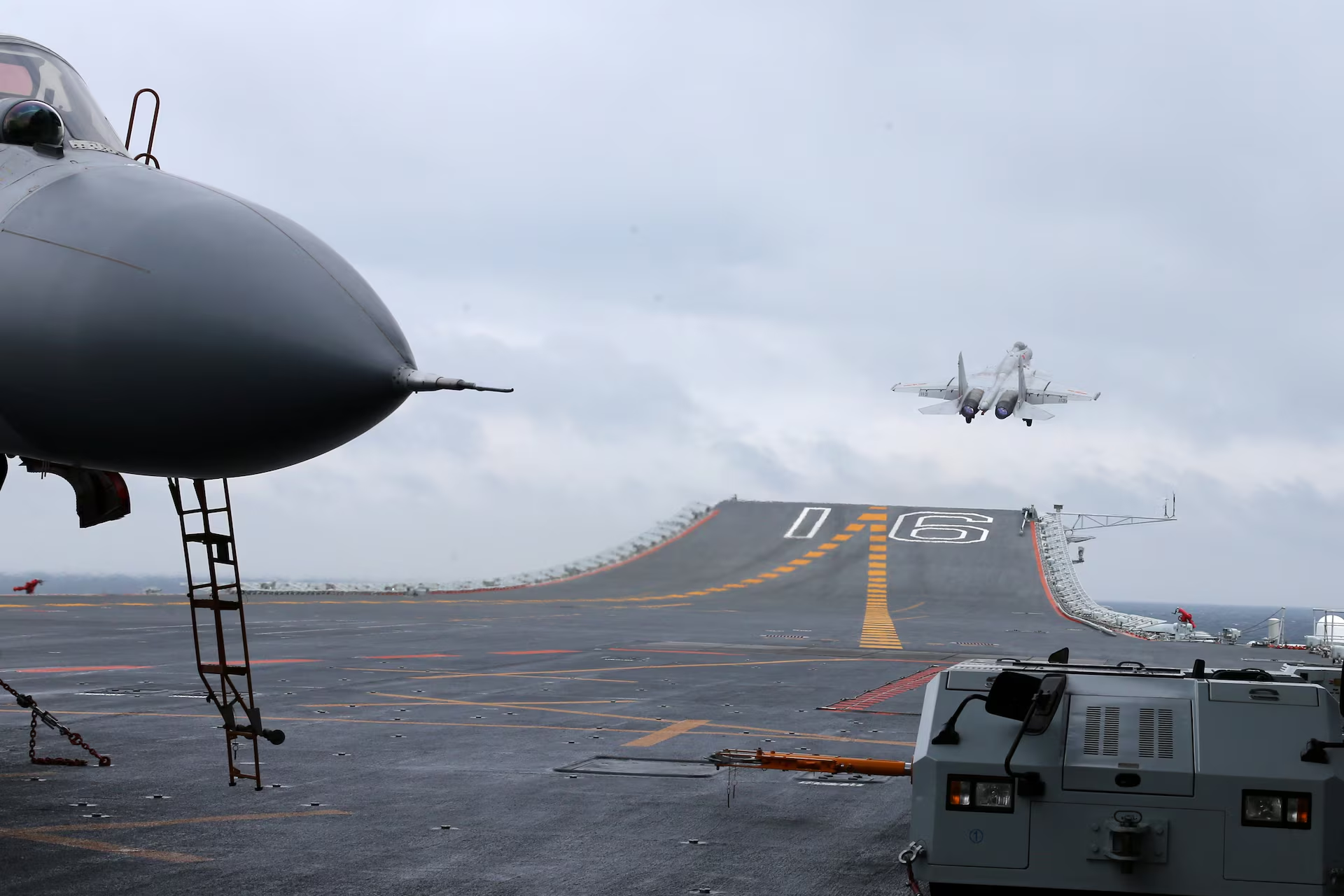
Washington has reinforced its support for Tokyo after Chinese fighter jets allegedly aimed their fire-control radar at Japanese Self-Defense Force (JSDF) aircraft near Okinawa, prompting renewed concern over the stability of East Asian airspace. Japan condemned the manoeuvre as a “dangerous” escalation that risked triggering a military miscalculation.
The United States criticised Beijing’s actions and urged China to avoid behaviour that could jeopardise regional stability. In a statement to reporters, a US State Department spokesperson said the episode was “not conducive to peace” and emphasised America’s unwavering commitment to Japan. Details of the US response were first reported by Reuters .
Japan says Chinese jets locked targeting radar
According to Japanese defence officials, the incident occurred during Chinese carrier-based drills last week near the Miyako Strait. Japan alleges that Chinese aircraft “irradiated” its planes with fire-control radar—an action widely interpreted by militaries as a pre-attack signal. Japan lodged a formal protest, calling the move an unacceptable threat. More details were shared by the Reuters Tokyo bureau .
China has pushed back. Beijing insists its pilots were conducting lawful training and accused Tokyo of interfering with legitimate exercises. Chinese officials also claimed Japan’s aircraft approached too closely during the drills. Beijing’s rebuttal appeared in The Straits Times .
US message to Beijing: ‘Our commitment to Japan is unwavering’
The Biden administration amplified Tokyo’s concerns, saying China’s radar actions contributed to an increasingly volatile environment in the region. The State Department’s comments follow months of rising tension between Tokyo and Beijing over Taiwan and expanded military activity around Japan.
Senior US officials, according to AP News, view the radar confrontation as part of a “pattern” of intimidation aimed at testing Japan’s response. Washington has repeatedly warned about unsafe Chinese intercepts across the Indo-Pacific, including several close calls previously documented by BBC News Asia.
Tokyo welcomed Washington’s support. Japan’s defence ministry said coordination with the US remains “tight and continuous,” reflecting how central the alliance has become to Japanese security as China intensifies its operations around Taiwan and the East China Sea.
Tension also rising over Taiwan
The radar episode comes during heightened concern over Taiwan, where Chinese air and naval activity has increased sharply. Taiwanese President Lai Ching-te called China’s drills “inappropriate and escalatory,” remarks reported by Reuters Taipei .
Japan sees Taiwan’s stability as directly linked to its own security. Prime Minister Sanae Takaichi recently said a Chinese attack on Taiwan could put Japan in a “survival-threatening situation.” Those comments drew criticism from Beijing, with the Chinese foreign ministry warning Japan against “military threats.” Coverage of China’s response appeared in Reuters Beijing bureau .
Chinese–Russian patrols add to the pressure
Not long after the radar incident, Japan scrambled fighter jets to track joint Chinese–Russian patrols approaching its airspace. Analysts warned that multiple overlapping operations—Chinese drills, Russian patrols, and Japan’s monitoring flights—could create conditions for rapid escalation. The joint patrol was confirmed by Reuters Defence .
Military experts quoted in the Straits Times Asia Desk say radar incidents are among the most dangerous confrontations because they can be misread as preparation for missile launch, forcing pilots to react instantly.
What’s next for the region?
The US, Japan, China and Taiwan are all expected to monitor military interactions more closely in the coming weeks. The Pentagon may push for expanded communication channels with China to prevent mid-air misunderstandings, a strategy it has used previously during periods of tension in the South China Sea .
For now, both Tokyo and Washington appear intent on drawing firm boundaries around what they consider unacceptable military behaviour. Beijing, meanwhile, is likely to continue asserting that Japan and the US are “militarising” Asia and interfering in China’s security interests.
You may also like
María Corina Machado Missing Before Nobel Peace Prize Appearance: Oslo Ceremony Canceled

Make Swikblog your go-to source on Google for reliable updates, smart insights, and daily trends.