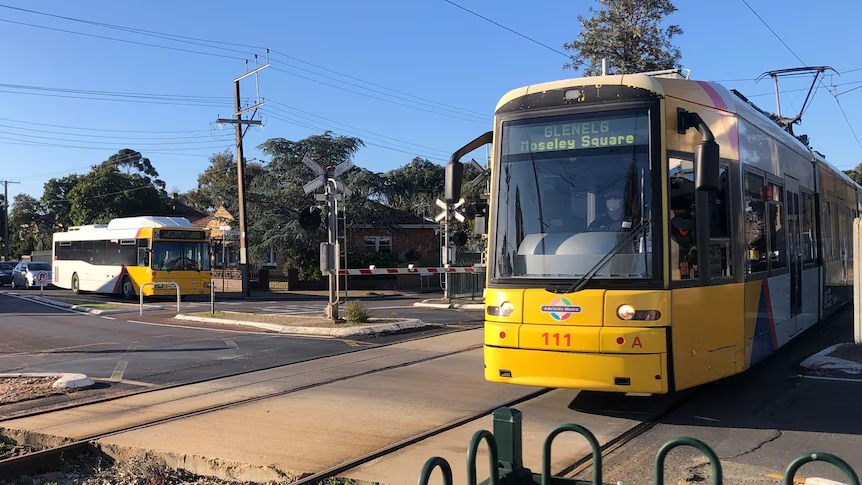

South Australia has ruled out introducing free public transport despite mounting pressure from political parties, business groups and community organisations as fuel prices continue to rise. State Treasurer Tom Koutsantonis said the government is focused on protecting the state budget and maintaining flexibility if fuel supply conditions deteriorate further.
The decision means commuters in Adelaide will continue paying fares for buses, trains and trams, even as some Australian states move toward temporary fare-free travel to ease cost-of-living pressures. South Australian ministers argue the transport network is already heavily supported by taxpayers, making a complete fare waiver financially difficult.
Read More
South Australia chooses budget stability over free fares
Speaking on Monday, Koutsantonis dismissed calls for free public transport, saying governments cannot fund every popular proposal. He noted that public transport operating costs are already substantially subsidised, with taxpayers covering around 90 per cent of the system’s expenses.
According to the state government, removing fares entirely would require additional public spending at a time when authorities want to preserve financial capacity in case fuel shortages or other economic challenges worsen. Officials believe acting too quickly could reduce the state’s ability to respond if conditions become more severe later in the year.
Transport Minister Joe Szakacs reinforced the government’s position, confirming there are currently no plans to reduce fares. He added that public transport demand continues to grow, with passenger validations increasing by about three per cent compared with the same period last year.
Other Australian states are taking different approaches
South Australia’s decision contrasts with measures introduced elsewhere. Victoria has announced statewide free public transport beginning in April, while Tasmania is temporarily waiving fares until July. New South Wales, however, has adopted a position similar to South Australia by rejecting free public transport despite higher fuel costs.
The differing approaches reflect how each state is balancing cost-of-living support with budget priorities. While some governments view free travel as temporary financial relief for households, others believe targeted assistance or capped fares may be more sustainable. A separate proposal for a public transport fare cap and its estimated $100 million cost illustrates the financial trade-offs governments face when considering broad commuter subsidies.
The debate is also being shaped by evidence from places that have already tested free travel. Reports of a 30 per cent increase in public transport ridership during a fare-free period have strengthened arguments that removing ticket costs can quickly change commuter behaviour, although the long-term budget impact remains a central concern.
Business groups warn of wider economic effects
Opposition parties and industry organisations argue that free public transport could help reduce financial pressure on workers while supporting businesses that depend on strong visitor numbers. Deputy Liberal leader Josh Teague has called for fares to be suspended for three months, saying immediate assistance is needed as motorists face higher fuel bills.
The South Australian Business Chamber has also expressed concern about the economic consequences of rising transport costs. Chief executive Andrew Kay said more employees are requesting to work from home because commuting has become increasingly expensive, creating additional challenges for businesses trying to bring staff back into workplaces.
Adelaide city councillor Henry Davis has similarly argued that reducing transport costs could encourage more people to visit the central business district, benefiting retailers, hospitality venues and other city businesses that rely on consistent customer traffic.
Fuel price relief continues to shape the debate
Concerns over fuel availability have added another layer to the discussion, with some service stations reporting supply disruptions. In response, Prime Minister Anthony Albanese announced a temporary reduction in the federal fuel excise, lowering petrol and diesel prices by 26.3 cents per litre for three months.
Although the federal measure provides short-term relief for motorists, it has not ended calls for additional state-based support. Supporters of fare-free public transport argue it would provide broader assistance to commuters while helping reduce road congestion and fuel consumption.
For now, South Australia remains committed to its existing approach. Future decisions are likely to depend on fuel market conditions, government finances and whether public demand for further cost-of-living support continues to grow. Official updates are available through ABC News Australia.

Make Swikblog your go-to source on Google for reliable updates, smart insights, and daily trends.