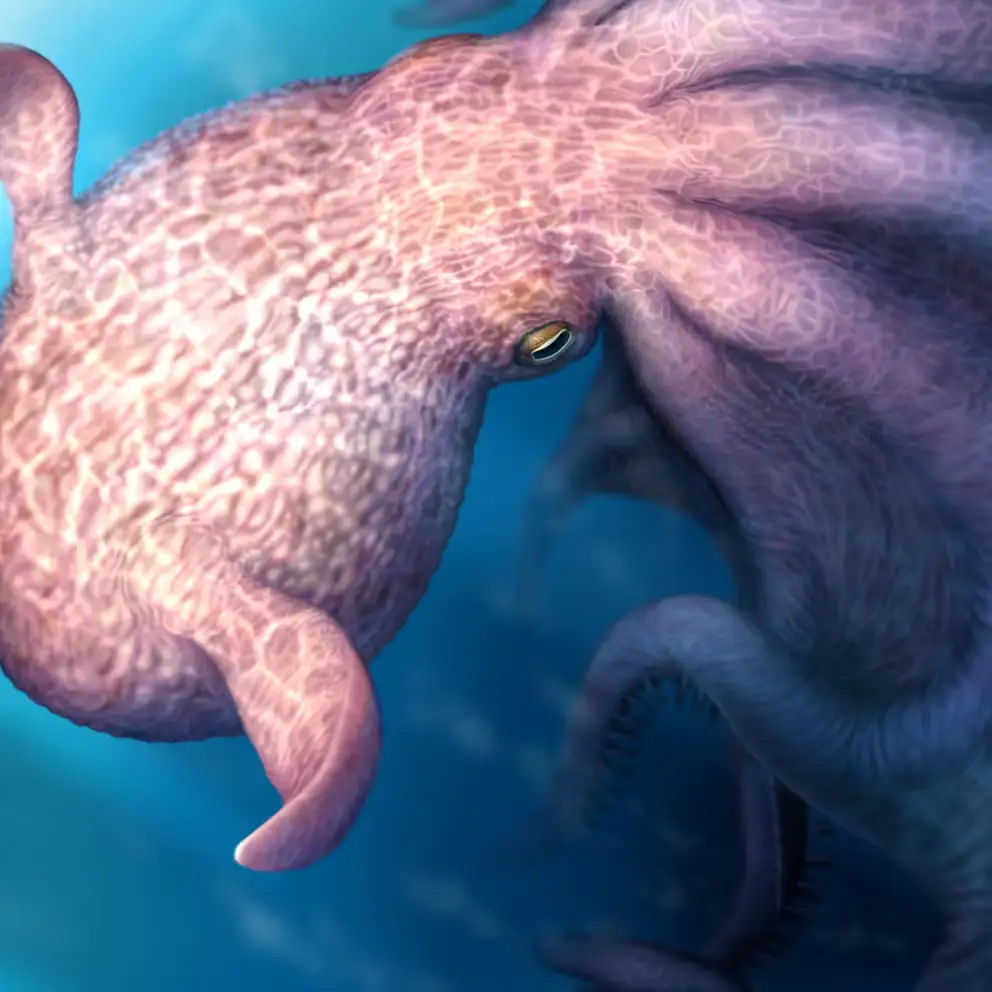

For centuries, the Kraken belonged to the world of sailors’ tales — a giant creature imagined as powerful enough to pull ships beneath the waves. Now, a new fossil study has given that legend a surprising scientific parallel: researchers say a huge octopus-like predator may have ruled parts of the ancient ocean during the age of dinosaurs.
The animal, known as Nanaimoteuthis haggarti, lived roughly 86 million to 72 million years ago in the Late Cretaceous period. Based on fossil evidence, scientists estimate that some individuals may have reached up to 19 metres in length. That is longer than many buses and larger than the modern giant squid, one of today’s biggest invertebrates.
What makes the discovery especially important is not only the animal’s size, but its position in the food chain. For a long time, prehistoric seas have been described mainly as a world ruled by large vertebrates — marine reptiles, sharks and powerful fish. This new research suggests that at least some giant invertebrates were not background players. They may have hunted at the very top of the ecosystem.
A rare clue from a creature that almost never fossilises
Octopuses are difficult animals to study in deep time because their soft bodies usually disappear after death. Unlike dinosaurs, mosasaurs or sharks, they leave no large skeleton behind. That means palaeontologists often have to depend on the few hard parts that survive.
In this case, the key evidence comes from fossilised beaks — the strong jaw structures octopuses use to bite and process prey. These beaks are made from chitin, a durable natural material also found in crab shells, lobster shells and insect exoskeletons.
Researchers studied fossil beaks from Japan and Canada’s Vancouver Island, including both newly found material and specimens that had been known before but needed a fresh look. By comparing those fossils with the anatomy of modern octopuses, they were able to estimate body size and feeding behaviour.
The results point to a creature far larger than expected. Nanaimoteuthis haggarti may have ranged from about six metres to 19 metres long. A close relative, Nanaimoteuthis jeletzkyi, appears to have been smaller but still impressive, measuring around three to eight metres.
These estimates place the larger species among the most remarkable invertebrates known from the fossil record. But the jaws revealed something even more dramatic than size.
Signs of a bone-crushing hunter
The fossil beaks showed heavy wear, including damage consistent with repeated contact with hard prey. In the largest examples, scientists found that around one-tenth of the jaw length may have been worn away. That level of wear is more severe than what is normally seen in modern octopuses and cuttlefish that feed on hard-shelled animals.
This suggests the ancient octopus was not feeding only on soft prey. It may have crushed shells, bones and other tough structures while eating large fish, clams, shelled cephalopods and other sizeable marine animals.
That detail changes the image of the animal. This was not simply a large, slow creature moving through the water. It was likely an active predator with flexible arms, a powerful bite and the ability to control struggling prey.
Modern octopuses already use their arms with extraordinary precision. They grip, pull, twist and manipulate food before using their beaks to tear into it. A much larger ancient relative with similar abilities would have been a serious threat in Cretaceous seas.
Why scientists are comparing it to a real Kraken
The Kraken label is not meant to suggest the folklore was literally true. These animals lived tens of millions of years before humans, ships or Norse legends. But the comparison is easy to understand.
A 19-metre octopus-like predator with long arms, strong jaws and advanced behaviour fits the broad idea of a sea monster better than almost any fossil discovery in recent years. It gives the myth a scientific echo, even if the legend itself came much later.
Researchers also noticed asymmetrical wear on the jaws. That may sound like a small detail, but it could point to lateralised behaviour — the tendency to favour one side over the other. In simple terms, it may be something like “handedness.”
That matters because modern octopuses are among the most intelligent invertebrates alive. They solve problems, escape enclosures, remember routes and use camouflage in sophisticated ways. The fossil jaws cannot prove exactly how smart these ancient animals were, but the wear pattern suggests repeated, controlled behaviour rather than random damage.
For more on how octopus intelligence works in modern species, see this research overview from the Natural History Museum.
The shape of the beaks also resembles those of some living deep-sea octopuses that swim with the help of fins. That has led researchers to suggest the Cretaceous species may also have had fins, giving them an efficient way to move through open water.
A new picture of ancient oceans
The Cretaceous seas were already known to be dangerous. Mosasaurs, plesiosaurs and sharks hunted in the same broad marine world, with some reptiles reaching more than 15 metres in length. Until now, these vertebrate predators were usually treated as the main rulers of the ecosystem.
The discovery of giant predatory octopuses complicates that picture. If Nanaimoteuthis haggarti really reached the top predator tier, it may have competed with marine reptiles and large sharks for food. It may also have shaped the behaviour of prey species in ways that are only beginning to be understood.
This is why the finding is more than a curiosity. It challenges a long-standing assumption that large vertebrates dominated marine ecosystems for hundreds of millions of years without serious competition from invertebrates.
Instead, the ancient ocean may have been a more balanced and stranger place, where animals without bones could still become giants, hunt large prey and influence the structure of entire food webs.
What this discovery really means
The most fascinating part of the research may be what it says about the limits of the fossil record. Soft-bodied animals are often missing from ancient history, not because they were unimportant, but because they rarely left clear remains behind.
That means scientists may have underestimated the role of giant invertebrates in past ecosystems. The fossilised beaks of Nanaimoteuthis are a reminder that some of Earth’s most powerful predators may have vanished almost completely from view.
There are still unanswered questions. Researchers do not yet know exactly how these octopuses hunted, why they disappeared, or whether changing ocean conditions, competition or extinction events played a role. Their full body shape also remains partly uncertain because the evidence comes mainly from jaws rather than complete soft-tissue fossils.
Even with those limits, the discovery is significant. It adds a new predator to the story of the dinosaur age and pushes scientists to rethink who really ruled prehistoric seas.
The Kraken remains a myth, but the ancient ocean clearly had monsters of its own. And this one was not a dragon, reptile or shark. It was a giant octopus — intelligent, powerful and big enough to make the sea itself seem more mysterious than ever.

Make Swikblog your go-to source on Google for reliable updates, smart insights, and daily trends.