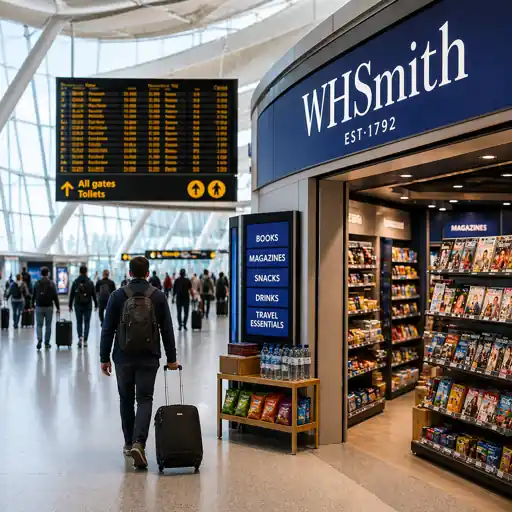

WH Smith has become one of the clearest UK market examples of how fast an energy shock can move from global politics into company earnings. The travel retailer’s shares fell sharply after it warned that profits would be lower than previously expected, with flight disruption and weaker passenger spending now weighing on its airport-led business.
The company’s latest update matters because WH Smith is no longer mainly a familiar high street chain. After selling its UK high street business, the group is now far more dependent on travel locations, including airports, railway stations and international transport hubs. That model can be highly profitable when passenger numbers are rising, but it also leaves the business exposed when airlines cut capacity and travellers become more cautious.
Why WH Smith’s warning matters
WH Smith said it now expects headline pre-tax profit for the year ending in August to come in between £90 million and £105 million, down from its previous range of £100 million to £115 million. The downgrade was enough to trigger a heavy sell-off, with the stock falling as much as 17% in early trading.
The company also suspended its dividend, a decision aimed at protecting cash while visibility remains limited. For shareholders, that move is significant. Dividend suspensions often suggest management is preparing for a tougher trading period rather than treating the disruption as a brief setback.
The pressure is coming from two directions at once. First, airlines are reducing flights as jet fuel availability becomes more uncertain. Second, consumers are facing higher costs and weaker confidence, which can reduce spending even when they do travel. For a retailer built around convenience purchases in travel hubs, both trends are damaging.
Jet fuel disruption hits travel retail
The crisis around the Strait of Hormuz has become a major concern for energy markets because the route is central to global oil and gas flows. With supply uncertainty affecting aviation fuel, airlines across Europe, Asia and the Middle East have started adjusting schedules to conserve fuel and limit operational risk.
Flight cancellations are especially painful for airport retailers. WH Smith does not just need people to fly; it needs steady passenger flow through terminals. Fewer departures mean fewer customers buying books, food, drinks, electronics accessories and travel essentials before boarding.
Lufthansa has reportedly cancelled around 20,000 flights, while other airlines have restricted some services. The European Union has also warned that summer holiday travel could be disrupted if fuel shortages continue. That creates a difficult backdrop for WH Smith during one of the most important periods of the travel calendar.
For wider context on global energy supply risks, the International Energy Agency regularly tracks oil market disruption and energy security trends.
A bigger problem than one retailer
WH Smith’s profit warning is not just a company-specific story. It points to a broader strain building across the economy as higher energy costs feed into transport, production and household budgets.
Retailers and consumer companies are already warning that the conflict could push costs higher. Reckitt Benckiser has flagged the possibility of up to £150 million in additional energy costs, while major supermarkets including Tesco and Sainsbury’s are under pressure to keep prices low even as production and transport expenses rise.
That matters for WH Smith because weaker consumer confidence can hit discretionary spending. Airport shoppers may still buy essentials, but they are less likely to spend freely if ticket prices rise, holiday plans become uncertain or household budgets come under pressure.
This is where the company’s strategic shift becomes important. Moving away from the UK high street gave WH Smith greater exposure to global travel growth, but it also reduced the cushion that a more diversified retail base might have provided during an aviation-led slowdown.
What investors will watch next
The biggest question for investors is whether the disruption proves temporary or stretches through the summer travel season. If airlines restore schedules quickly and fuel flows improve, WH Smith may be able to stabilise trading. If cancellations continue, the company could face further pressure on sales and margins.
Passenger numbers will be the key metric. Even a small reduction in airport footfall can have an outsized effect on travel retailers because rents, staffing and store operating costs remain relatively fixed. Lower traffic can therefore squeeze profitability faster than headline sales numbers might suggest.
The suspended dividend will also remain in focus. Investors will want to see whether WH Smith can rebuild enough confidence to resume payouts later, or whether cash preservation becomes a longer-term priority.
Despite the near-term pressure, WH Smith still has a sizeable international footprint, with around 1,200 stores worldwide. Its airport and travel hub presence remains valuable, but the latest warning shows that the business is highly sensitive to shocks in aviation, energy markets and consumer confidence.
For now, the market reaction shows that investors are treating the jet fuel crisis as more than a short-term inconvenience. WH Smith’s downgrade has turned into a warning signal for the wider travel retail sector, especially as airlines, consumers and energy markets all face a more uncertain summer.
You may like: YouTube Deepfake Detection Tool Targets Hollywood Celebrities

Make Swikblog your go-to source on Google for reliable updates, smart insights, and daily trends.