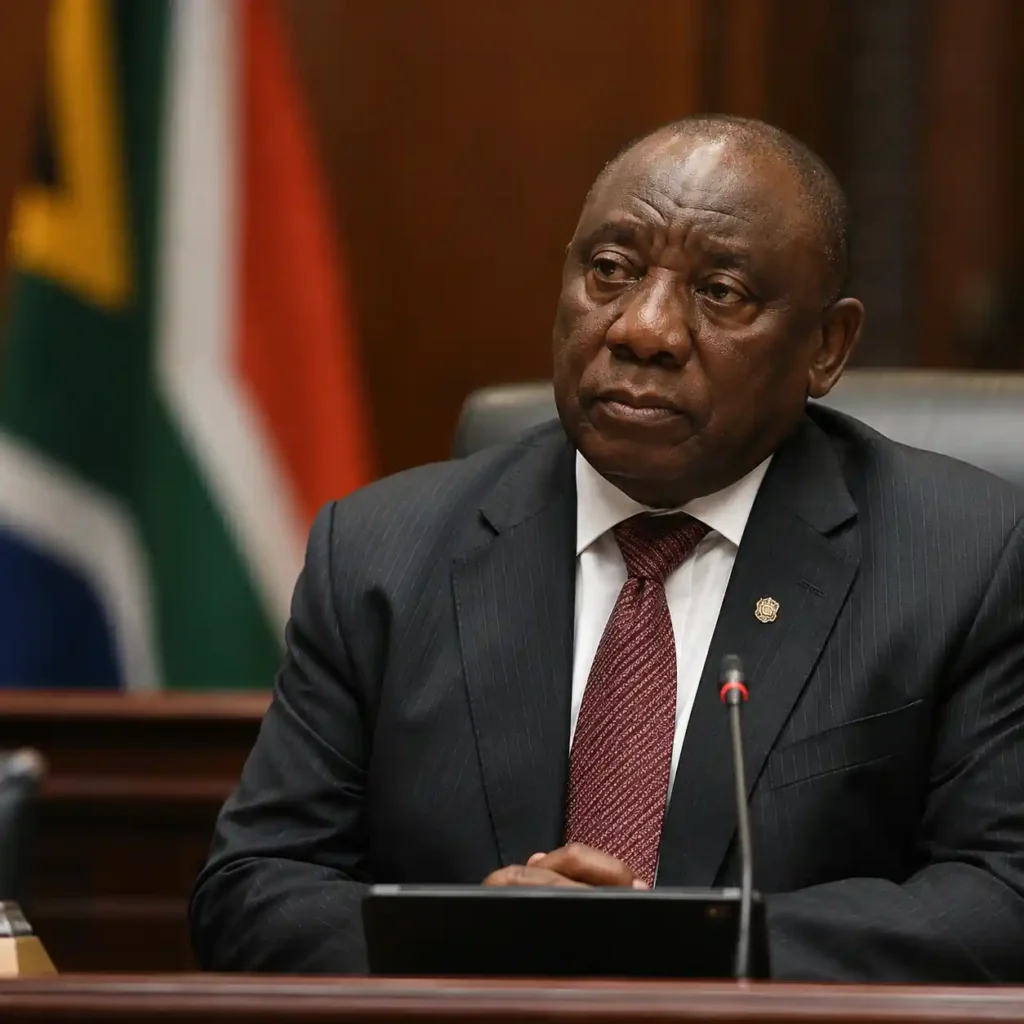

President Cyril Ramaphosa is facing a renewed impeachment threat after South Africa’s Constitutional Court revived the Phala Phala process and placed Parliament’s handling of the matter back under sharp national scrutiny.
The ruling has reopened a politically explosive chapter that the African National Congress had hoped was behind it. Instead, the country now faces a fresh parliamentary process that could test Ramaphosa’s authority, the strength of the Government of National Unity, and the ANC’s ability to protect its leader in a far more fragmented political environment.
At the centre of the judgment is Parliament’s 2022 decision to reject the findings of an independent Section 89 panel that had recommended further inquiry into the Phala Phala scandal. The Constitutional Court found that the National Assembly’s handling of that vote was constitutionally flawed, meaning the matter must now be referred to an impeachment committee for proper consideration.
The decision does not remove Ramaphosa from office. It also does not make a final finding that he committed impeachable conduct. But politically, it is a serious blow. The president must now prepare for a process that could force him to answer uncomfortable questions in Parliament about the theft of foreign currency from his Limpopo farm and the way the matter was allegedly handled afterward.
The Phala Phala controversy began after claims emerged that a large amount of foreign cash had been stolen from Ramaphosa’s private game farm. The president has maintained that the money came from a legitimate transaction involving the sale of game. His critics, however, have questioned why the cash was kept on the property and whether law enforcement resources were used outside normal channels after the burglary.
Ramaphosa has survived previous investigations linked to the matter. Institutions including the South African Revenue Service, the South African Reserve Bank and the Public Protector have not produced findings that ended his presidency. That history will form a key part of his defence as the impeachment committee begins its work.
However, the Constitutional Court ruling changes the political balance. The problem for Ramaphosa is no longer only the original farm theft controversy. It is now also about whether Parliament failed in its constitutional duty by preventing the issue from being properly tested through an impeachment process.
Readers can follow official court information through the Constitutional Court of South Africa. Broader international political coverage and market reaction analysis can also be found on Swikblog’s global politics section.
Why This Ruling Is Politically Dangerous for Ramaphosa
The timing of the judgment could hardly be more sensitive for the president. When the Phala Phala report first threatened his leadership in 2022, Ramaphosa still had the protection of an ANC majority in Parliament. That shield no longer exists in the same form.
After the 2024 election, the ANC lost its outright majority and entered a Government of National Unity with other parties. That has made Parliament more unpredictable and has given opposition parties greater space to influence committees, inquiries and public debate.
The Economic Freedom Fighters are likely to use the impeachment process aggressively. Julius Malema has already called for Ramaphosa to resign and is expected to frame the judgment as proof that the president was protected by ANC numbers rather than cleared through open accountability.
The EFF’s role matters because the party was central to the legal challenge that brought the issue back before the Constitutional Court. Its victory gives Malema a powerful political platform at a time when coalition politics are reshaping South Africa’s national direction.
The Democratic Alliance also faces a delicate test. As a major partner in the GNU, the DA has an interest in political stability. But it also cannot be seen to abandon its long-standing position on accountability and constitutional oversight. Its public response suggests it will not give Ramaphosa automatic protection.
That leaves the ANC with the hardest decision. The party must decide whether standing behind Ramaphosa helps preserve stability or whether a drawn-out impeachment process causes deeper damage before the next major political contest.
Deputy President Paul Mashatile is widely seen as the most likely beneficiary if Ramaphosa is forced out or persuaded to step aside. Yet such a transition would carry its own risks. Mashatile does not enjoy the same level of confidence among investors and reform-minded voters, and his rise could shift the ANC closer to the EFF in future coalition arrangements.
For the ANC, the question is not only legal. It is strategic. A public impeachment inquiry could keep Phala Phala in the headlines for months, weaken Ramaphosa’s reform message and give opposition parties a daily opportunity to attack the party’s credibility.
Read More
What Happens Next
Parliament must now move toward establishing an impeachment committee to examine the Section 89 panel report and related evidence. That process could include questions about the source of the money, the handling of the burglary, the role of police officials, and whether Ramaphosa met the standards expected of the head of state.
ActionSA may also play a visible role after using access-to-information processes to obtain material linked to investigations around Phala Phala. Any documents suggesting irregular or unofficial police activity could become important in the committee’s work.
The presidency has responded by saying Ramaphosa respects the Constitutional Court and remains committed to due process. That message is designed to show calm and institutional respect, but it does not remove the political threat now building around him.
The coming weeks will show whether Ramaphosa chooses to fight through the process, whether the ANC closes ranks again, or whether internal party pressure begins to build for an early leadership transition.
For South Africa, the judgment is bigger than one president. It strengthens the principle that Parliament cannot use procedure to avoid accountability when serious allegations are placed before it. That makes the ruling an important moment for constitutional oversight, even before the political outcome is known.
Ramaphosa remains in office for now. But the Phala Phala issue has returned at full force, and this time he faces it in a weaker Parliament, a divided ANC, and a political climate where opposition parties have far more power than they did in 2022.
More Africa-focused political developments, economic updates and international affairs reporting are available on Swikblog.

Make Swikblog your go-to source on Google for reliable updates, smart insights, and daily trends.