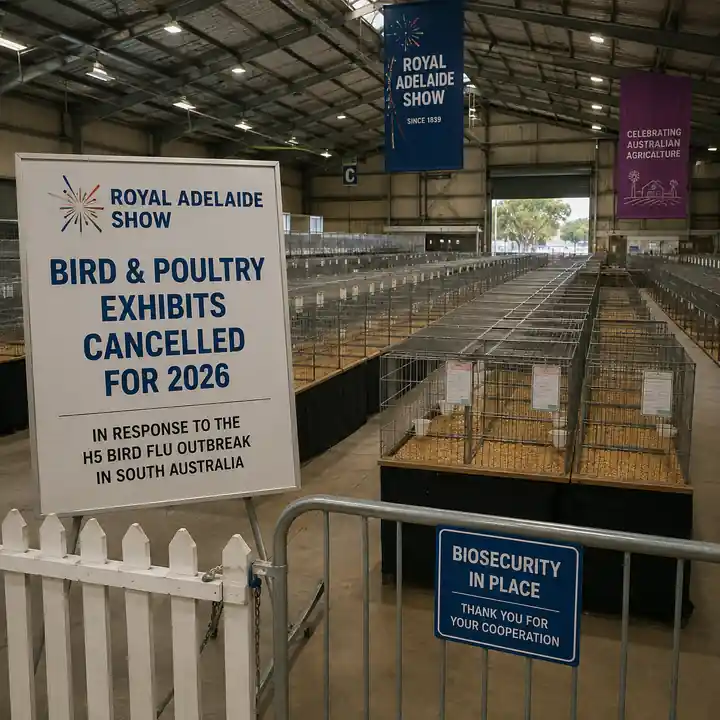

The Royal Adelaide Show has cancelled its bird and poultry competitions and exhibits for 2026 as South Australia responds to a fast-growing H5 bird flu outbreak, with 119 confirmed cases now recorded across the state.
The decision was announced on Friday, August 7, less than a month before the show opens at Adelaide Showground. The 2026 Royal Adelaide Show is scheduled to run from Saturday, September 5 to Sunday, September 13, with the rest of the event continuing as planned.
South Australia’s confirmed H5 count has more than doubled from 58 at the start of the week to 119. That represents more than three-quarters of Australia’s 155 confirmed cases. Separate reporting on August 7 also listed 42 suspected cases in South Australia, which are not part of the confirmed total.
Why the Royal Adelaide Show cancelled bird competitions
Royal Agricultural and Horticultural Society of South Australia chief executive Will Rayner said organisers considered the immediate risk low but decided to act early as a biosecurity precaution. It is the first time in the show’s history that its bird competitions have been cancelled.
Around 150 exhibitors, volunteers and stewards are affected. Entries in the poultry and bird section were already about 20% lower, with some participants choosing not to bring their birds into the show environment while the outbreak remained active.
Organisers considered advice from relevant authorities on measures that could reduce risk but concluded they could not practically meet every requirement during the event. Cancelling several weeks in advance also gives regional exhibitors and volunteers more time to change their plans.
The move does not mean H5 has been found in show birds or South Australian poultry. Authorities have continued to say the detections are in wild seabirds, not poultry. Australia’s emergence of H5 had already drawn attention after a suspected H5 bird flu case was identified in Western Australia in June.
South Australia’s H5 outbreak has accelerated
The speed of the increase is central to the show’s decision. Environment Minister Emily Bourke said South Australia had moved from just five cases to almost 120 in 18 days. The state government has backed the cancellation on animal-welfare and biosecurity grounds.
The 119 confirmed cases also do not include bird deaths linked to a mass mortality event at Baudin Rocks near Robe. That means the confirmed figure should not be interpreted as a count of every sick or dead bird being investigated across South Australia.
The outbreak follows weeks of surveillance along the state’s coastline. Earlier wildlife incidents, including marine animal deaths reported on South Australia’s Eyre Peninsula, have also increased public attention on unusual wildlife mortality, although those events should not be treated as evidence of H5 infection without laboratory confirmation.
PIRSA says H5N1 clade 2.3.4.4b is a highly pathogenic avian influenza strain that has spread internationally through wild-bird movements. The department continues to advise people not to touch sick or dead birds and to report unusual wildlife deaths. Current official advice is available on PIRSA’s avian influenza information page.
Cancellation for exhibitors and country shows
The bird section is only a small part of the Royal Adelaide Show’s wider program, which has more than 26,000 competitive entries. For poultry and bird exhibitors, however, the impact is significant because breeding, preparation and travel can involve months of work.
The response is also extending beyond Adelaide. PIRSA is working with country-show organisers to assess risks, and decisions are expected to be made according to local conditions rather than through a blanket statewide cancellation. The Port Lincoln Show had already cancelled its poultry event as a precaution while H5 detections were increasing.
Farne Islands Puffin Cam Returns After Bird Flu Killed Nearly 10,000 Seabirds
Australia Seabird Crisis Deepens as Dead Penguins Wash Up on Beaches
Things to know for Visitors and Bird owners
Visitors can still attend the Royal Adelaide Show from September 5, but there will be no bird or poultry competitions or displays this year. Other competitive sections and attractions are expected to operate.
For bird owners, the key distinction remains that H5 has not been detected in Australian poultry in the information currently available. Avoiding contact with sick or dead wild birds, keeping domestic birds separated from wild birds where practical, and following official reporting advice remain the most useful precautions while surveillance continues.
The rapid increase from 58 to 119 confirmed South Australian cases in a matter of days explains why organisers acted before opening day. The cancellation reduces one avoidable gathering of birds while authorities continue to determine how widely H5 is circulating in wild populations.

Make Swikblog your go-to source on Google for reliable updates, smart insights, and daily trends.