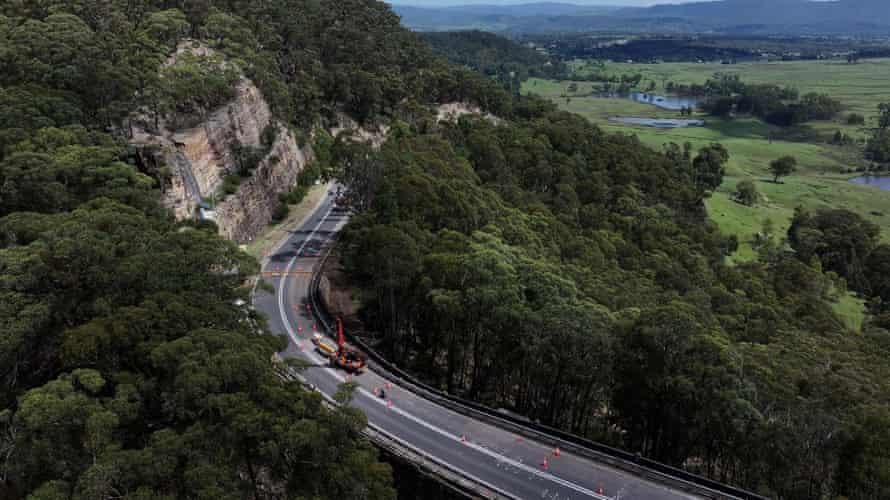

A critical transport link through Australia’s Blue Mountains has been shut down after engineers discovered structural cracks in the historic Mitchells Causeway, commonly known as the Convict Bridge. The closure of the Victoria Pass section of the Great Western Highway has immediately disrupted travel for thousands of commuters, forcing major detours and triggering growing frustration among residents and businesses in the region.
The road, which connects Sydney with communities in the central west of New South Wales, normally carries about 12,000 vehicles every day. With the bridge closed indefinitely while structural investigations take place, some journeys that once took minutes are now stretching into lengthy detours that can add up to two hours during peak traffic periods.
Historic bridge faces major structural failure
The Mitchells Causeway dates back to 1832, when convicts constructed the sandstone causeway along the steep cliffs of the Blue Mountains. Built long before modern bridge engineering standards, the structure relies largely on stone retaining walls and compacted materials rather than reinforced piles or piers used in contemporary infrastructure.
Recent inspections uncovered long cracks running across the road surface, prompting Transport for NSW to immediately close the Victoria Pass route to traffic. Officials later confirmed that the bridge had experienced a significant geotechnical shift, causing parts of the structure to move.
Authorities say engineers now need to carry out detailed assessments including drilling tests and 3D imaging to determine the full extent of the damage. Even in the most optimistic scenario, officials estimate the road could remain closed for at least three months while repairs are planned and executed.
Commuters and businesses face disruption
The closure has quickly reshaped daily life in several Blue Mountains communities. Detour routes are sending heavy traffic through smaller towns, while schoolchildren and workers now face dramatically longer travel times.
Residents from Hartley and Little Hartley say students who previously needed only a short journey across Victoria Pass are now spending up to two hours returning home from school. Local streets in Lithgow have also begun carrying diverted truck traffic, raising concerns about road damage and noise.
Businesses in small villages along the route have been particularly affected. Some local shop owners report losing as much as 70% of their normal revenue since the closure began, as passing traffic that once supported roadside businesses disappears.
Transport alternatives and emergency access
Transport authorities have attempted to ease the disruption by increasing train and bus services in the region. Emergency services such as ambulances can still access sections of the highway up to the closure point, and alternate driving routes remain available for urgent response vehicles.
Drivers are being advised to carefully plan journeys, follow diversion signs and allow significantly more time for travel between Lithgow and the upper Blue Mountains.
Debate over long-term transport planning
The sudden closure has also reignited debate about the future of transport infrastructure in the Blue Mountains. Earlier plans proposed a 34-kilometre highway upgrade between Katoomba and Lithgow, including a large tunnel beneath Victoria Pass designed to bypass the fragile historic route.
Those plans were eventually shelved after funding commitments changed between state and federal governments. Critics now argue that the shutdown of the Convict Bridge highlights the risks of relying on aging infrastructure without long-term replacement projects.
Engineering experts say temporary stabilisation may be possible by injecting cement mixtures into the internal structure to reinforce the aging materials. However, larger solutions such as tunnels or completely new road alignments may ultimately be required to guarantee the safety and reliability of the region’s main highway.
For now, communities across the Blue Mountains are adjusting to the reality of a critical transport route suddenly out of service. Until repairs are complete and the structure is deemed safe again, residents, commuters and businesses must navigate longer journeys and growing uncertainty about the future of one of the region’s oldest pieces of infrastructure.
For additional reporting on the closure and engineering investigations, more details are available through coverage by The Guardian’s Australia news section.


Make Swikblog your go-to source on Google for reliable updates, smart insights, and daily trends.