
Two flights travelling from Turkey to Scotland were forced into emergency handling on Friday after pilots transmitted the internationally recognised Squawk 7700 code while flying over the North Sea. Both aircraft landed safely, but the unusual timing of two separate alerts on similar Turkey-to-UK routes quickly drew attention from aviation watchers and passengers tracking the flights online.
The first known incident involved a SunExpress service operating from Dalaman to Edinburgh. Flight XQ3688, flown by a Boeing 737 MAX 8, had left the Turkish resort city shortly before 3.45pm on April 24 and was nearing the UK when the emergency signal was issued. Rather than diverting, the aircraft continued toward Edinburgh, where it landed safely shortly before 6.10pm.
SunExpress later said the alert was linked to a passenger medical issue. Medical staff met the aircraft after landing, though the airline did not release further details about the passenger’s condition. The carrier said passenger and crew safety remained its highest priority.
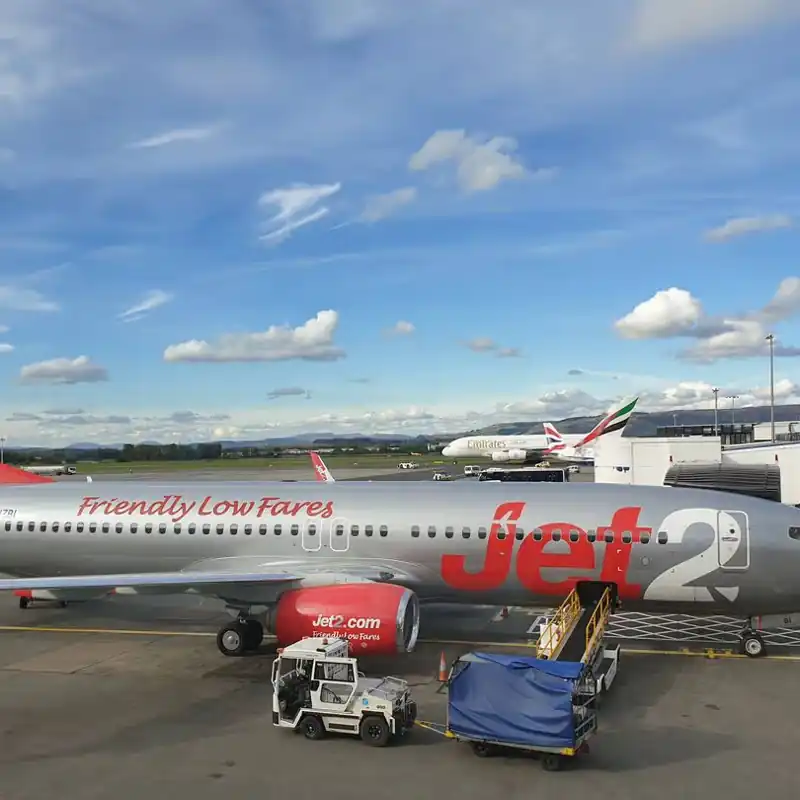
A separate Jet2 flight from Dalaman to Glasgow also declared a general emergency while over the North Sea. The Boeing 737 was flying at around 36,000 feet when the Squawk 7700 code was sent. Flight tracking data indicated the aircraft held its altitude briefly before receiving priority descent from air traffic control.
The Jet2 aircraft was then given priority approach into Glasgow Airport and landed safely on runway 23 at around 4.32pm, close to its scheduled arrival time. The precise reason for that emergency alert has not been confirmed publicly.
Why Squawk 7700 is used during a flight
Squawk 7700 is not a phrase passengers usually hear during a normal journey, but it is one of the most important emergency signals in aviation. When selected on an aircraft transponder, it tells air traffic controllers that the crew is dealing with a general emergency and may need immediate priority.
According to SKYbrary Aviation Safety, emergency transponder codes are used to help controllers identify aircraft requiring urgent attention. Code 7700 can cover a wide range of situations, including medical emergencies, technical warnings, smoke reports, pressurisation concerns or any event where the crew believes priority handling is needed.
That broad meaning is important. A Squawk 7700 alert does not automatically mean an aircraft is in danger of crashing or that a serious mechanical failure has occurred. In many cases, it is used because the safest response is to give the aircraft a clear route, reduce delays and have support ready on the ground.
In the SunExpress case, the airline’s confirmation of a passenger medical issue points to a controlled onboard emergency rather than a reported aircraft fault. On commercial flights, medical events can range from fainting and breathing difficulties to more serious health episodes requiring urgent assessment after landing.
Cabin crew are trained to manage such situations while pilots coordinate with air traffic control. If the aircraft is already close to its destination and the destination airport has the required medical response available, continuing can sometimes be the fastest and safest option.
Why both aircraft continued to Scotland
Emergency declarations often raise one obvious question: why did the aircraft not divert immediately? The answer depends on timing, location, aircraft condition and the nature of the incident.
When a plane is stable, close to destination and able to land quickly with support waiting, pilots may continue rather than divert to another airport. A diversion can add complexity, especially if the receiving airport has fewer facilities, limited medical access or poor operational conditions.
For the Edinburgh-bound SunExpress aircraft, continuing its route meant medical personnel could meet the passenger soon after landing. For the Glasgow-bound Jet2 flight, the priority descent and approach suggest that controllers helped clear the way so the aircraft could land without unnecessary delay.
Flight tracking platform Flightradar24 has previously explained that Squawk 7700 alerts often attract major public attention because they are visible in real time. That visibility can make an incident appear dramatic online even when the crew is managing the situation calmly and according to procedure.
The SunExpress flight reportedly became one of the most closely followed aircraft globally on flight tracking services during the emergency. That level of attention reflects how quickly aviation alerts now spread, particularly when they happen near busy UK airspace.
The two incidents also came on a busy travel route connecting Turkish holiday destinations with Scottish airports. Dalaman is a major seasonal gateway for UK travellers, especially during school holiday and summer travel periods. Flights between Turkey and the UK regularly carry leisure passengers, families and older travellers, which can increase the chance of onboard medical events simply because of passenger volume.
There is currently no confirmed link between the SunExpress and Jet2 emergencies. The overlap appears to be timing and geography rather than a shared operational problem. One incident has been attributed to a passenger medical issue, while the other has not been fully explained.
For travellers, the key point is that emergency declarations are part of the safety system, not evidence that the system has failed. Pilots use the tools available to them early so that controllers, airports and emergency responders can prepare before the aircraft reaches the runway.
That preparation can include clearing traffic, arranging a direct approach, positioning medical teams, alerting airport fire crews or ensuring ground staff are ready to assist immediately after arrival. Most passengers may see only the final moments of that response, but the coordination starts much earlier.
The successful landings in Edinburgh and Glasgow underline how aviation procedures are designed to manage unexpected events quickly. Even when a flight appears on public trackers with an emergency code, the aircraft may still be operating normally, with the alert used to remove delays and speed up support.
Both Turkey-to-Scotland flights landed safely, and no aircraft damage or wider airport disruption was reported from the information available. The SunExpress passenger received medical attention after arrival, while the Jet2 incident remains unclear pending further confirmation.
Friday’s North Sea alerts are likely to remain notable because they happened within hours of each other and involved similar UK-bound routes. But the outcome also shows why commercial aviation relies on clear emergency codes, trained crews and coordinated air traffic control: when something unexpected happens mid-air, every part of the system is already built to respond.
You may like: Air New Zealand NZ81 Braking Failure Sparks Auckland Airport Delays

Make Swikblog your go-to source on Google for reliable updates, smart insights, and daily trends.