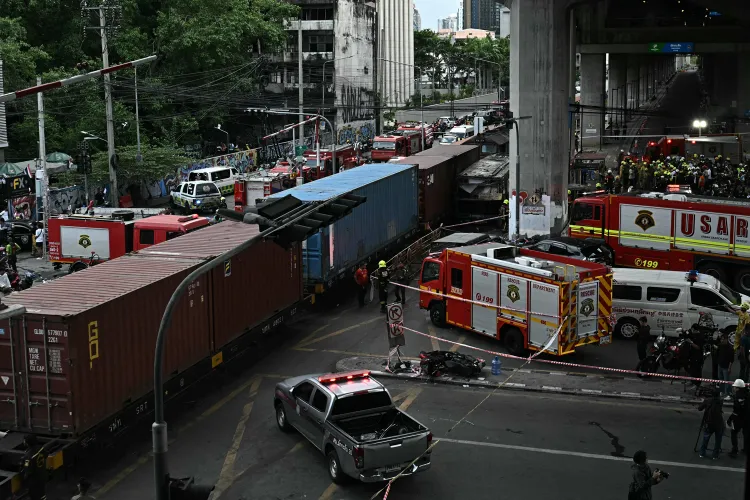

A deadly collision between a freight train and a public bus near Bangkok’s Makkasan Airport Rail Link station has left at least eight people dead and 35 others injured, turning a crowded city crossing into a scene of fire, panic and urgent rescue work.
The crash happened on Saturday afternoon, May 16, near the Airport Rail Link’s Makkasan station in Thailand’s capital. The area sits along one of Bangkok’s important commuter routes, with buses, cars, motorcycles and airport-bound passengers regularly moving through the surrounding roads.
According to The Associated Press, the freight train struck a public bus at a railway crossing, killing at least eight people and injuring more than 20. Bangkok police and local reports later put the number of injured at 35.
Videos from the scene showed vehicles lined up near the crossing before the train hit the orange bus. The impact pushed the bus along the tracks and appeared to drag nearby vehicles into the crash zone. Within moments, fire broke out and spread around the bus and surrounding cars.
The flames made the rescue operation far more dangerous. Firefighters and emergency workers rushed to the site below the Makkasan rail station as smoke rose from the wreckage. After the fire was brought under control, rescue teams entered the badly damaged bus to recover victims and check for anyone still trapped inside.
Bangkok police chief Urumporn Koondejsumrit said eight people were killed and 35 were injured. Officials said the victims who died were found inside the bus. The identities of the dead had not been publicly released at the time of reporting.
The crash has raised serious questions about what happened at the railway crossing in the seconds before impact. One eyewitness, Kittipong Raksa, told AP that he had stopped his car near the tracks after hearing the train warning signal. He said he did not see the barriers come down before the train arrived.
Raksa described hearing two loud impacts before realizing the train had hit the bus. He later found an injured person trapped under his car with a broken leg. His account has added to public concern over whether the crossing’s safety system worked as it should.
Thai Deputy Transport Minister Siripong Angkasakulkiat said investigators were still examining the cause of the crash. Officials are expected to look at whether the bus became stuck on the tracks, whether traffic congestion played a role, or whether the crossing barriers failed to lower properly.
The Bangkok Post reported that the collision happened near Makkasan station on Saturday afternoon and confirmed at least eight deaths and 35 injuries. The report also placed the crash near Asok-Din Daeng Road, a busy route in Bangkok’s Ratchathewi district.
That location matters. Makkasan is not a quiet rural crossing; it is part of a busy transport area linked to Bangkok’s Airport Rail Link. Heavy road traffic, buses and motorcycles often move close to rail infrastructure there. In such locations, even a short delay at a crossing can become dangerous if vehicles are trapped near the tracks.
Freight trains are especially difficult to stop quickly. Their weight and momentum mean that even emergency braking may not prevent a collision once a vehicle is already on the tracks. That is why railway crossings depend heavily on clear warning signals, working barriers and enough space for vehicles to move away before a train arrives.
The fire also points to how quickly a rail-road collision can become a mass-casualty event. The bus did not only suffer impact damage; it caught fire after being dragged, and flames spread to nearby vehicles. Several motorcyclists were also reportedly thrown onto the road during the crash, increasing the number of people affected beyond those inside the bus.
Emergency footage from the scene showed police officers, firefighters, rescue workers and forensic teams operating around the wreckage. Their work continued after the flames were extinguished, as officials tried to recover bodies and document the scene for the investigation.
The crash has triggered fresh concern over railway crossing safety in Thailand. Public attention is now focused on whether the crossing barriers, signal lights and traffic-control systems were functioning properly at the time of the accident. Investigators may also review video evidence, witness statements, train operating data and the position of vehicles before the impact.
Read More
- Visit Swikblog Homepage
- Puffins Found Dead After Deadly Storms as Breeding Season Begins
- Belfast Plants 293,516 Trees Under 1 Million Trees Initiative
- Hackney Half Marathon 2026 Road Closures: East London Streets Shut
- Kingston Power Outage Leaves 13,432 Customers Affected
- NTSB Wimberley Plane Crash Report: 5 Killed
For families of the victims, those technical questions will not lessen the grief. But the answers could help determine whether the tragedy was caused by equipment failure, human error, traffic conditions, or a combination of factors.
Similar transport incidents have repeatedly shown how vulnerable buses can be at rail crossings. Swikblog recently covered another train-related bus incident in the United States involving students, where authorities later arrested the driver after a collision investigation. You can read that report here: Florida school bus train crash driver arrested after serious collision investigation.
Saturday’s Bangkok crash is likely to put pressure on transport officials to review safety measures at crossings used by public buses and heavy traffic. Possible areas of review may include barrier timing, warning visibility, emergency response access and traffic flow around crossings near major rail stations.
Authorities have not yet given a final conclusion on why the bus was in the train’s path. Until the investigation is complete, officials are expected to continue collecting witness accounts and technical evidence from the crossing.
What is already clear is that the collision unfolded in seconds but left lasting consequences. A public bus, a freight train, several nearby vehicles and a busy airport-linked transport zone were pulled into one disaster, leaving eight people dead, dozens hurt and Bangkok asking whether a safer crossing system could have prevented the tragedy.

Make Swikblog your go-to source on Google for reliable updates, smart insights, and daily trends.