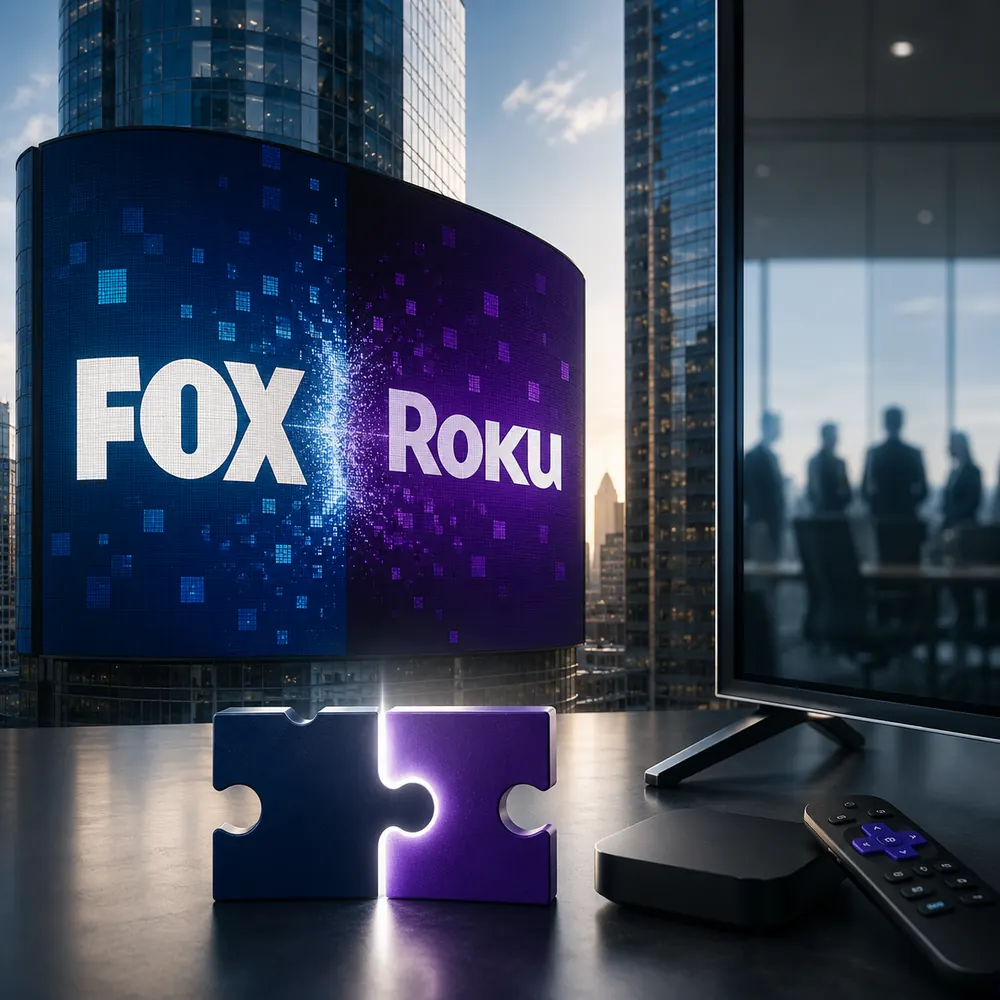

Fox Corporation shares fell while Roku stock surged after Fox agreed to buy the streaming platform in a cash-and-stock deal valued at about $22 billion, giving investors two very different trades from the same announcement.
FOXA was trading near $65.85, down about 3.6%, while Roku jumped to around $143.66, up roughly 20%. The gap reflects the usual market reaction to a major takeover: Roku shareholders are pricing in the acquisition premium, while Fox investors are judging whether the price and integration risk are worth the long-term streaming opportunity.
Deal terms and market reaction
The agreement values Roku at $160 per share. Roku shareholders will receive $96 in cash and 0.9693 shares of Fox Class A common stock for each Roku share they own.
After the deal closes, existing Fox shareholders are expected to own about 73% of the combined company, while Roku shareholders are expected to own about 27%. The transaction still needs regulatory approval and Roku shareholder approval, with closing expected in the first half of 2027.
Fox is buying Roku to expand beyond traditional television and strengthen its position in connected TV advertising. The deal combines Fox’s sports, news and entertainment portfolio, including Tubi, with Roku’s TV operating system, streaming devices, The Roku Channel and advertising technology.
According to the official Fox announcement, the combined business is expected to become the third-largest U.S. television platform by viewing share, behind only YouTube and Netflix.
That scale is the main reason Roku stock moved sharply higher. Roku gives Fox access to more than 100 million global streaming households, a direct consumer platform and a stronger position in ad-supported streaming. For Fox, the deal is less about buying hardware and more about owning a bigger part of the streaming distribution layer.
Investor debate around Fox stock
The drop in FOXA shows that investors are not only looking at the strategic fit. They are also weighing the size of the deal, the cash component, the stock dilution and the execution risk that comes with combining two different businesses.
Fox already owns Tubi, one of the stronger free ad-supported streaming services in the U.S. Roku adds another major ad-supported streaming asset through The Roku Channel, along with a device and smart TV ecosystem that reaches viewers directly. The long-term argument is clear: more users, more data, more ad inventory and more leverage in the connected TV market.
The near-term concern is also clear. A $22 billion acquisition is a large commitment for Fox, whose market value is close to the deal size. Investors may want to see how Fox funds the cash portion, how quickly it can integrate Roku and whether the combined company can turn scale into stronger earnings growth.
Roku’s rally is easier to explain. The stock moved closer to the $160 deal value because shareholders are being offered a premium through a mix of cash and Fox shares. The remaining gap between Roku’s trading price and the deal price reflects normal deal uncertainty, including approvals and the fact that part of the payment depends on Fox’s share price.
For Fox, the market is treating the deal as a strategic bet rather than an immediate earnings win. The company is moving deeper into streaming at a time when traditional media groups are under pressure to hold audiences, improve advertising efficiency and compete with larger technology platforms.
The deal also changes the story around Fox’s digital business. Instead of relying mainly on content and Tubi, Fox would control a wider connected TV ecosystem that includes distribution, advertising technology and streaming inventory. That could give the company more pricing power with advertisers if the integration works.
Still, the risk is that Fox pays heavily for growth in a market that remains competitive. Connected TV advertising is expanding, but Roku competes with platforms tied to Amazon, Google, Samsung and other major players. Keeping Roku’s platform open will also be important, because its value depends on broad app support and trust from streaming partners.
For investors, the stock moves tell the story. Roku holders received a clear takeover premium. Fox holders received a bigger streaming ambition, but also a larger balance-sheet and execution question. The deal may give Fox a stronger future in connected TV, but the early market reaction shows Wall Street wants proof that the price can translate into durable growth.

Make Swikblog your go-to source on Google for reliable updates, smart insights, and daily trends.