US markets started the week under pressure as investors priced in fresh trade-policy volatility. Stock index futures fell after the Supreme Court struck down a broad slice of President Donald Trump’s most sweeping tariff program, a ruling that initially fueled hopes for easing trade tension. That optimism faded quickly when Trump signaled a new baseline tariff level of 15%, up from 10%, reintroducing uncertainty just as the market heads into a pivotal earnings and geopolitical stretch.
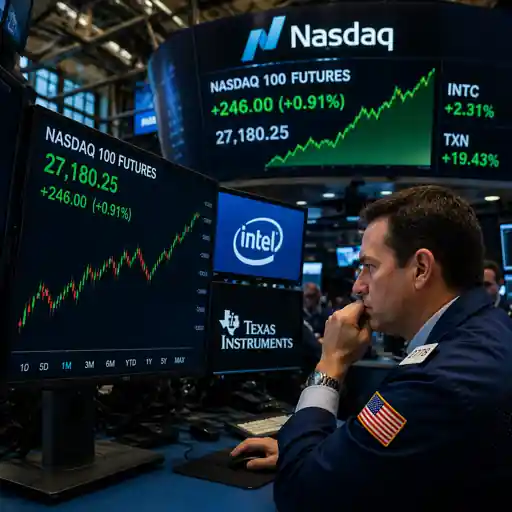
By early Monday, the red was broad across the three major benchmarks. Dow futures were down about 0.5%, S&P 500 futures fell roughly 0.6%, and Nasdaq 100 futures led the drop, sinking around 0.7%. The move was notable because it followed a strong end to last week, when equities rallied on the court decision and closed Friday and the week higher. Futures, however, reflected the market’s central problem: investors can’t confidently model the policy path when trade rules are changing day to day.
Futures slip as policy clarity disappears
In futures trading, the point is not only direction but the signal about risk appetite. S&P 500 E-mini futures were recently around 6,903.25, down 20 points (about -0.29%). Nasdaq futures were weaker, echoing the market’s tendency to rotate away from higher-duration growth exposure when macro uncertainty spikes. The idea that tariffs could be dialed down by legal constraints was a tailwind late last week; the immediate shift to a higher baseline rate put the trade premium right back into equity pricing.
The Supreme Court ruling effectively removed the administration’s prior broad approach, but it didn’t eliminate tariffs as a tool. Traders are now focused on what comes next: whether the White House attempts to keep higher duties in place under a limited authority window, or pivots to other tariff mechanisms that may be narrower but potentially more durable. Either route keeps businesses and investors in a holding pattern.
The 150-day clock and the next legal route
One key concern circulating on desks is duration. Market strategists highlighted that a temporary tariff imposed under a provision like Section 122 is typically constrained to 150 days, a window that would run into late July, after which congressional approval may be needed to extend it. That creates an awkward political timeline heading into midterm season and raises the probability of another policy pivot rather than a clean, stable tariff regime.
In practical terms, companies that import components or finished goods face immediate choices even before the legal dust settles: accelerate orders, adjust inventories, or re-route sourcing. For markets, that uncertainty hits confidence, margins, and forward guidance. Retailers and consumer brands in particular may face a three-way decision: reinvest any tariff relief into lower prices, protect profitability by holding price, or redirect savings into supply chain resilience. The market response will likely vary by category and competition, which is why investors tend to punish ambiguity and reward clearer demand visibility.
Oil eases as Iran talks return to the calendar
Trade isn’t the only geopolitical driver in play. Iran moved back to center stage after Trump urged Tehran to reach an agreement with the US on its nuclear program, warning of consequences if talks fail. Negotiations are expected to resume this week, adding a second catalyst to a market already skittish about surprise headlines.
Oil prices slid about 1% Monday, cooling after a strong prior week in which crude ended up more than 5%. That pullback matters for equities because energy often acts as a real-time gauge of inflation expectations and geopolitical risk. If oil remains contained, it can ease some inflation anxiety at the margin. If oil snaps higher again on Middle East headlines, it can tighten financial conditions quickly through higher input costs and renewed rate sensitivity.
Crypto reacts fast as risk appetite fades
Crypto also reflected the shift into caution. Bitcoin fell as much as about 4.8% to near $64,300, its weakest level since early February, while Ether slid around 5.2% at one point. The crypto move underlined a broader pattern: when markets reprice macro uncertainty, higher-beta assets often absorb the first wave of de-risking, even if the longer-term narrative around adoption and institutional flows remains intact.
Nvidia and big tech earnings loom
The calendar now does the rest of the work. Nvidia is due to report Wednesday, and the company remains a market-moving event given its influence across AI-linked supply chains, cloud spending narratives, and index performance. Salesforce also reports Wednesday, offering a check on enterprise software demand, while Home Depot reports Tuesday as a read on big-ticket consumer behavior.
In a tape driven by policy headlines, earnings can either stabilize sentiment or amplify swings. A strong set of results can offset some macro risk by reinforcing profit momentum. A cautious outlook can do the opposite, especially if investors interpret it as management teams struggling to plan around tariffs, costs, and demand visibility.
What traders are watching at the open
After a powerful rebound late last week, Monday’s futures drop reads less like panic and more like repricing. The market is trying to balance two competing forces: a legal pushback on a wide-ranging tariff approach, and a political response that keeps tariffs elevated at 15%. Until there is clarity on implementation and durability, traders will likely treat rallies as fragile and remain highly sensitive to new headlines.
For live contract levels and intraday moves, many investors track the CME’s benchmark equity futures, including E-mini Nasdaq-100 futures, to see how tech risk is being priced in real time.
You May Also Like
- Wall Street Futures Fall as Nasdaq Drops After Trump’s 15% Tariff Move
- Bitcoin Crashes Below $65,000 as Tariff Uncertainty Hits Crypto

Make Swikblog your go-to source on Google for reliable updates, smart insights, and daily trends.